

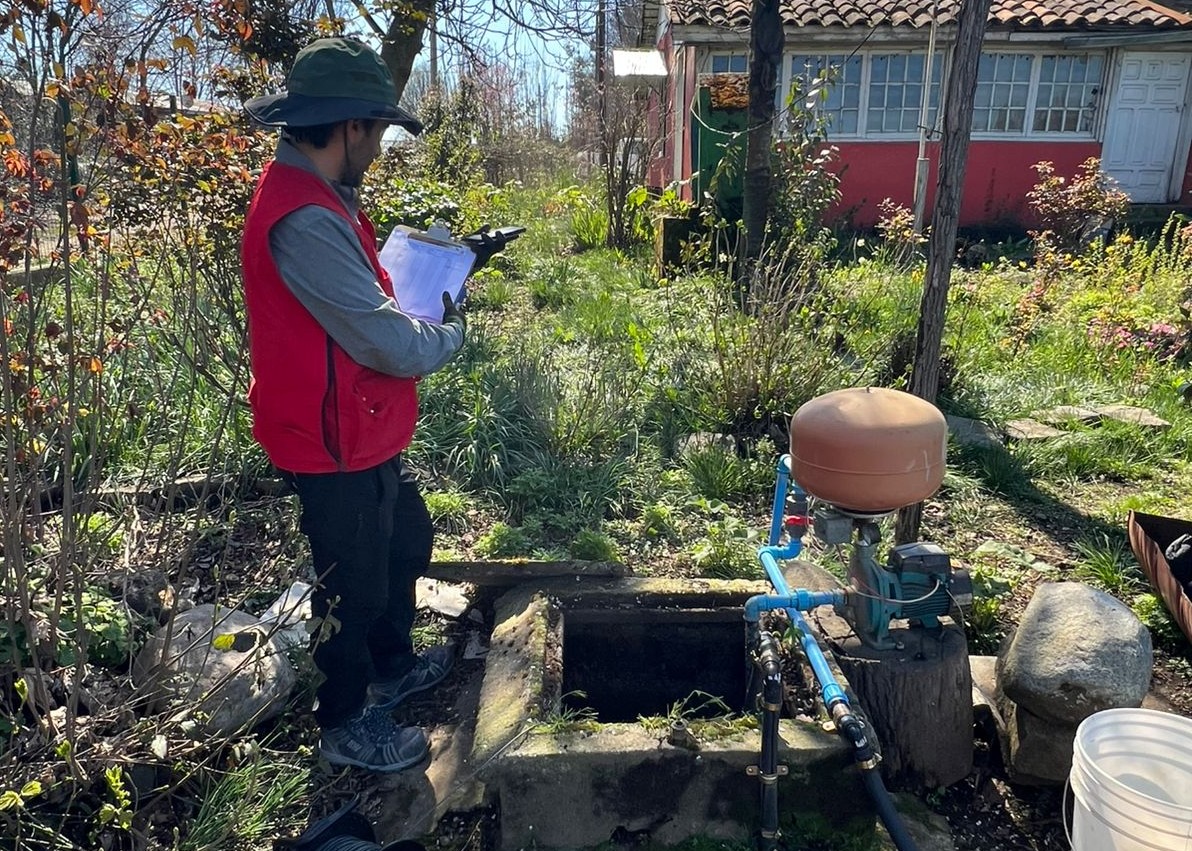
A project led by the UNESCO Chair in Surface Hydrology at the University of Talca demonstrates the feasibility of capturing rainfall and injecting it into wells to recover groundwater levels in areas affected by drought.
(text)
Amid one of the longest droughts recorded in Chile, researchers are promoting an innovative solution to address water scarcity in rural areas: capturing rainwater and reinjecting it into wells to recharge underground aquifers.
The proposal arises from the Rainwater Well Recharge Manual project, developed by the UNESCO Chair in Surface Hydrology at the University of Talca and funded by the Regional Government of Ñuble through the Innovation Fund for Competitiveness (FIC). The pilot plan was implemented in municipalities such as San Carlos, Coihueco, Ñiquén, and San Fabián, territories particularly affected by water scarcity.
The project was led by hydrologist Dr. Roberto Pizarro, an academic at the University of Talca, who explains that the initial motivation came from a simple question: what would happen if water captured in winter were returned to the same underground system from which it is extracted in summer? "In Chile, we still rely almost exclusively on the natural recharge of aquifers. But climate change, decreased rainfall, and overexploitation of groundwater have significantly reduced that capacity," he notes.
The diagnosis is clear: in regions like Ñuble, a sustained decline in the water table is observed, a phenomenon that threatens agriculture and drinking water supply in rural communities that depend on Rural Drinking Water (APR) systems.
Underground solution
The project proposes applying the concept of Managed Aquifer Recharge, a practice used in various countries to store water in the subsoil during periods of greater availability. The Chilean initiative adapts this idea by capturing rainwater on waterproofed surfaces that channel the water into storage tanks. Then, the resource is filtered and injected into noria wells, helping to maintain groundwater levels.
The system was designed to comply with national regulations, which require that water used for recharge have a quality equal to or higher than that existing in the aquifer. In the tests conducted, rainwater showed even higher quality than the groundwater commonly used. "After a simple filtration process, it can be perfectly suitable for this use. In some cases, its quality is comparable to that of drinking water," explains Pizarro.
The pilot was implemented in three different wells. The results identified that noria wells —with larger diameters and shallower depths— are the most suitable for this type of recharge. In them, it was possible to inject approximately 3.6 m³ of water per hour, with water level increases close to 50 cm without affecting system stability. This confirms that the subsoil can act as a natural reservoir capable of storing water in winter for later use.
Future policy
Beyond the technical results, the research team highlights the potential of this technology as a water management tool on a territorial scale. Recharging aquifers with rainwater would reduce pressure on groundwater, restore their hydrological balance, and generate strategic reserves for drought periods.
"If many rural landowners captured rainwater and injected it into their own wells, we would be helping to restore the natural hydrological cycle. It is a way of returning water to the great reservoir that nature provides us underground, which are the aquifers," states Pizarro.
The researcher emphasizes that this solution has advantages over large hydraulic works, such as surface reservoirs. Aquifers function as "invisible reservoirs," capable of storing large volumes of water without the environmental, social, or economic impacts associated with dams.
The model can be replicated in rural communities, small farmers, and APR systems, where water availability determines quality of life and productive viability. Currently, the project's results are being disseminated in various Latin American countries. Institutions from Colombia, Argentina, and Bolivia have shown interest in learning about the Chilean experience, opening opportunities for scientific cooperation.
The team also seeks for aquifer recharge with rainwater to be incorporated into public promotion programs, such as those promoted by INDAP or the National Irrigation Commission (CNR). In a context of growing climate uncertainty, the challenge is to move from the pilot to public policies that allow this solution to be scaled up.
"Rainwater is an opportunity we often let slip away," concludes Pizarro. "If we learn to capture it and store it underground, we can transform our aquifers into a strategic reserve for the future," he adds.
Sector assessment
From Acoforag, we highlight the project's contribution to advancing practical solutions to the water crisis affecting the country. We emphasize that this type of innovation, based on the natural functioning of the water cycle, strengthens the resilience of rural territories and opens new opportunities for sustainable water management.
The report in theAcoforag Magazine






Comments (0)
No comments yet. Be the first to comment!
Leave a comment