

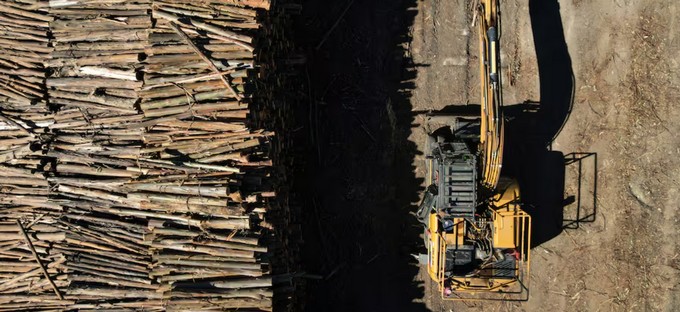
The government of José Antonio Kast, through the Minister of Agriculture, Jaime Campos, is preparing a draft promotion law for the forestry industry, aimed particularly at medium and small sectors.
Jaime Campos stated that this law is the government's number one dream for the industry. "Chile needs a new forestry promotion law. It is inconceivable that, with all the tradition our country has in this area, we currently lack an efficient instrument for an activity that, as we well know, is absolutely complementary to agricultural activity," the authority commented this Wednesday at a seminar of the National Agriculture Society (SNA).
"According to the information I have received, within about 60 days we will present the President of the Republic with a concrete proposal on this matter. Adapted to the reality of the 21st century, because it is no longer simply about reissuing what Decree Law 701 was in its time. The possibilities we have with this activity are obviously enormous," he added, alluding to the 1974 reform that stimulated forest plantations in the country.
Those familiar with the process say that medium and small foresters—independent sawmills, remanufacturing plants, and small sawmills, among others—are unprotected and that their business is not currently profitable. Precisely, the new law seeks to increase the number of forestry SMEs.
Campos, after his speech, did not want to give details about the content of the project. "When we have it, we will present it to Parliament first," he responded to Pulso.
Sector suggestions
However, there are suggestions that the forestry sector, the party interested in promoting this project, has conveyed to the government. "Any promotion mechanism must have the explicit acceptance of small and medium forest landowners; they will be the ones who must use the incentives, so a mechanism cannot be implemented without their participation in the technical-regulatory debate," says a document that Futuro Madera, which brings together the country's major forestry guilds, delivered to Campos during his visit to the commune of Yumbel.
The text, titled "Towards a new forestry promotion policy to re-boost the sector," contains various suggestions to reactivate the medium and small industry.
The proposals are grouped into three main ideas: legal and institutional aspects; financing and competitiveness for SMEs; and demand pull and housing policy.
In the first point, the guilds raise the need for a single window for SMEs and small landowners, permanent and non-competitive financing with defined limits on amounts, hectares, and deadlines. They specifically warn that the competitive mechanism is not a good tool to counteract the "shortage" that timber SMEs have faced.
In the second group of proposals, Futuro Madera raises the need for financing from Corfo to boost the logistical capabilities of local forestry service companies, such as nurseries, planting, pruning, and thinning contractors.
The "reinsurance fund" is another idea, whose role is to create a reinsurance system for extreme events, considering the difficulties certain forestry sectors face in contracting coverage.
"It constitutes the main bottleneck that paralyzes plantations; the implementation of this risk coverage would become a mechanism capable of restoring confidence to the private investor," the proposal explains.
The president of Corma, Rodrigo O’Ryan, delves into this and highlights and promotes the measure in particular, stating that the global context in forestry matters is different from the Chilean reality.
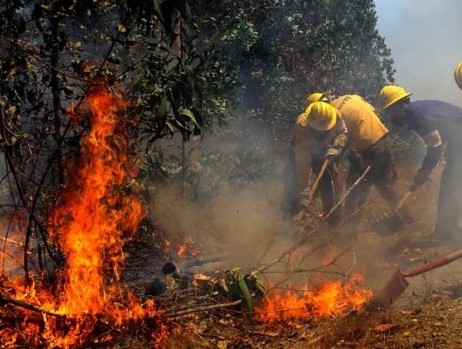
The union leader says that other countries face fires caused by natural reasons: lightning, extreme droughts, winds. In contrast, in Chile "intentionality is the dominant factor" and thus, "the Chilean risk is neither diversifiable nor projectable, which are the two minimum conditions for a private insurer to operate with commercial rationality," he points out.
"State reinsurance is not only a financial support tool but a correction of a specific market failure in the Chilean context, generated by a phenomenon—the violence and intentionality of fires—that no private actor can manage alone," O’Ryan alludes.
Additionally, the organization proposes that the State finance productive plantations to promote afforestation and reforestation among medium and small landowners.
"This instrument should recognize the positive social profitability generated by plantations, through environmental, economic, and territorial benefits, as well as the long-term nature of these investments, whose returns can materialize over periods of 12 or even 24 years, depending on the species," the document reads.
Commitment to demand
The third plan of proposals is related to boosting the sector through commitments to purchase wood for public infrastructure and housing plans from the Ministry of Housing and Urbanism (Minvu).
The proposal states that if mandatory quotas of sawn wood from SMEs are established in infrastructure and housing plans, the State commits an institutional buyer for medium and small forest owners who would decide in the future to plant under the umbrella of the new promotion law.
Likewise, they suggest increasing the industrialization of wood housing construction, setting production goals so that plantations are planned in alignment with housing demand.
Source:La Tercera





Comments (0)
No comments yet. Be the first to comment!
Leave a comment