

The University of Concepción, through its institutional initiative Campus Naturaleza UdeC, formalized a scientific cooperation alliance with the Cambridge University Botanic Garden (CUBG) by signing a Memorandum of Understanding (MoU) aimed at strengthening the conservation of threatened Chilean flora and projecting new research and ecological restoration actions.
The agreement incorporates Campus Naturaleza UdeC as a new conservation partner of the Cambridge University Botanic Garden, a British institution that maintains international collaborations with multiple botanical gardens and institutions worldwide. The alliance with Chile will allow expanding this work towards one of the territories with the highest plant endemism and, at the same time, with growing threats associated with climate change and ecosystem degradation.
The cooperation includes the development of long-term projects focused on the collection of seeds, plant material, and ecological data in different regions of the country. It also considers the cultivation in Cambridge of representative species of Chilean flora for ex situ conservation, research, and education purposes.
For Campus Naturaleza UdeC, the agreement represents a major step towards strengthening local capacities with the aim of developing the botanical garden, as well as collaborative and well-coordinated work to protect the country's native flora, develop living collections, and strengthen ecosystem restoration from the Biobío Region.
Professor Samuel Brockington, curator of CUBG, stated that "we are very excited about the opportunity to collaborate with the University of Concepción. Chile is a country with great floristic richness and extraordinary biocultural diversity. At the Cambridge University Botanic Garden, we have long been interested in exploring the feasibility of cultivating Chilean plant species as part of our long-term climate change adaptation strategies. Campus Naturaleza represents an inspiring model from which the world can learn, and it is a privilege to be part of the path initiated by Professor Cristian Echeverría Leal and his team."
Conservation from Biobío with international projection
Campus Naturaleza UdeC is developed on 186 hectares of the University of Concepción, located on the hills and ravines adjacent to its heritage campus. The project integrates in situ and ex situ conservation, ecological restoration, biocultural environmental education, and comprehensive health, articulating science, territory, and community participation.
Among its main initiatives is the development of a future botanical garden focused on the conservation of threatened native species of Chile. Its first collection includes ruil (Nothofagus alessandrii), hualo (Nothofagus glauca), and roble de Santiago (Nothofagus macrocarpa), species that are part of the plant heritage of south-central Chile and face different levels of threat.
The director of Campus Naturaleza UdeC and academic at the Faculty of Forest Sciences of the University of Concepción, Cristian Echeverría Leal, highlighted that the agreement will allow projecting the work developed in Concepción towards international conservation scenarios.
"This alliance with CUBG represents a decisive step in the internationalization of Campus Naturaleza UdeC. It is not just about exchanging seeds or technical knowledge, but about building a long-term scientific collaboration that strengthens the conservation of Chilean flora from a global perspective. From southern Chile, we contribute territory, experience in ecological restoration, and community commitment; together with CUBG, we project a model of international cooperation based on evidence, reciprocity, and a forward-looking vision," he stated.
Echeverría added that "Chile is a biodiversity hotspot with high levels of endemism and growing vulnerability to climate change and human pressures. International alliances are fundamental to strengthening the generation of applied knowledge. This collaboration allows us to project Chilean flora in global ex situ conservation scenarios, while advancing in ecosystem restoration."
Seed expedition in Chile
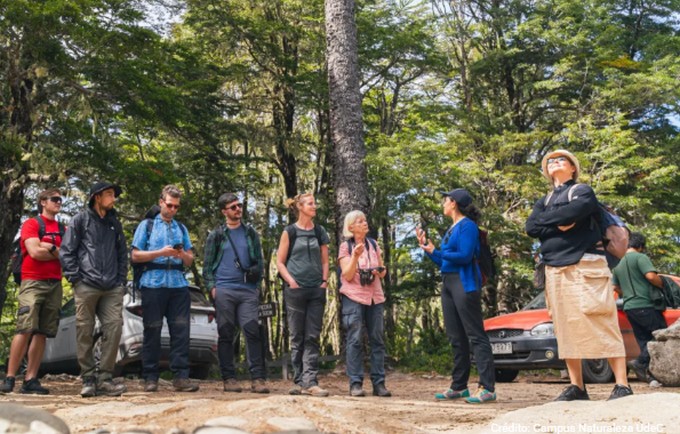
The alliance already records a first joint action. During March 2026, specialists from the Cambridge University Botanic Garden participated, together with collaborators from Campus Naturaleza UdeC and representatives from the botanical gardens of Oslo and Gothenburg, in a seed collection expedition carried out in different regions of Chile.
The expedition focused mainly on Andean-Mediterranean deciduous temperate Nothofagus forests, plant formations of special interest for conservation and for the study of species that could respond to future climate scenarios.
The collected material will contribute to the development of ex situ collections not only of species but of threatened ecosystems and to strengthening research and conservation actions both in Chile and Cambridge. For Campus Naturaleza UdeC, this work is linked to its purpose of conserving genetic diversity, supporting ecological restoration processes, and providing applied knowledge to address biodiversity loss.
With the signing of this memorandum, the University of Concepción strengthens its presence in international scientific cooperation and positions from Biobío a university experience that links nature conservation, research, education, and human well-being.






Comments (0)
No comments yet. Be the first to comment!
Leave a comment