

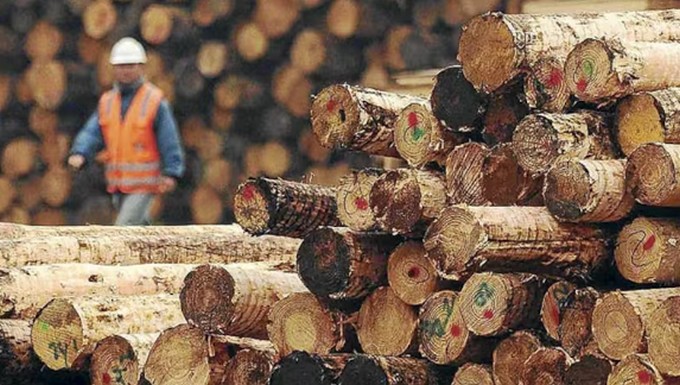
The forestry sector could contribute more to national employment. In 2024, the entire industry provided jobs for 102,000 people, but ten years ago that number reached 114,000.
Employment in this economic activity is divided into four main segments: primary industry, secondary industry, silviculture and extraction, and other silvicultural activities.
The segment that contributed the most two years ago was the primary industry, as it concentrated 30% of the sector's employment and provided jobs for 30,311 people, according to the 2025 forestry yearbook from the Ministry of Agriculture and the Forestry Institute (Infor). However, this area employed 35,520 people in 2014. A similar situation occurs with the secondary industry.
The sector is among the priorities of José Antonio Kast's government. In fact, through the Minister of Agriculture, Jaime Campos, the current administration is working on a bill to boost and promote activity in the area, particularly for small and medium-sized enterprises. The segments they are looking at include sawmills and remanufacturing plants, small board and veneer plants, among others. Precisely, a good part of these fall under the primary and secondary industries.
Although the primary industry is one of the largest employers in the forestry sector, its contribution has been declining year after year, as has that of the secondary industry. Comparing 2014 and 2024, the primary industry fell by 15%, with 5,209 fewer jobs, while the secondary industry decreased by 17%, with 5,181 fewer jobs, according to the yearbook.
Within these categories, the specific activity that generates the most employment is sawmills, providing jobs for 12,591 people, representing 12% of the total. Despite being the largest, this was its lowest number since at least 2003. In its best years, this industry employed 20,000 people, between 2005 and 2007.
Next in employment are forest exploitation, from the silviculture and extraction segment, which employed 11,762 people in 2024; and the doors, windows, and moldings area, from the secondary industry, with 9,768 workers.
Sawmills on the Decline
Sawmills, industrial facilities where logs are processed, have changed over time, which is explained by various factors. Among them are the lower level of real estate projects, fires, rural violence, the closure of these facilities themselves, and the expiration of DL 701, which, according to industry criticism, removed the incentive for planting on small and medium-sized properties.
The most recent sawmilling study conducted by Infor is from 2025. There, they report that sawn wood production reached 7 million cubic meters (m³) in 2024, an increase of 1% compared to the previous year, but a drop of 12% versus 2014. In 2024, 98% of this wood came from radiata pine, while the rest came from other species.
"A trend that is increasing, among other things, because there is no available forest resource that allows for significantly diversifying the species to be sawn," states the Infor report.
That's regarding production. Now, if we look at the number of sawmills operating (and not idle) over the last ten years, they also show a significant decrease of 149 plants.
Exactly, in 2014 there were 912 sawmills, and two years ago, the most recent figure, a total of 763. This represents a drop of 16% over the decade. Meanwhile, in 2023 there were 801 sawmills operating. Compared to the 2024 report, this implies a decrease of 38 plants.
"One of the characteristics of the sawmilling industry in Chile is the high concentration of volume produced in a small number of companies. If we consider the 10 companies with the highest production during 2024, it is observed that together they represent 59.6% of the national production of sawn wood," the study states, highlighting companies such as Arauco, CMPC, and Forestal Santa Blanca, among others, in the lead in installed capacity.
Sawn wood from large plants has fallen in recent years. If in 2014, 4.7 million cubic meters of sawn wood were produced, two years ago 3.9 million m³ were produced, a total of 842,000 m³ less. The average production of large sawmills in the 2014-2023 period was 4.5 million m³.
At the same time, production from the small and medium-sized sawmilling sectors also shows a clear downward trend, especially in the years 2023 and 2024. In this sector, the average production in the 2014-2023 period reached 3.5 million cubic meters of sawn wood. However, the 2024 production for this segment was 3.09 million m³: exactly 460,000 m³ less.
The Infor study analyzes that "the trend for the 2010-2024 period makes it evident that the decline in the number of operating sawmills is clearly concentrated in mobile sawmills, as well as an increase in idle sawmills. The number of permanent operating sawmills shows a clear growth trend until 2019, then declines, but without returning to the levels of the beginning of the previous decade."
Another Problem
Afforestation is another problem that last year's Infor forestry yearbook highlights.
The report states that there were 85,593 hectares planted in 2024, of which 98% corresponded to reforestation, while the other 2% corresponded to afforestation, with exactly 1,831 hectares, which are mainly species other than radiata pine and eucalyptus, which are no longer very common in this process.
"Considering that afforestation has been at very low levels for more than a decade, it becomes evident that owners of forest-capable soils devoid of forests do not plant their land without a promotion incentive like the one that existed, in different versions, for about four decades (1974 to 2012)," the organization specifies.
Indeed, since 2013, a sharp drop in afforestation has been observed, reaching 6,609 hectares, whereas in previous years, between 2000 and 2012, the average was 44,000 hectares per year.
Source:La Tercera





Comments (0)
No comments yet. Be the first to comment!
Leave a comment