

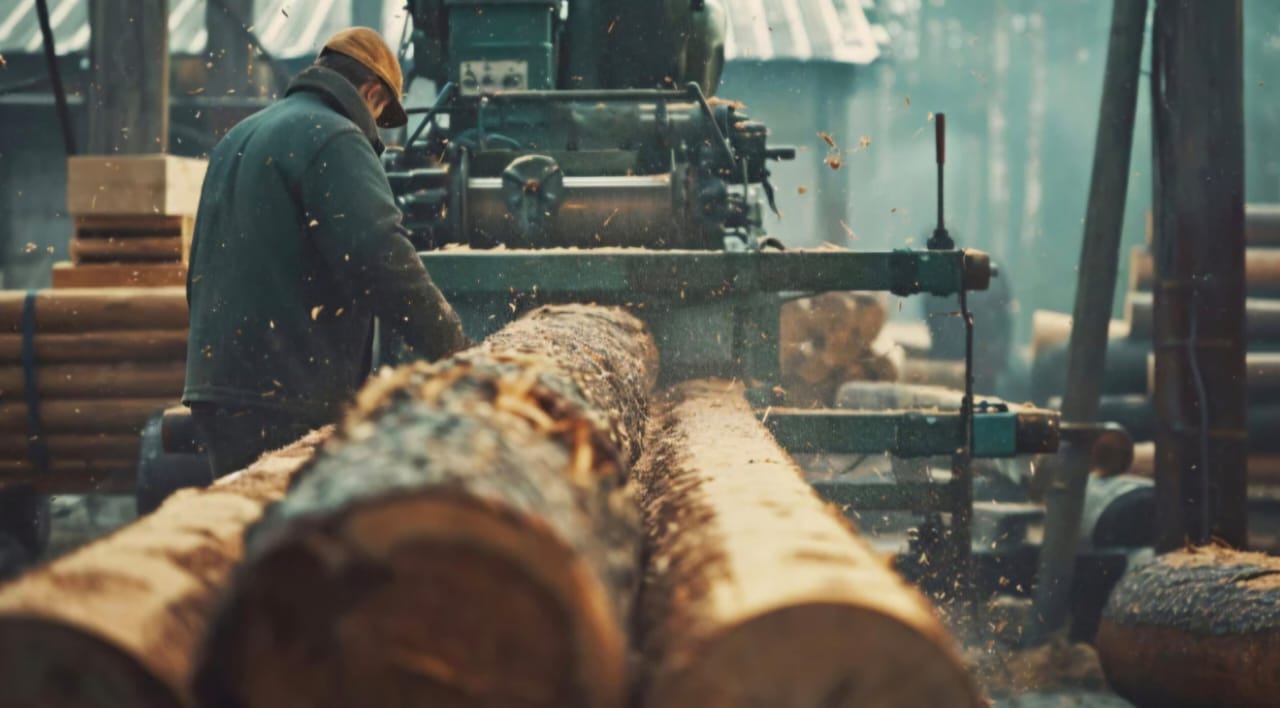
In a scenario marked by a decrease in planted areas and the consequences left by the large forest fires of recent years, the announcement of a new forestry development law raised expectations regarding the recovery of the country's forest heritage and the future supply of raw materials for the industry.
In an exclusive interview with Diario La Tribuna and Radio San Cristóbal, Hernán Muñoz Bernal, president of PymeMad Maule and PymeMad Nacional A.G., analyzed the implications of this initiative. While the guild acknowledges that it is urgent to replant as many hectares and species as possible in Chile, they emphasize that public policy must focus directly on SMEs. The main reason is that, unlike large companies, SMEs cannot acquire forest heritage on their own due to the high capital required. Additionally, spokespersons warn that this long-awaited development—whose effects will be seen in the long term—will not stop the severe immediate crisis facing sawmills, triggered by the large environmental fires of recent years.
THE SAWMILL CRISIS AND THE IMPACT OF FIRES
Muñoz Bernal is emphatic in clarifying that the current sawmill crisis has a direct cause: the loss of forest mass due to fires. This loss originated from the 2017 fires in the Maule region and, subsequently, in 2023 in the Ñuble and Biobío regions, reducing approximately 5 million cubic meters of wood annually for processing. According to figures from the Forest Institute (Infor), the closure of around 130 sawmills nationwide has already been recorded in the last five years. The situation will not improve soon: for every major fire, about 100 facilities close, so the guild projects that between 70 and 100 more sawmills will shut down in the next five years. Since the new forestry development law will not solve this urgency, the sector is seeking rapid assistance. They recently met with the Ministry of Economy to form a working group to prevent closures, lower operating costs, increase productivity, and add value, while also considering technological and energy-saving issues.
UPDATE OF DL 701 AND PROMOTION OF PLANTING
Historically, Chile's forestry development was driven by Decree Law 701, a tool that Muñoz describes as very good for its time. Thanks to its benefits, between 70,000 and 80,000 hectares were planted annually. However, without those incentives, the country now barely manages to plant a maximum of 600 hectares per year. Therefore, the leader emphasizes that the new project must not only provide funding but also completely update the regulation of the activity. Agreements such as the Forestry Policy 2015-2035, the planting manual, and protocols ensuring full respect for biodiversity and territory—variables that the old DL 701 omitted at the time—must be integrated. Asked about a recent agreement signed by the Chilean Wood Corporation (Corma) to open a carbon credit market for forestry SMEs, the president stated that his guild was not invited to that meeting, although he affirms that any aid aimed at small businesses will always be welcome.
TIMBER SPECIES AND THE ECONOMIC ENGINE OF THE SOUTHERN ZONE
A key demand from PymeMad is that the new development concentrate its resources and prioritize timber species oriented toward construction. The reason is that such wood is the material that provides the greatest benefits in the face of climate change, standing out for its very high carbon retention capacity. While representatives do not oppose state promotion of other species for pulp, they firmly insist that, given the undeniable scarcity of economic resources, the government's priority must be solid wood. This support is absolutely vital to consolidate the development of the entire southern macrozone, spanning from the sixth region to the southernmost tip of the country. The timber sector is a major job generator, functioning as the main economic engine for thousands of Chilean families who depend on these forestry and agricultural tasks.
DEMYSTIFYING THE SECTOR IN THE FACE OF POLITICAL IGNORANCE
The legislative path toward the new model will face tough political challenges ahead of its projected implementation in 2027, due to the deep ideologization of the forestry debate. Muñoz laments that various biological species have been demonized due to total ignorance among the population. As an example, he recalls that the pine species was introduced to the country before 1900 with the noble purpose of protecting degraded soils and safeguarding important water sources—ecological benefits that are now fully demonstrated by contemporary forest science. Despite this verifiable evidence, fake news remains deeply rooted among citizens and legislators themselves. Faced with this complex media scenario, PymeMad and other sectoral guilds work hard to debunk operational falsehoods, hoping that the respective authorities will legislate always thinking of the greater good of the country and not yielding to activism that they describe as based purely on lies.
Source:La Tribuna





Comments (0)
No comments yet. Be the first to comment!
Leave a comment