

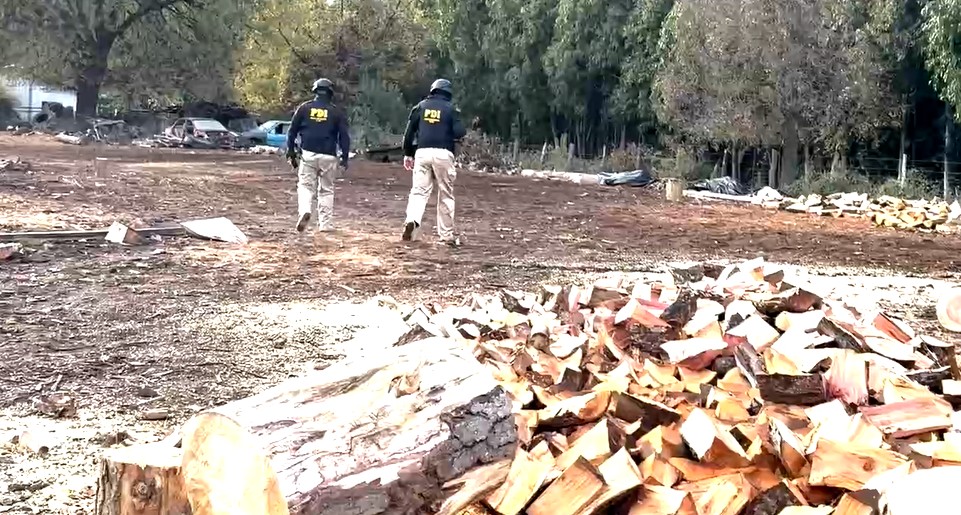
The largest blow against timber theft recorded in the Ñuble Region was carried out by the Public Prosecutor's Office and the Investigative Police (PDI) following an extensive investigation that culminated in the arrest of 17 members of a criminal organization dedicated to the illegal theft, processing, and commercialization of timber.
The operation, named "Operation Las Hormigas," was led by the Criminal Analysis System (SAC) of the Ñuble Prosecutor's Office alongside detectives from the Criminal Investigation Brigade (Bicrim) of Chillán and the Money Laundering Investigation Brigade (Brilac) of the PDI.
The investigation established at least 14 instances of timber theft on properties of Forestal Arauco located in the El Carmen commune. According to the chief prosecutor of SAC Ñuble, Rolando Canahuate, the organization maintained a complex operational structure that included transport logistics, timber processing, and mechanisms to feign legality in its commercialization.
"What we seek in the Criminal Analysis System is to attack where it hurts them most, which is precisely their assets. Following the money trail is the only way to gradually dismantle these types of organizations," stated the prosecutor.
As part of the investigation, the Prosecutor's Office also requested the retention of 28 banking products linked to the defendants and announced actions aimed at pursuing potential tax crimes associated with the illicit activity.
Sawmill operated as a collection and processing center
During the raids carried out at various points in the region, authorities seized over 40 vehicles and machinery used for timber theft and transport, including trucks, vans, tractors, chainsaws, and industrial equipment, assets valued at nearly $1.5 billion.
Likewise, processed and stockpiled timber was confiscated at a sawmill located on the road to Pinto, in Chillán, with an estimated value of approximately $3 billion. Additionally, over $3 million in cash, three shotguns, a revolver, and more than one hundred rounds of ammunition were found. The weapons had their serial numbers tampered with.
According to the formal charges, the main leader of the organization would be Carlos Jara Urra, owner of a forestry company that, according to the Prosecutor's Office, functioned as the group's operations center. Alongside him, José Urra Bórquez, Juan Urra Troncoso, and Claudio Montes Constanzo were identified as ringleaders.
Prosecutor Álvaro Serrano explained that the stolen timber was transported to the sawmill, where it was processed and subsequently commercialized using falsified documentation.
"They even falsified dispatch guides to justify the transport of stolen timber and feign legality before police checks or inspections on the routes," he stated.

The investigation also established that three workers from a contractor company linked to Forestal Arauco provided privileged information about properties with less surveillance and loads ready for collection, thus facilitating the commission of the crimes.
Following the formal charges hearing, the Yungay Guarantee Court ordered pretrial detention for the four main defendants, while the rest were subjected to precautionary measures such as a ban on approaching the affected properties, a ban on leaving the country, and a ban on contacting each other.
The court set a five-month period for the development of the investigation
Prefect Inspector Enrique Zamora, head of the Ñuble Police Region, described the procedure as a "historic criminal investigation," highlighting that over approximately a year and a half, various police intelligence techniques, criminal analysis, and intrusive investigative steps were employed to gather the necessary evidence.
From the Government, the regional presidential delegate of Ñuble, Diego Sepúlveda, praised the outcome of the operation and stated that it is the biggest blow against timber theft in the region's history. Along the same lines, the Regional Ministerial Secretary of Public Security, Héctor Ponce, recalled that this crime is part of the priorities established in the 2026 Plan against Organized Crime.








Comments (0)
No comments yet. Be the first to comment!
Leave a comment