

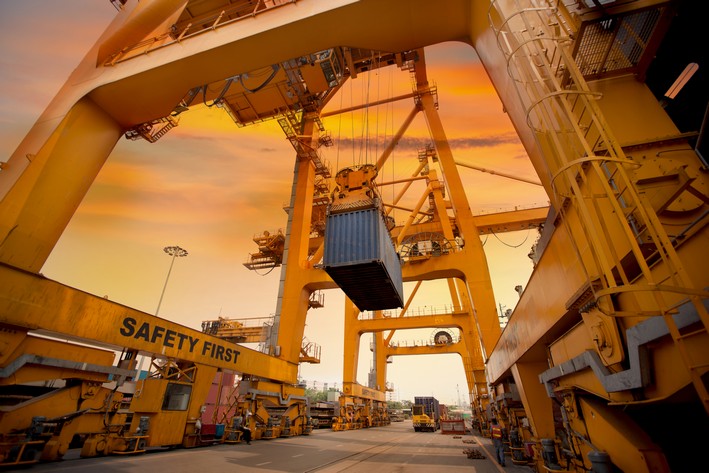
A group of business associations, including those grouped in the National Agriculture Society (SNA), Wines of Chile, and the Salmon Council, stated they are confident that the Foreign Ministry will manage to reverse the new 12.5% tariff imposed by the United States on dozens of economies, including the local one.
The president of the SNA, Antonio Walker, emphasized that the surcharges reduce the competitiveness of Chilean products; and from the Salmon Council, which works with Chile's second most exported product, they highlighted the importance of reversing the scenario, especially considering that the US is one of the largest markets, as it does not produce salmon.
Walker also once again regretted that the arguments presented by our country were not considered in the negotiations, especially considering the free trade agreements and the track record as a reliable partner.
New US tariffs: Chile at 12.5%
The leader of the agricultural guild stated that the tariff "is tough" for the industry, in the context of rising costs in recent months: "The costs of fertilizers, inputs, energy; air, sea, and land freight have increased. This 12.5% makes us less competitive."
"We are very confident that this investigation, thanks to the negotiation that the Foreign Ministry will carry out, will be successful. We believe we must respect the Free Trade Agreement with the United States," added Walker, who highlighted, however, that 60% of the products in the export basket to the North American country were exempt from the tariff.
For his part, the general manager of Wines of Chile, Claudio Cilveti, added that - in line with what was said by Foreign Minister Francisco Pérez Mackenna - efforts should focus on the 40% of products that will indeed face a higher tariff when entering the US.
Iván Marambio, president of Frutas de Chile, emphasized the exclusion of avocados, kiwis, and oranges: "We are providing inputs to the negotiations being carried out by the Government. The import of fresh fruit to the US means a contribution of more than 19,000 jobs in the United States, mainly on the East Coast, and US$4 billion to the GDP (of the North American country)."
Measure excluded copper, but not salmon, wine, and several fruits
The Executive branch has stressed that they will deepen dialogues with representatives of Donald Trump's administration, after they announced the aforementioned new tariffs ranging from 10% to 12.5% on imports from 60 countries and economies, including Chile, justifying it with an investigation into "insufficient efforts to combat forced labor."
The measure excludes copper, the main local export product to the United States. However, it does affect salmon, fruit, wine, and various wood-derived products.
Chile's trade exchange reached US$106.498 billion in the first half of 2026, with a growth of 9.6% compared to the same period in 2025, according to the latest Monthly Foreign Trade Report from the Studies Directorate of the Undersecretariat of International Economic Relations (SUBREI).
In terms of destinations, 96.17% of goods exports went to economies with which Chile maintains current trade agreements.
China remained the main market (33.9%), followed by the United States (16.7%), Japan (8.3%), and South Korea (3.9%).
Non-mining exports totaled US$23.466 billion (+5.6%). The food industry reached an all-time high, with US$7.121 billion (+4.2%), driven by increased shipments of salmon and trout in their various formats, frozen fruits, canned mussels, and beef and sheep meat. Machinery and equipment exports grew by 17.6%, while wines fell by 8.9% and the forestry sector by 12%.
For the Government, the new tariff decision was adopted within the framework of an investigation carried out in accordance with US domestic law, and "not as a result of a bilateral negotiation" between the two countries, which responded to a cross-cutting trade policy (applied to 60 economies in total) "and in no case was it a measure specifically directed against Chile."
China strikes back at the US
In this regard, China accused the United States this Monday of "politically manipulating" the issue of forced labor in light of the new tariffs announced by Washington, a measure it described as "unilateral" and "protectionist."
"For a long time (the United States) has politically manipulated the issue of forced labor. This time, it has initiated an investigation (...) and imposed additional unilateral tariffs on this pretext," stated a spokesperson for the Chinese Ministry of Commerce.
It urged the US to "correct its erroneous practices."
Source:BiobioChile





Comments (0)
No comments yet. Be the first to comment!
Leave a comment