

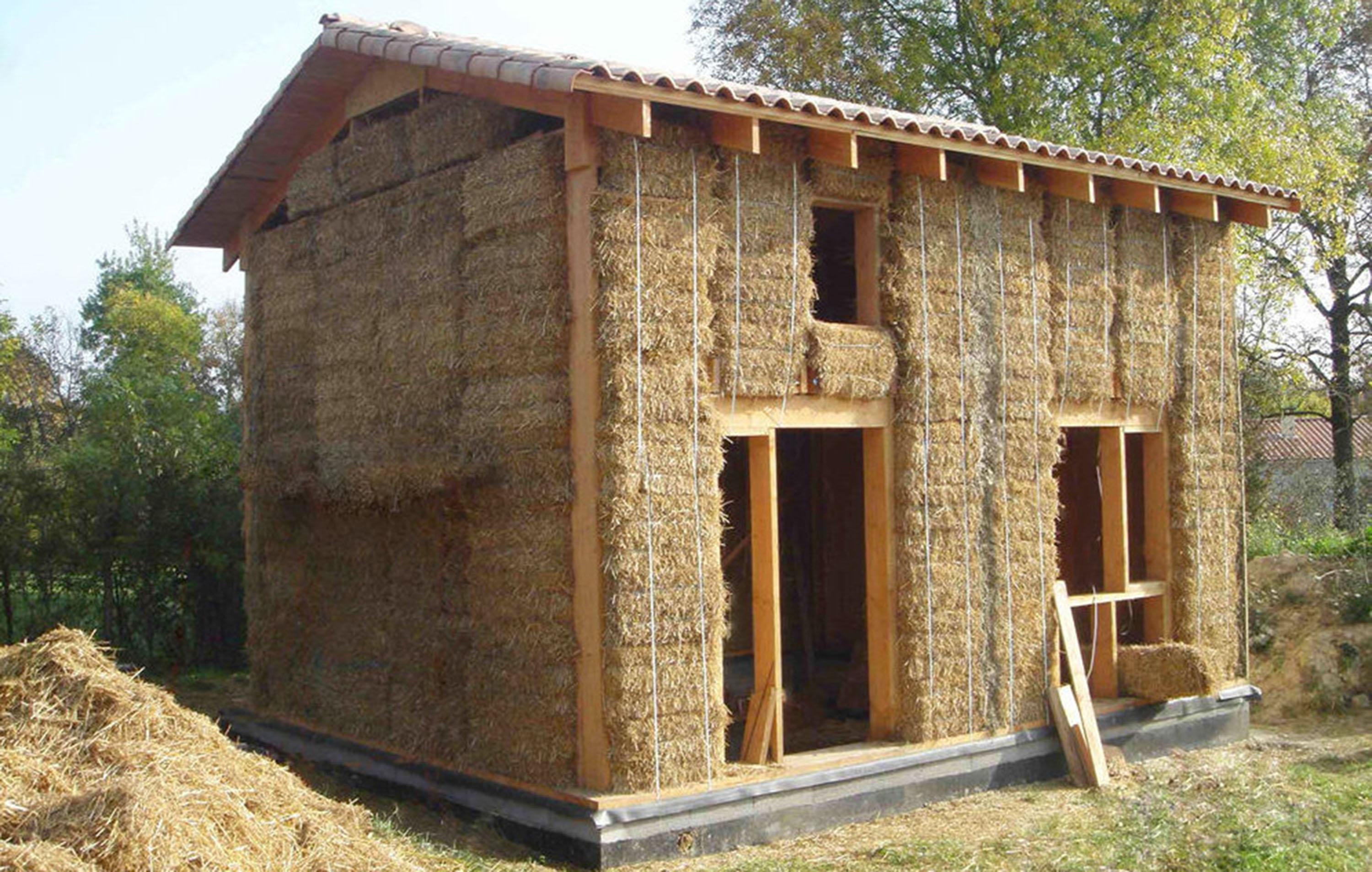
While the housing deficit continues to be one of the main challenges for the Biobío Region, various voices from the world of architecture and construction suggest that part of the answer could be found in a practice that was relegated by the industry for decades: bioconstruction.
Although the concept is still unknown to many, it is a system that uses natural materials available in the environment, such as earth, clay, plant fibers, and wood, prioritizing low environmental impact processes and a design that seeks to integrate into the territory.
More than an isolated technique, its proponents describe it as a different way of understanding housing, where energy efficiency, respect for the environment, and the responsible use of local resources are all part of the same project.
The Biobío Region appears as a particularly favorable setting for this type of building. The abundance of clays with different characteristics, the availability of plant fibers such as coligüe and quila, in addition to the construction tradition present in various rural areas, are factors that, according to specialists, could turn the area into a national benchmark for the development of this type of housing solution.
Miguel Millar knows this reality firsthand. He has been working in bioconstruction for almost two decades and, after starting his journey in La Serena, has developed projects in various regions of Chile and also in countries like Argentina and Colombia.
He has lived in the Biobío Region for 14 years, where he has deepened his work with materials native to the territory.
In his opinion, one of the main attributes of Biobío is precisely the richness of its raw materials. He explains that few regions bring together such a wide diversity of clays suitable for natural construction and an availability of plant fibers that often go unnoticed by the conventional industry.
Millar maintains that materials like coligüe and quila have been undervalued in recent decades, being used mainly for minor agricultural purposes, despite their excellent structural properties.
"I believe that bioconstruction is an excellent alternative, considering the pollution overload that traditional construction brings," he states.
The builder recalls that, for centuries, homes in Chile were built with materials obtained directly from the immediate environment. The traditional adobe houses are, in his opinion, an example of this, many of which remain standing despite having faced earthquakes and the passage of time.
That is why he insists that bioconstruction is not a recent innovation, but rather the recovery of ancestral knowledge that was displaced by industrialized materials for rapid production and marketing.
However, he acknowledges that the main obstacle is not technical, but cultural. In his opinion, there is still a strong prejudice that associates houses built with earth with poverty. "There is a stigma there that we have to overcome at a social level," he maintains.
For Millar, this barrier prevents many people from learning about the advantages these buildings offer in terms of thermal efficiency, comfort, and sustainability. Added to this is another phenomenon he observes with concern: the proliferation of online content that presents bioconstruction as a simple and completely self-taught activity.
Far from being limited to the rural world, he assures that these techniques can be implemented without problems in urban areas. He even suggests that Concepción has important comparative advantages due to the proximity of materials and the quality of clays present in different sectors of the province and nearby communes such as Santa Juana, as well as other territories in the south-central part of the country.
Despite the growing interest this construction system arouses, the Regional Ministerial Secretariat of Housing and Urbanism of Biobío indicated, in response to a query from Diario Concepción, that so far they have not developed bioconstruction initiatives.
Someone who has also found a different way of understanding the trade in this is civil engineer Bárbara Letelier Hidalgo.
11 years ago she decided to leave conventional construction behind to dedicate herself fully to this field, a decision that, according to her, was motivated both by criticisms of the industry's production model and by personal experiences that marked her professional career.
Letelier maintains that traditional construction reproduces a logic where recognition is usually concentrated in higher-ranking positions, while collective work remains invisible. To this she adds the difficult experiences she lived as a woman occupying positions of responsibility in large-scale projects.
"Well, in my case it has to do with several factors that are mainly related to the critique of conventional construction as a system, to the way work is done," she recounts in relation to the economic model and the workforce.
She adds that, being young and holding management positions, she had to face constant power conflicts and situations of mistreatment from both men and women within the construction sites.
"Bioconstruction works from another perspective, it has such a great connection, a worldview I could say, with the environment, with the territory, with connecting to the place where you develop it, that it has another way of functioning," she states.
She explains that each project begins with a detailed observation of the space to be worked on and the materials available on site. Instead of relying on inputs transported from long distances, the priority is to take advantage of existing resources, considerably reducing the ecological footprint of each construction.
The professional acknowledges that it is demanding work from a physical point of view and highly artisanal, but she highlights that precisely this characteristic favors collaborative work and allows for equitable gender participation.
View from Academia
From the academic field, architect Rodrigo Pérez, from the Faculty of Architecture, Urbanism and Geography at the University of Concepción, agrees that the main challenge for the expansion of bioconstruction lies not in the climatic conditions of Biobío, but in a problem of knowledge and social perception.
"The issue is more about a cultural problem and lack of knowledge than a climatic one," he points out. In his opinion, over time, much of the traditional construction culture has been lost and the prejudice that building with earth means building precarious or low-quality homes has taken hold.
Pérez explains that this perception ignores the existence of various construction systems that have demonstrated excellent structural performance.
Among them he mentions quincha, a technique whose main structure is made of wood and whose fillings of plant fibers and stabilized earth plasters give it seismic-resistant behavior and thermal performance superior to many conventional solutions.
Regarding adobe, he acknowledges that it has limitations for certain housing programs, especially social housing, due to the thickness of its walls, which reduces the usable built area.
However, he clarifies that this does not represent a disadvantage for all earth construction, as there are alternatives like quincha, whose thicknesses are similar to those of traditional masonry and offer better thermal performance.
For the academic, the term "traditional construction" even deserves a different reflection.
"For me, traditional construction is precisely what we now call bioconstruction," he maintains, recalling that for centuries communities built using the materials available in their immediate environment.
Among the main advantages of these techniques are the reduction of energy expenditure associated with transporting materials, the decrease in emissions during the construction process, and the use of biodegradable elements that, once their life cycle is complete, can be reintegrated into the soil without generating permanent waste.
Source:Diario Concepción




Comments (0)
No comments yet. Be the first to comment!
Leave a comment