

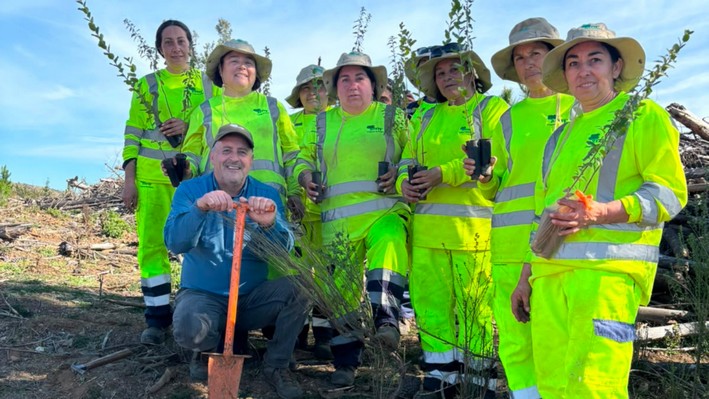
With the aim of recovering soils and areas affected by forest fires, CONAF's Emergency Employment Program (PEE), in the Ñuble Region, carried out a new planting session of native trees in Quirihue.
The activity took place on the Quilaco property, where quillay, peumo, and huingán were planted, in addition to the installation of protectors to prevent damage from animals, especially rabbits.
The property has a total area of 22.96 hectares and was affected by forest fires in 2023. Two years later, a first planting stage was carried out on an area of 15.12 hectares, incorporating productive and native species. During this 2026, a replanting of native species was carried out using the nucleus system, with a density of 600 plants per hectare.
Regarding the work technique used, Alfredo Rodríguez, program supervisor, detailed that "it consists of planting various shrub and tree species in small groups, generally one or two meters in diameter. As they grow, they create various strata or levels in height; on the edges, fast-growing species resistant to wind and radiation are established, which act as nurse plants to protect the more sensitive species inside. Over time, these nuclei are expected to act as sources of natural regeneration through seed dispersal, facilitating the recovery of the surrounding ecosystem."
For his part, the regional director of CONAF, Domingo González, pointed out that these works are carried out with all necessary safety measures and expressed that, "we are supporting the planting program by carrying out forestations for small landowners in the commune. In this sense, we transport the workers, provide them with training, and give them all the required personal protective equipment. They also participate in an induction talk related to all prevention measures. In this way, they carry out the tasks and install these plants that we bring from the CONAF Seed Center in Chillán."
In this way, the work of the Emergency Employment Program is carried out in rural areas, providing half-day employment, with special support for women heads of household, where 85% of the staff is made up of women.
"By working in the same commune, they generate identity, and they learn that the forest resources they are creating serve for soil protection and remain within the same area. In this way, they acquire another perspective regarding the forest, a perspective with greater experience, since they have been main actors in the reforestation process," detailed the director of CONAF Ñuble.




Comments (0)
No comments yet. Be the first to comment!
Leave a comment