

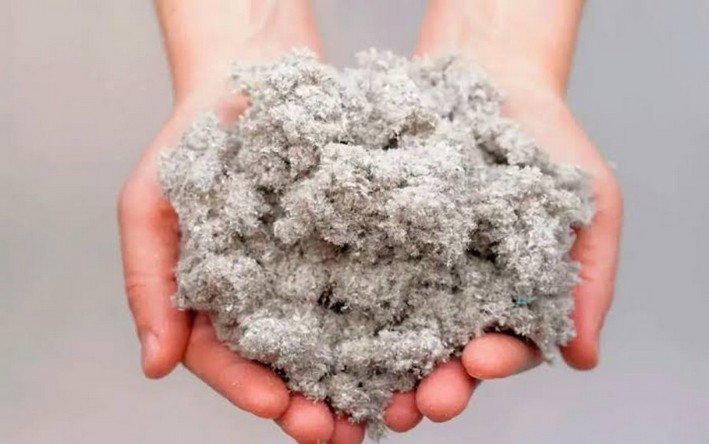
Taking a technology developed from scientific knowledge toward new industrial applications is the challenge of the NanoMat Consortium. The initiative seeks to expand the use of nanocellulose fibers as an additive to reinforce various materials such as cement, plastic, and paper, and to generate new market opportunities.
Led by FiNE along with other companies such as Resinas del Biobío S.A., Cementos Bío Bío S.A., FPC Papeles SpA, Härting S.A., and Empresas CMPC, among others, the consortium has support from Corfo and the participation of the academic ecosystem of the University of Concepción.
The launch was held at the Technological Development Unit of the University of Concepción, where the rector, Jacqueline Sepúlveda Carreño, valued the joint work between the public-private sector and academia.
"I want to highlight two fundamental aspects: first, the importance of collaboration between the productive sector, the State, and academia. Also, of course, the interaction that exists with the important international collaboration centers (...). That speaks very well of how an idea that is born in a laboratory finally becomes a company and positively impacts communities and territories. That is very good for UdeC; that is intellectual sovereignty," she commented.
The main stakeholders
The consortium defines its work as the search to "develop technology and open a market for a nanostructured cellulosic additive, designed to reinforce materials with high market demand, with technical, economic, and environmental benefits."
Álex Berg, director of FiNE and the NanoMat Consortium, commented that "we were born a year ago and began producing in a technology company that was created under the wing of the University of Concepción. It is an idea that became a project, then turned into technology, and later into a business (...). Last year we submitted a Corfo proposal to expand the range of applications for our product."
Likewise, Berg explained what NanoMat exactly is, stating that they are "tiny fibers of nanometric size, which today we are using in adhesive resins, and in the future we want to use them in a series of other materials."
Cristian Westermeyer, also director of FiNE and manager at Resinas del Biobío (Rebisa), added that "the NanoMat consortium is led by FiNE, and the idea is to introduce (...) this nanocellulose into other applications such as cement, plastic, and paper. At the same time, there are five other companies accompanying us. The idea with Corfo is for it to be a collaboration between more than one company; not only FiNE, but several more."
The project includes its own financing along with state contributions through Corfo.
The executive director of Corfo in Biobío, James Argo, explained that "this is one of the programs that requires the highest level of technological advances (...). Furthermore, we are very pleased with what has been achieved so far and the projections seen in these years of work here in the region."
The program has an investment of more than $5 billion, of which $1.5 billion corresponds to the state entity. Likewise, NanoMat technology already has tests at various universities in Germany and Austria.
Source:La Discusión





Comments (0)
No comments yet. Be the first to comment!
Leave a comment