

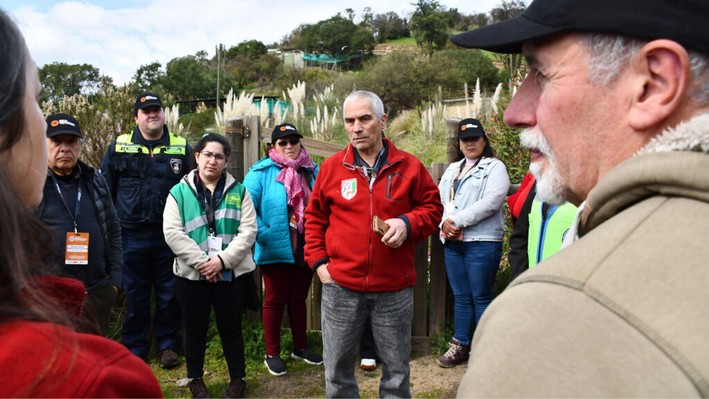
Caritas-Chile, CONAF, and SENAPRED lead this effort, promoting training for prepared communities in wildland-urban interface zones.
99.7% of wildfires in the country are caused by carelessness or negligence in handling heat sources, agricultural practices, or intentional acts driven by various motivations, including criminal intent. Therefore, efforts focus on fostering community participation to reduce occurrences and damage.
Under the Environment, Risk Management, and Emergency Program (MAGRE) and with funding from the United States Agency for International Development’s Bureau for Humanitarian Assistance (USAID-BHA), since 2022, Caritas Chile, CONAF, and SENAPRED have conducted significant fieldwork with 14 communities in the Valparaíso and Ñuble regions. The goal is to strengthen coordination among regional governments, municipalities, and residents to reduce wildfire risk in wildland-urban interface areas.
To showcase this interagency work, exchange best practices implemented in the territories, and outline action plans for 2024-2025, Caritas Chile, CONAF, and SENAPRED held the seminar "Wildfire Risk Reduction: How Do We Prepare as a Community?" at the Moneda Bicentenario Building Auditorium in Santiago.
Through the establishment of local committees over these years, residents have been trained by experts from these three institutions in developing preventive action plans, which were implemented in areas identified as high-risk.
The event was opened by Caritas Chile Director Lorenzo Figueroa León; SENAPRED National Director Alicia Cebrián; and CONAF’s Wildfire Protection Manager Jorge Saavedra. A greeting video from U.S. Ambassador to Chile Bernadette Meehan was also shown.
Information Exchange
Catherine Mella, head of Caritas-Chile’s Environment, Risk Management, and Emergencies Program, explained: "This seminar is a meeting space with various stakeholders to exchange information and experiences, with the sole aim of strengthening effective preventive coordination in risk zones. Today, we can highlight success cases in the Valparaíso and Ñuble regions. We will continue working in these regions and, by 2025, expand to the Biobío region, as we are convinced that preventive efforts involving all stakeholders are the most effective way to mitigate major disasters."
SENAPRED National Director Alicia Cebrián added: "Through recent emergency experiences, we’ve seen how wildfires have intensified. That’s why coordinated efforts with the National Disaster Prevention and Response System—comprising public, private, and organized civil society entities—are crucial. Among the ongoing preparedness actions is community-based disaster risk reduction, including wildfire threat training to create multipliers who lead awareness and education efforts, making territories safer."
Jorge Saavedra, CONAF’s Wildfire Protection Manager, emphasized: "It’s vital for citizens to understand current wildfire risks, especially due to climate change. Society must be prepared, making this preventive phase with communities critical. Sharing experiences, as done in this project, is foundational because risk mitigation is everyone’s responsibility, with communities playing a key role."
Notably, Caritas-Chile and CONAF have contributed to training and implementing disaster risk reduction measures in 73 communities nationwide. Soon, work will begin in 18 communities across Valparaíso, Maule, Biobío, and Ñuble to reduce wildland-urban interface wildfire risk, supported by international cooperation.
Topics Covered
The event addressed the Institutionalization of Risk Management in Latin America, presented by USAID/BHA-Costa Rica’s Integrated Fire Management Consultant Luisa Alfaro; CONAF’s Wildfire Prevention Department Head Rolando Pardo; and SENAPRED’s Acting Deputy Director of Disaster Risk Reduction Helia Vargas.
A second panel focused on territorial and participatory wildfire risk reduction from civil society’s perspective, featuring Caritas-Chile’s Catherine Mella; Ricardo Osses, President of the Peñablanca-Quillón Local Prevention and Emergency Committee; and Lucía Barraza, representative of Villa Cumbres de Viña del Mar.
Later, Daniela Ejsmentewicz, Executive Director of the University of Chile’s Disaster Risk Reduction Program (CITRID), and Kassandra Sagredo from SENAPRED’s Training Unit explained Community-Based Disaster Risk Management. Finally, USAID-BHA Disaster Risk Management Specialist Karina Almonacid discussed the role of Prepared Communities Networks.






Comments (0)
No comments yet. Be the first to comment!
Leave a comment