

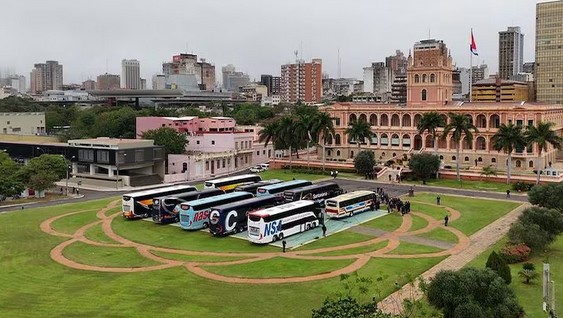
- The country has exceptional climatic and soil conditions for the sector, enabling shorter production cycles.
Although still in its early stages, the forestry industry or production in the country has managed to capture local and international attention due to the significant opportunities it represents. According to the National Forestry Institute (Infona), with 5 million hectares of high-potential land for forest plantations, the sector is poised to become a major player in the economy through job creation and investments in timber and non-timber products, such as pulp. Despite its potential, the sector faces major challenges: from updating the legal framework to designing financing funds tailored to the national forestry industry's timelines, which could help the segment take a leap forward and revolutionize the economy, according to industry leaders.
According to Infona data, 44.3% of the national territory has forest cover: 33.6% or 14,600,000 hectares of native forest, of which 2,600,000 are in the Eastern region and the remainder in the Western region or Chaco. Across the country, 200,000 hectares correspond to forest plantations, primarily eucalyptus, with a minimal percentage (7%) being palm groves.
Alongside its forest cover, Paraguay has exceptional climatic and soil conditions for the forestry sector, allowing for shorter production cycles—between 7 and 12 years—and higher yields compared to other countries in the region, where cycles range from 15 to 20 years.
Thus, the country is highly attractive for the establishment of timber industries (sawmills and laminators) and more complex industries like pulp production for packaging (paper) and textiles. In fact, the mega-investment by Parecel, whose construction is projected soon, falls into this category.
INVESTMENT GRADE CAN HELP
Infona’s head, Cristina Goralewski, told La Nación/Nación Media that the country’s macroeconomic stability, labor force, tax rates, and edaphoclimatic conditions position Paraguay as a hub for forestry investments. "The big leap can happen now. With the news of Paraguay achieving investment-grade status, a crucial step has been taken to consolidate investments in the forestry sector," she emphasized. Goralewski mentioned the ongoing government plan "Paraguay Forestal para el Mundo," an initiative aimed at creating opportunities for economic and social growth through the forestry sector. "It consists of several components. One is attracting national and international investment through incentives like a forestry guarantee subfund being developed with the AFD. Additionally, it seeks to position the forestry industry and its products while leveraging exports of our main commodities with sustainability-focused tools," she added.
José Ayala, sectoral specialist for Forestry Industries and Floriculture at the Investment and Export Network (Rediex), told La Nación/Nación Media that, according to Infona, recent data shows over 400 registered forestry industries, with more than 90% falling under micro, small, and medium-sized enterprises. Most are concentrated in Caaguazú, Coronel Oviedo, Minga Guazú, Hernandarias, and some in Central. These are mainly sawmills, laminators, carpentry shops, and more. Regarding production volume, the expert noted that these industries have a cutting capacity exceeding 1 million cubic meters. "But currently, they are operating at 50% of that capacity," he explained.
Ayala mentioned that most companies in the sector are currently focused on processing raw materials from forest plantations or eucalyptus, as well as producing and exporting charcoal, derived from native forest resources.
"The remaining production percentage is divided into products like flooring cuts, plywood, laminated wood, and furniture," he added. For the specialist, the local forestry industry is undoubtedly poised to become a major economic driver through job creation and large-scale investments, but he noted that significant challenges remain.
CHALLENGES
Beyond having precise and transparent sectoral information—requiring collaboration among institutions—Ayala stressed the need to review existing legislation and promote the country to attract more investments. "Funding and financing plans tailored to the sector are crucial, given its long-term nature. That’s why a forestry committee led by the Development Finance Agency (AFD) was created. They are exploring benefits for forestry investors, not just loans but other incentives," he noted. Additionally, the expert emphasized defining specific development areas or models within the industry to concentrate activity. "This will require infrastructure improvements like roads, transportation, and ports—all with sustainability in mind, as the market demands," he analyzed.
Ayala believes Paraguay is currently in a favorable moment for forestry investment after achieving investment-grade status, making it crucial to continue developing the sector as a state policy.
A GROWING INDUSTRY
Paraguay’s forestry production continues to evolve, generating $94,567,132 in exports in 2023 and $45,603,934 in the first half of this year (up to June). Key exports include charcoal, firewood, raw timber, poles, sawn wood, parquet, furniture, and wooden accessories. With this growth, the sector is optimistic about increasing exports and entering new markets worldwide, with Mexico, Vietnam, and even India in sight.
GREAT POTENTIAL
In an interview with La Nación/Nación Media, Juan Carlos Altieri, vice president of the Paraguayan Timber Federation (Fepama), described the forestry industry as "nascent" but full of potential. He noted strong demand for plywood, raising expectations for new markets. "The forestry sector is very pleased with current market trends and future projections. There’s anticipation of exporting processed goods—not just raw materials—to Mexico, Vietnam, and even India, which are interested in Paraguayan products like plywood. This is very important for the country," he added.
Altieri highlighted major investments in the forestry industry, particularly in pulp, with an upcoming plant expected to boost the national economy. "The forestry sector employs many people. In reforestation alone, 100 to 150 jobs are created per 100 hectares. Paraguay has the capacity to cultivate up to 2 million hectares without issue," he stated, expressing optimism about the industry’s future.
Source:lancion.com.py




Comments (0)
No comments yet. Be the first to comment!
Leave a comment