

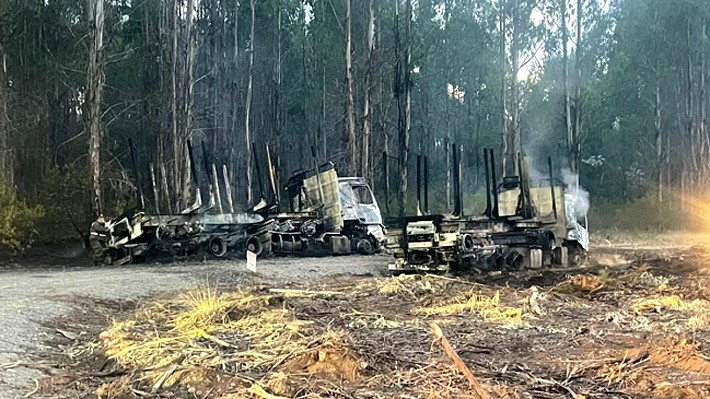
The burning of seven forestry machines in the commune of Cunco, La Araucanía, last Sunday, along with other attacks in that region affecting various activities, has reignited concerns in the forestry industry.
In the sector, they state that despite the state of emergency being in effect, the fear of attacks in the southern macro-zone is constant and indicate a resurgence of violence is being observed. In August, forestry worker Manuel León (60) was killed—while César Osorio (50) was seriously injured—after unknown assailants shot at the vehicle providing private security services for CMPC in Victoria, La Araucanía.
Insecurity adds to the deterioration shown in the financial results of Arauco (Angelini) and Empresas CMPC (Matte), due to weak pulp prices amid oversupply. Additionally, the United States' decision to implement a 10% surcharge on imports of softwood and sawn timber starting October 14, along with a 25% tariff on manufactured wood products, compounds the situation.
According to figures from the Chilean Forestry Contractors Association (Acoforag), 19 arson attacks have been recorded in their sector this year, between the Biobío and Los Ríos regions. Throughout 2024, they counted 26 such incidents, and since 2014 to date, their records show a total of 515 events.
Losses from attacks on contractors during 2025 are estimated at $8.225 billion. In 2024, they were about $13.309 billion, and over the last 11 years, losses amount to $212.158 billion.
"Terrorist violence remains fully entrenched in La Araucanía, despite the figures, statements, and justifications from the Ministry of Security and the Government. The reality is one: insecurity and fear continue to dominate the area," stated Acoforag. They added that "it is urgent to advance the Law on Rules of Use of Force, the Intelligence Law, and the Critical Infrastructure Law, projects that are stalled in Congress. Without these instruments, it will be impossible to control the terrorist groups entrenched in the southern macro-zone."
Michel Esquerré, president of PymeMad—a guild that groups together SMEs in the forestry sector—stated that "the attacks generate a process of investment withdrawal in the sector because having your machines burned, having your work violated, inhibits investment by entrepreneurs in the sector."
Rodrigo O'Ryan, president of the Chilean Wood Corporation (Corma), affirmed that "the resurgence of violent acts in La Araucanía is a worrying signal that directly affects the security of communities and workers in all productive sectors, not just the forestry sector." He added that an "effective" state presence in the territory and a "preventive, proportional, and sustained over time" strategy are required. He stated that "all this becomes especially relevant as the fire season approaches, where intentionality has been one of the main causes."
The forestry company Arauco indicated that the electoral process could have an influence on the recent attacks. Although the company noted that attacks have decreased lately, they still persist. Regarding the pulp situation, the Angelini group company stated that in recent weeks the price has recovered and they hope it consolidates as a trend. Concerning the new tariffs in the U.S., they asserted it is still too early to assess their impacts but indicated they reject tariff barriers.
O'Ryan estimated that "progress must be made together with Subrei to diversify markets and promote, from the state, the use of wood in construction and other forest-based products. Simultaneously, it is urgent to approve a forestry promotion policy that drives the sector's development as a pillar of the new bioeconomy and contributes to fulfilling Chile's environmental commitments."
Source:El Mercurio




Comments (0)
No comments yet. Be the first to comment!
Leave a comment