

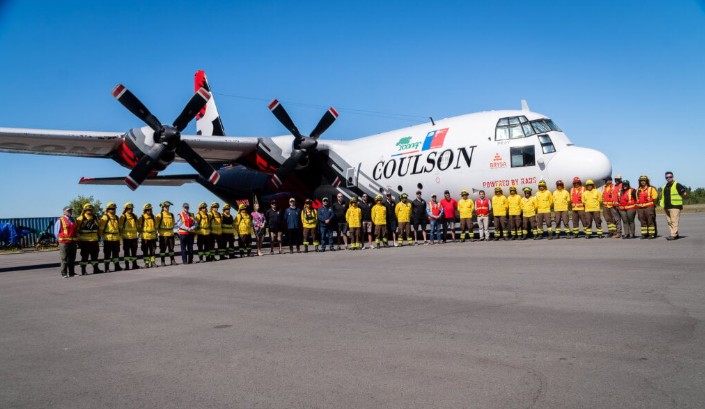
Imposing on the tarmac of the María Dolores Aerodrome awaits the Hercules C-130 aircraft that arrived in the province of Biobío for the 2025-2026 wildfire season.
It is a heavy, large-capacity tanker that allows for a rapid and effective response to wildfires on a national scale. It has an autonomy of three hours, a drop capacity of 15,000 liters of water or retardant, and a maximum flight speed of 570 km/h.
It was reported at the time that the aircraft has high maneuverability and can significantly reduce its speed, which allows it to operate in complex terrain, at low altitude, and perform partial or total drops with very high precision.
These characteristics allow it to adapt more easily to the rest of the air group and carry out operations in a coordinated and expeditious manner.
Its crew is the same one that has operated on other occasions in Chile, so its members possess extensive knowledge of the territory, its geography, and capabilities.
RAPID REACTION
The captain of the Hercules C-130, Todd Davis, has 17 years dedicated to this work, five of which he has spent in Chile.
In his opinion, the conditions for fighting wildfires in our country are much more favorable than even those in the United States. "I think Chile handles rapid reaction very well," he emphasized. Regarding geographical features, Todd Davis stated that "they can be even better than in the United States. We can handle them very well," he noted. With the existing topography, the aircraft can glide and fight fires.
With the existing topography, the aircraft can glide and fight fires quickly and at low altitude, reaffirmed the captain. "We can take off quickly if we are dispatched. Within 10 minutes we can be in the air to go out and fight fires," he indicated.
OVER 560 FIREFIGHTERS DEPLOYED
It was reported at the time that the Biobío region has more than 560 firefighters, both men and women, with experience in combating wildfires.
In Los Ángeles, the Duqueco base of the National Forestry Corporation (Conaf) has five brigades, composed of between 12 and 17 people each.
One of the brigade leaders is Juan González Ceballos, who has been working in this role for 18 seasons. In his view, the support of the Hercules C-130 aircraft is fundamental. "It works with retardant for wildfires, which allows for more effective and safer firefighting for the personnel on the ground," he indicated.
For González, personnel safety comes first. Each day, during formation, he conducts a safety talk lasting approximately 10 to 15 minutes.
According to him, on that occasion, they are explained everything related to how to avoid situations that put their lives at risk.
"We always have to remember that there is a family behind us waiting for us. A mother, a father, a brother, or a cousin," emphasized the brigade leader.
In that same talk, emphasis is placed on the fact that, although the firefighter wants to protect the flora and fauna, they must always prioritize their physical integrity first. "A tree can be planted once, twice, three, four, or five times, but a person is very valuable. So, personnel safety always comes first, above all else. That doesn't mean one neglects the rest," he stressed.
SUPPORT AMID INCREASE IN FIRES
Visiting Los Ángeles, regional and provincial authorities inspected the Hercules C130 "tanker." The regional presidential delegate, Eduardo Pacheco, highlighted the aircraft's operational speed.
With the arrival of the aircraft, the authority seeks to make it clear that all conditions are in place from the State to work, attend to any emergency, and combat wildfires during this season. "Today we can tell the inhabitants of the region that this tanker is already here, that it will be available along with more than 10 other aircraft. To that is added all the help from forestry companies and the 42 brigades — including night brigades — that are ready," he stated.
For his part, the regional director of Conaf, Esteban Krause, emphasized that over 560 people have been hired throughout the Biobío region, who will use all their tools to prevent damage to homes, lives, or natural resources. "More than 70% of the people working for Conaf are individuals with several seasons of experience. Of the total, approximately 25% are young people who have joined in these seasons," he indicated.
For Krause, the above demonstrates that there is tremendous experience and capacity to face this challenge. The official also stated that "the region faces a 24% increase in the occurrence of wildfires compared to the previous season, along with a 283% increase in the affected area." Given this situation, he called for prevention and for citizens to "adopt care measures and avoid any risky practices involving the use of fire."
Source:La Tribuna



Comments (0)
No comments yet. Be the first to comment!
Leave a comment