

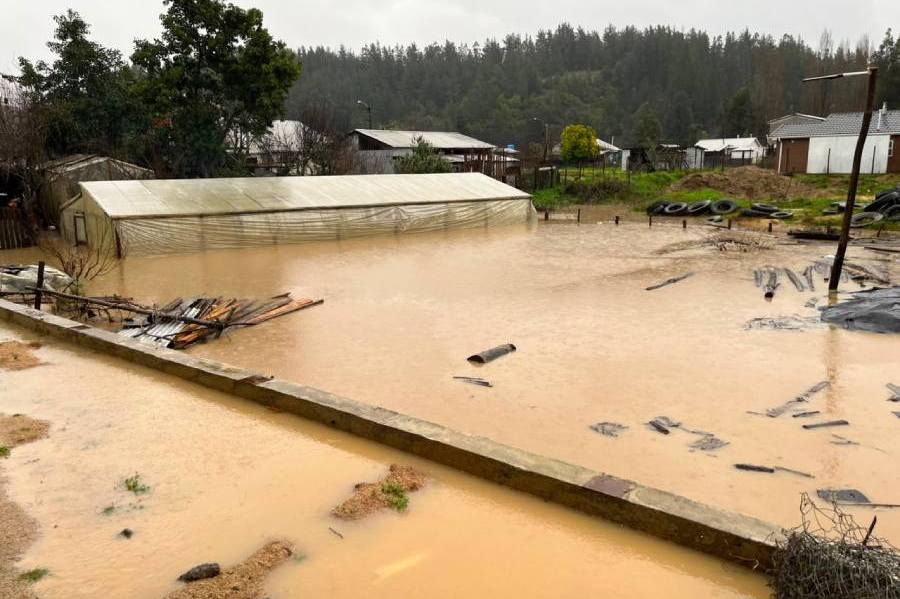
The regional agricultural sector is experiencing a complicated situation as a result of the frontal systems that have hit the country in recent weeks. This was acknowledged by the president of the Ñuble Farmers Association, Carlos González, who explained that waterlogging in orchards could cause root mortality in plants and fruit trees, while in traditional crops, it has prevented timely fertilization and, in many cases, is delaying sowings.
Likewise, the authority has reported damage to farm infrastructure, mainly as a consequence of strong winds and overflows of rivers and streams.
Preliminary figures at the regional level estimated at the end of last week that 280 small producers using Indap services had been affected by the frontal systems, a figure that would have been greatly exceeded during the weekend, according to sector sources. The definitive registry is still being prepared by the technical teams.
Production impact
The greatest impact will be on production, where a reduction in the area of cereals, such as wheat, corn, and barley, among others, is estimated.
Carlos González stated that, although the first frontal systems caused minor damage in the region, the accumulation of water in recent weeks has changed the scenario.
"The agricultural sector is very complicated with the recent rains, many river and stream overflows, flooded sowings, orchards with a lot of water, because the soil is already saturated and when that happens there is root death; when the water recedes, we will see mortality in plants and trees," explained the leader.
He exclaimed that "I don't recall a year like this one, I believe it is going to be tremendously damaging for agriculture in Ñuble," before reviewing the situation of the main traditional crops.
"In the case of wheat, those who managed to sow now have the serious problem that they cannot enter the fields to fertilize with urea, which the wheat and rapeseed are desperately asking for. And for intermediate wheat, I don't know if they will be able to sow, because the rain will continue. Therefore, we foresee that there will be a decline in the wheat area," predicted González.
He also cast doubt on whether the entire area of durum wheat and chicory will be sown in August; and regarding barley, which is a winter crop, he pointed out that slightly less than a third of the projected area has been sown and recalled that the later it is sown, the lower the yields.
Regarding corn, whose sowing begins in September, the farmers' leader warned that rain forecasts for spring could dampen the season.
Finally, the agricultural leader warned that weather forecasts are not auspicious, since if intense rains extend during spring, a production crisis of great magnitude would be recorded in fruit trees.
"Forecasts say water is coming until December, and experts anticipate that frontal systems from September onward will be stronger than those we already had. If those forecasts come true, we are facing a catastrophe, because remember that in September all the fruit in bloom would be affected, such as cherries, hazelnuts, apples, and kiwis. If we have torrential rains and then frosts, I believe we are heading toward a production and economic crisis," González launched.
Minister of Agriculture
In this context, this Tuesday, presidential delegate Diego Sepúlveda met with the Minister of Agriculture, Jaime Campos, to coordinate actions to respond promptly to the needs of the sector, especially small farmers.
At the meeting, the Secretary of State announced that he will visit Ñuble this Thursday, with the aim of assessing the situation on the ground and defining the support measures that the ministry will promote. "On Thursday I will be in Ñuble and they will make effective proposals to me regarding how the Ministry of Agriculture and its services will go to the aid of small farmers in the region," he stated.
Source:La Tribuna







Comments (0)
No comments yet. Be the first to comment!
Leave a comment