

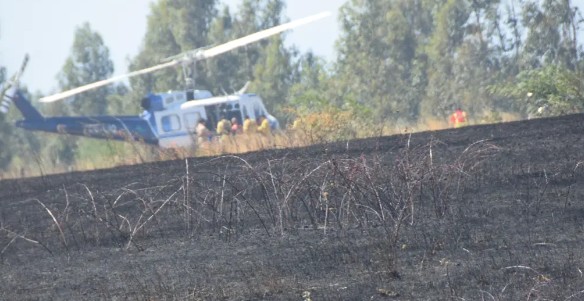
Over the last decade, the province of Biobío has experienced a scenario marked by the irregularity of forest fires, which left a toll of 200,865.19 hectares consumed in a total of 6,144 incidents between the 2015-2016 and 2024-2025 seasons.
Historical analysis shows that the greatest destruction was concentrated in the 2022-2023 season, with 140,851.08 hectares affected, a figure that contrasts with 2016-2017, when 17,070.32 hectares were recorded.
Statistics provided to Diario La Tribuna by Conaf Regional also show that a high number of fires does not always equate to a larger burned area: the season with the most incidents was 2021-2022, with 743 fires, while the smallest affected area of the decade corresponded to 2020-2021, with 2,177.89 hectares.
Added to this is the direct impact on native forests, one of the most sensitive components of the provincial ecosystem. According to data provided by Conaf, between the 2015-2016 and 2025-2026 seasons, 31,297.41 hectares of native forest were consumed in the province of Biobío alone, with marked variability between years. The most severe damage occurred in the 2022-2023 season, when fire ravaged 22,697.57 hectares, mainly affecting species such as ancient oaks and araucarias, whose slow regeneration makes the scenario even more critical.
Meanwhile, the period of least impact was 2017-2018, with 113.57 hectares, highlighting the irregular nature of fire behavior in the area. These figures reflect not only the magnitude of the environmental loss but also the fragility of the high-Andean ecosystems and the Nahuelbuta Mountain Range, where a large part of the native vegetation of high ecological value in the province of Biobío is concentrated.
It should be mentioned that the seasonal data spans from July of each year, with the high season considered from December to March, although these periods are increasingly extending.
"Native forests have suffered an alarming deterioration"
Ancient oaks and araucarias are among the species most affected by the destruction caused by fires in the province of Biobío. In this context, and with all the coordination carried out with the private sector to respond in a timely manner to the contingency and prevent the aftermath from being even greater, the regional director of Conaf, Esteban Krause, shared his perspective on the impact on native forests in the province of Biobío.
Regarding this situation, he warned in an interview with Diario La Tribuna: "In the province of Biobío, native forests have suffered an alarming deterioration during the last seasons, according to specific data from the area that we have compiled between 2015 and 2026. The affected hectares vary each year, reaching concerning figures that put biodiversity at risk."
Krause explained that the loss of this type of vegetation cover has direct consequences on the ecosystem and people's lives: "The loss of native forest implies the reduction of habitat for numerous animal and plant species, endangering the region's unique biodiversity. Furthermore, it affects people's quality of life, as the loss of vegetation cover contributes to desertification and reduces the ecosystem services that forests provide, such as climate regulation and soil conservation."
The regional director also highlighted the importance of prevention and community collaboration: "Therefore, the prevention of forest fires is fundamental. Every fire that is avoided protects hectares of native forest, safeguards species, and maintains the ecosystems that give us water, clean air, and food security. The community's collaboration in reporting risks, respecting fire use regulations, and participating in preventive actions is key to conserving our natural heritage and ensuring a sustainable future for the province and new generations."
"Flora, especially in watersheds, is the most affected"
Regarding the effects of forest fires on the environment, Dr. Raúl Briones, a biodiversity specialist at Bioforest, warned about the direct consequences on the flora and fauna of the province of Biobío: "The species affected by forest fires are, obviously, flora, especially those that were in watersheds. Then, in fauna, it's the less vagile species, meaning those with reduced mobility: arthropods, reptiles, and amphibians, for example, and precisely these groups present high endemism in the Nahuelbuta Mountain Range."
Dr. Raúl Briones, biodiversity specialist at Bioforest
In an interview with Diario La Tribuna, Briones also explained the impacts on the soil and the organisms living in it: "The impacts of fires are on the soil: it burns and loses the most productive layer of soil, and with it all the fauna of humus, arthropods, fungi, and bacteria." Furthermore, he added that "the loss of the vegetation layer due to fires generates a loss of soil directly from the fire, but later, with rain, the washing away of material causes a second, more indirect loss of soil. This washing away, in addition to the general loss of soil, causes an overabundance of organic matter and clays in water bodies, increasing negative indices in hydrological watersheds."
On the other hand, he highlighted the recovery capacity of some animals after fires: "We have conducted pre- and post-fire research and have found that micro and macro mammals flee from the high temperatures caused by fires (although many die burned). However, these burned sites are recolonized in a period of a couple of months (in mice) and six months (in herbivores)."
It should be mentioned that the flora of the watersheds in the Nahuelbuta Mountain Range is especially vulnerable because it concentrates much of the vegetation in dense and dry areas, where there are branches, leaves, and grasses that facilitate the spread of fire. Furthermore, these areas harbor unique species that have special characteristics to survive in this environment. The loss of this vegetation directly affects local fauna and reduces essential ecosystem services, such as water regulation, erosion control, and soil conservation, generating impacts that extend to the entire ecosystem and the nearest human communities.
"It is important for the community to report risky behavior"
Regarding the prevention of forest fires in the province of Biobío, the regional director of Senapred, Alejandro Sandoval, highlighted the importance of active citizen participation: "The responsible behavior of citizens, staying informed about the risks they live with, preparing their surroundings to reduce risk, I recommend reviewing the guide for preparing homes for forest fires, organizing within communities to be able to share alerts and relevant information."
He added that, besides preparation, social responsibility is key to avoiding emergencies: "It is important for the community to condemn and report irresponsible risky behavior that causes forest fires."
It should be mentioned that the National Disaster Prevention and Response Service -Senapred- plays a central role in coordinating the response to forest fires, managing alerts, providing prevention and evacuation recommendations, and strengthening community preparedness in collaboration between different public and private institutions.
Furthermore, for the 2025-2026 season, the Strategy for Strengthening Forest Fire Management is being implemented, which seeks to unify the work of public, private, and civil society organizations to reduce risks and improve response. This strategy incorporates lessons learned from previous emergencies and focuses on protecting people and safeguarding the environment, adapting to the particularities of each territory.
The plan considers 107 commitments from 23 institutions, distributed across three axes: Risk Mitigation, Response Preparedness, and Communication, with specific activities aimed at strengthening prevention, community preparedness, and information dissemination, ensuring that citizens are informed and can act responsibly in the face of the threat of forest fires.
"More than 99 percent of fires are caused by people," Beatriz Cárdenas, CMPC Bosques
From CMPC, they reported that they are already prepared to face the most complex stage of the forest fire season in the province of Biobío. Beatriz Cárdenas, who leads the Fire Prevention area at CMPC Bosques, highlighted the work carried out throughout the year, both in prevention and in preparation for firefighting: "Training programs have been strengthened with an international standard, in which more than a thousand firefighters have participated this year, in addition, of course, to the ground and aerial resources that complete this preparation plan."
In terms of resources, the company has 21 aircraft, of which 12 are planes and nine are helicopters. For the Biobío region and province, it is expected to operate with ten aircraft, five planes and five helicopters, along with the Hercules C-130, which will be based at the María Dolores aerodrome. The Air Tractor 802 tanker planes have a capacity of 3,000 liters of water or retardant, while the helicopters include a Chinook CH-46 with a capacity of over 4,000 liters and eight medium Bell 212 and 412 helicopters, used both for transporting firefighters and for water drops of 1,200 liters.
On the ground, CMPC has 145 brigades, with a total of 1,083 equipped and trained firefighters to combat fires, thus complementing the aerial work.
Cárdenas emphasized that, despite having sophisticated resources and public-private coordination, the key remains preventing fires: "More than 99 percent of fires in our country are caused by people, intentionally, negligently, or accidentally. Therefore, avoiding fires is everyone's task." Finally, the expert underlined that "CMPC's main objective is people's lives," along with the protection of the region's ecosystems and forest heritage.
Source:La Tribuna



Comments (0)
No comments yet. Be the first to comment!
Leave a comment