

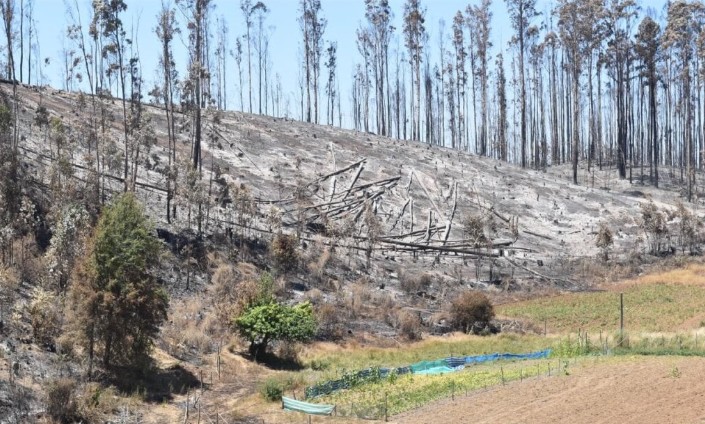
The forest emergency in the Biobío region has diminished compared to what was experienced during last weekend. However, the situation remains critical, especially considering that there is still over a month left before the period of peak summer intensity ends.
In that regard, according to the regional report delivered by the National Forestry Corporation (Conaf) this Sunday, January 25th, seven active fire hotspots were recorded simultaneously in different points of the region. Concurrently, the total affected area exceeds 32,000 hectares since the start of the summer season.
This figure represents a 207% increase in affected area compared to the total recorded during 2025.
CUMULATIVE IMPACT
Facing this scenario, the president of the Chilean Wood Corporation (Corma) Biobío-Ñuble, Alejandro Casagrande, addressed the impact this national emergency could have on the forestry industry. He assured that all damaged areas directly affect the sector's productive chain.
"If plantations burn, the forestry industry will be affected. That is clear," he stated, although he specified that a definitive quantification of the productive damage does not yet exist.
"How much will it be affected? It will depend on the damaged area and the level of damage those plantations have. That is information that we, and I believe the companies, still do not have," he added.
Casagrande explained that not every fire implies a total loss of marketable volume, as it will depend on the age of the forest, the fire's intensity, and the recovery capacity of the affected areas. However, he warned that the problem cannot be analyzed in isolation.
"We are coming out of 2017 and 2023, which were catastrophic seasons. Each of those seasons meant a reduction of close to 10% in the volume available for the sector," he indicated.
Before the mega fires of 2017, the annual sustainable harvest reached 46 million cubic meters. After that season, it dropped to 40 million, and after 2023, projections place it between 36 and 37 million.
"That lost volume will only return in 24 more years, because it's necessary to replant and wait for the complete cycle. That is the drama, especially for small and medium-sized enterprises, which do not have the financial backing to withstand so many years with less supply."
JOB LOSS
The leader was emphatic that the impact is not only productive. "Here we are talking about loss of forests, but ultimately we are talking about loss of jobs and good jobs," he noted.
In the last 10 to 12 years, he affirmed, around 48,000 jobs have been lost in the forestry sector nationwide, and more than half are from the Biobío region. Furthermore, in the last five years, close to 200 small and medium-sized industrial timber companies have closed.
"That is no coincidence. It has to do with fires, with less wood availability, and with an increasingly complex environment," he added.
He also made a direct call for prevention: "99% of fires are caused by people. With the conditions we have —over 30 or 35°C, very low humidity, and wind— there must be zero fires."
SIGNIFICANT IMPACT
From the perspective of small and medium-sized timber industries, the president of PymeMad Biobío, Michel Esquerré Dal Borgo, provided preliminary figures that help gauge the current impact.
"The impact on mature plantations is not more than 6,000 hectares. In total, it could be around 12,000 hectares between mature and young plantations. It is not as significant a number as in 2023," he stated.
In 2023, he recalled, the magnitude of the fires was "off the charts," with a much greater impact on forests of harvestable age, which directly affected supply.
Therefore, he estimated that "there should not be a very serious impact on supply for this year," although he clarified that this does not mean the damage is minor.
"It's not that it isn't large. It is important. But it is not comparable to what was experienced in previous years," he specified.
In this scenario, reconstruction and reforestation take on special relevance. "It has to be fast and effective. It cannot turn into a slow process like what happened after the fires in Valparaíso and Viña del Mar in 2024," affirmed Esquerré.
He also raised the need to strengthen legislation regarding fires, improve territorial planning in urban-rural interface zones, and reinforce public-private coordination to prevent new emergencies.
A SUMMER THAT IS NOT OVER YET
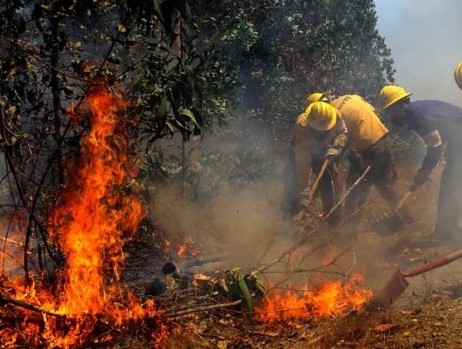
With temperatures that could reach 36°C in the coming days and no rain projected in the short term, the situation remains uncertain. Conaf brigades, Firefighters, and private companies continue to be deployed in the Biobío region to contain the active forest fires.
While the fight continues, the forestry sector watches cautiously. The final impact —the guilds agree— will depend on how much further the fire advances and on how quickly recovery can begin.
Source:La Tribuna


Comments (0)
No comments yet. Be the first to comment!
Leave a comment