

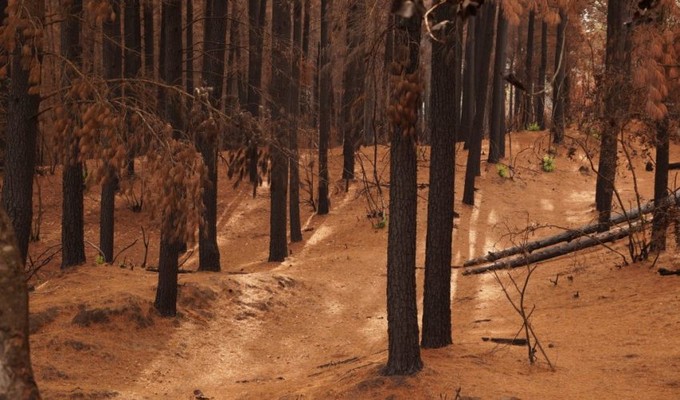
Forest fires not only leave visible losses in vegetation and housing, but also generate silent impacts on the soil that can lead to new emergencies. The scientific community at the University of Concepción raises the alarm about the "secondary crisis" that will come with the loss of soil infiltration capacity with the first rains.
The academic from the Department of Geography at the University of Concepción and member of the Biobío Multi-Threat Study Group, Dr. Ianire Galilea Salvador, warned that soils affected by severe fires can behave like impermeable surfaces, significantly increasing the threat of mudflows and floods.
The science behind the "phobia" of water
The phenomenon, according to the researcher, occurs due to the composition of the soils in the area, called Alfisols. These soils, rich in aluminum and iron, react to temperatures above 300°C.
"The organic matter from pine and eucalyptus plantations is not completely consumed; it melts and mixes with soil particles. This creates a layer of impermeable wax, a phenomenon called hydrophobicity," she detailed.
By losing its porosity, the soil no longer acts like a sponge, but like a slide. The specialist indicated that "when the rains come, the water will not infiltrate; it will create mud highways that will drag enormous volumes of material towards populated areas."
Critical diagnosis of public management
The expert points out that this vulnerability is aggravated by a reactive vision of the State. Currently, barely 5% of the public budget for the forestry sector is dedicated to prevention.
"In Chile, we are not predictive. Actions are taken after the fact, when the risk has already become a disaster. There is a lack of proactivity to generate updated contingency plans, something that in countries with similar risks is done permanently," emphasized the academic.
Dr. Galilea recalled that the Coastal Mountain Range has been suffering from historical exhaustion since the 17th and 18th centuries, when native forests were massively cleared for cereal cultivation without rotation. "Today, forest monoculture is almost the only use the soil allows, because it is weakened by centuries of mistreatment. It is a structurally fragile soil and very prone to degradation."
The risk in urban areas
During field inspections in areas like Lirquén, an extremely narrow urban-forest interface has been detected, with houses just meters away from combustion. "We saw that underground combustion at the root level in pines and eucalyptus still exists. That, combined with the lack of soil absorption, favors mass removals (landslides) and immediate flooding," she warned.
For Dr. Galilea, recovery must not be improvised. Academia proposes three urgent axes:
- Detailed Cartography: Generate maps at a 1:10,000 scale to know the real properties of each locality, as current data is too general.
- Social Pact: Coordination between companies, the public sector, and inhabitants to redesign land use.
- Informed Intervention: Not carrying out mitigation works without technical knowledge, as they could accelerate erosion.
"The soil is a living and dynamic entity, not an inert surface. If we do not change the paradigm of how we treat it, we will continue to replicate these tragedies year after year," she concluded.
Source:Diario Concepción



Comments (0)
No comments yet. Be the first to comment!
Leave a comment