

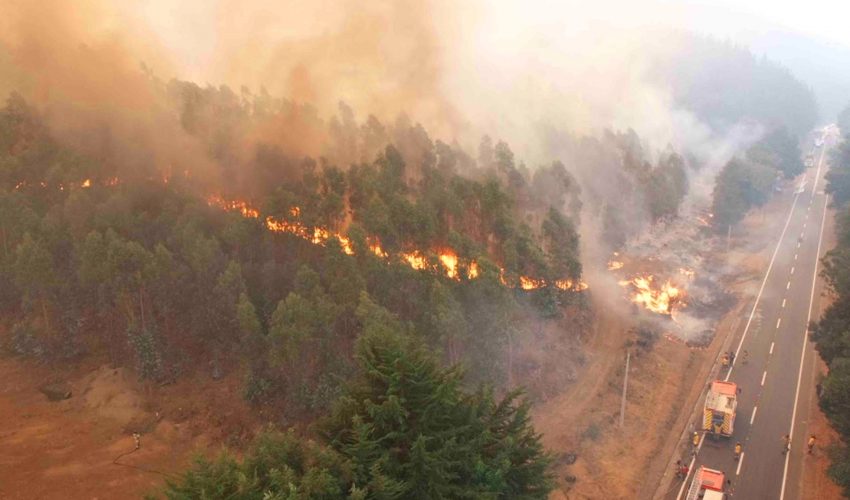
Firebreaks, vegetation clearing, scheduled drills, and work with communities are part of the deployment that Biobío municipalities are preparing for the imminent wildfire season.
Florida, for example, has already increased its capacity to carry out firebreaks and preventive corridors.
In an interview with Diario Concepción, its mayor, Rodrigo Montero, explained that the available hours of rented machinery increased from 200 to 350, mainly to intervene in urban sectors, while in rural areas the work is coordinated through thePrevention Network and coordination with Conaf
He also detailed that the commune maintains coordination with 35 sectors: 22 linked to the Prevention Network, 11 associated with Arauco, and two others directly with the municipality. The goal is to expand the coverage of preventive measures before the highest-risk period.
However, part of the interventions with machinery still depends on vegetation conditions. Montero explained that the aim is to avoid clearing while the grass remains green. "If we make a firebreak now and everything is green, in two more months it will be full of grass again," he said.
Meanwhile, the commune already has a date for a practical exercise. This Saturday, October 10, a drill will be held in the rural sector of Manco and El Naranjo, an area heavily affected during the 2017 fires. Firefighters, Arauco, Conaf, Carabineros, the municipality, security teams, the Prevention Network, and neighborhood leaders will participate.
Montero also announced that the municipality is studying the creation of a Risk and Disaster Directorate. The proposal will be presented to the municipal council on October 21 and, if approved, could begin operating in November.
Deployment in Penco and demands on private parties
In Penco, the municipality has already begun implementing part of the measures defined together with Conaf. According to Mayor Rodrigo Vera, the commune has a strategic plan that made it possible to identify critical points and establish coordination with private companies, which were formally notified to carry out actions during the next 30 days.
"We had a strategic plan to identify the points, we coordinated, and we notified the private companies by official letter," Vera said. The communal leader warned that, if they do not comply with firebreak, mitigation, or sector closure actions, the municipality could turn to the courts to require them.
The discussion coincides with the progress of the Fire Law in Congress, whose Mixed Committee dispatched the bill this Wednesday and rejected compensating private parties that fail to comply with preventive measures such as the construction of firebreaks. The initiative must now be voted on by both chambers.
In addition to these efforts, there is the deployment of 43 people assigned to preventive work through the Emergency Employment Program. The workers complete 21-hour workweeks and will remain in these roles until December, with tasks coordinated by Conaf.
The intervention includes sectors such as Santa Rosa and San Jorge, La Greda, Mantahue, Lomas de Peumo, Villa Los Aromos and Los Avellanos, Penco Chico, Condominio San Alfonso, Villa Vista Sur, Villa Belén, and downtown Penco.
Penco is also preparing a wildfire drill, although there is still no defined date. Vera explained that the intention is to coordinate it with companies and communities in the coming days, depending on weather conditions, with special attention to connectivity routes that could be used during an emergency.
The mayor also proposed strengthening coordination between communes. "Any event that occurs in Penco, Tomé, or Florida can affect all three," he said, proposing to move forward with a prevention roundtable that allows responses to be coordinated for emergencies that may cross communal boundaries.
Pending coordination
In Concepción, part of the actions previously reported by the municipality is still in the process of coordination, including preventive work with Conaf and other actors to intervene in critical points and strengthen preparation for potential fires.
Thus, the municipality also still has pending the rescheduling of the evacuation drill that had been suspended at the end of September, as a result of an emergency that occurred during that week.
From the municipality, they specified that this exercise corresponds to a municipal preparedness measure together with neighbors and other local actors, so its implementation does not depend on coordination with Conaf.
Definition of resources
This scenario is unfolding while the regional action framework for the next season is still not finalized. And to gauge it, Diario Concepción asked Conaf about the region's state of preparation for the 2026-2027 period.
From the corporation, they stated that the Regional Action Plan is still being drafted and that its main definitions, including the budget, will be announced during its official launch, preliminarily scheduled for the last week of October.
However, although there is still no regional breakdown, the national budget context is contained in the proposal for the 2027 Budget Bill, proposed by the executive branch and currently under legislative review.
The initiative contemplates $43.222 billion for strengthening the 2026-2027 and 2027-2028 fire seasons, in a proposal that considers, among other capabilities, the national deployment of aerial means and resources to reinforce firefighting.
In general terms, a budget of $263.532 billion is contemplated for Conaf, 17.5% higher than in 2026. Within that figure, the Fire Management Program concentrates $179.008 billion and considers 291 brigades for firefighting in urban, peri-urban, and rural areas.
The proposal also contemplates a national availability of 76 aircraft —70 leased and six owned—, in addition to resources for a medium-heavy helicopter with nighttime aerial firefighting capability.
Source:Diario Concepción








Comments (0)
No comments yet. Be the first to comment!
Leave a comment