

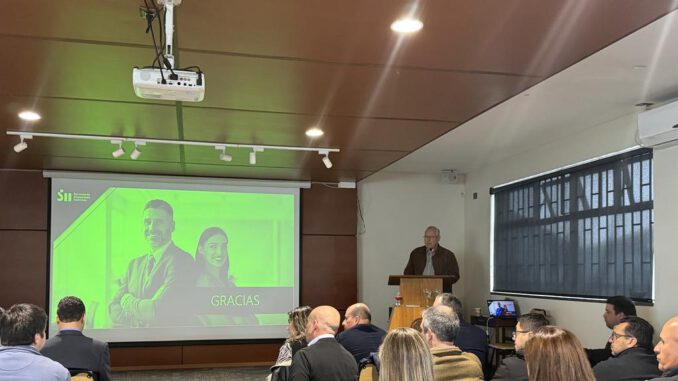
More than 45 company representatives participated in Temuco in a seminar aimed at analyzing the regulatory changes that will begin to take effect on November 1 and that will modify the procedures for issuing electronic tax documents and dispatch guides in the forestry sector.
The event addressed the challenges associated with the recording of operations, wood traceability, and proof of origin, aspects that are increasingly relevant for compliance with the national and international requirements facing the industry.
The event was organized by the Chilean Timber Corporation (Corma), La Araucanía, Los Ríos, and Los Lagos branches, under the title"New Requirements for Companies: Dispatch Guides, Origin, and EUDR". The meeting included the participation of representatives from the Regional Ministerial Secretariat of Finance, the Internal Revenue Service (SII), and forestry companies.
Marcelo Bonnefoy, manager of Corma La Araucanía, Los Ríos, and Los Lagos, highlighted the importance of anticipating the entry into force of the new provisions and preparing companies to face the regulatory changes.
"It is essential to anticipate the entry into force of these regulations. The world is changing rapidly and we must prepare ourselves to avoid problems in the development of our sector and our companies," he said.
The call brought together 31 participants from Corma member companies and representatives from 14 other non-member companies, reflecting the sector's interest in learning about the scope of the new obligations and adapting its procedures.
Authorities highlight progress in control and traceability
The Regional Ministerial Secretary of Finance of La Araucanía, Francisco Fuster, stated that the modifications will help strengthen the control and traceability mechanisms of the Chilean forestry industry, in addition to facilitating compliance with international standards.
"New rules related to wood traceability are entering into force, and this will modify the way tax documents are issued. This is in line with ensuring that we can comply with international regulations and keep Chilean timber production at the forefront," he explained.
Meanwhile, Jenny Saavedra, a lawyer from the Internal Revenue Service, valued the instance of collaboration between the public agency, Corma, and companies in the sector. The professional explained that these activities seek to provide timely information to facilitate compliance with tax obligations.
The presentation was related to Resolution No. 154 of 2025, which establishes new requirements for tax documentation, particularly in invoices and dispatch guides.
Companies share experiences in traceability
Another focus of the seminar was the exchange of experiences on the implementation of traceability systems, origin control, and chain of custody, fundamental tools for responding to the requirements of international markets.
Jessica Ordóñez, head of Traceability Control at ARAUCO, presented the company's experience in implementing systems and methodologies linked to the European Union regulation on deforestation-free products (EUDR).
"The presentation was based on the European Union regulation, to show how ARAUCO addresses it, the systems we have implemented, and the methodology we have adopted to give our clients confidence that we are doing things well," she commented.
The activity made it possible to bring technical information closer to companies of different sizes and strengthen coordination between the public and private sectors in the face of the new requirements. Early preparation and the adoption of adequate recording and traceability mechanisms will be key to facilitating the adaptation of companies and maintaining the continuity of their commercial operations.







Comments (0)
No comments yet. Be the first to comment!
Leave a comment