

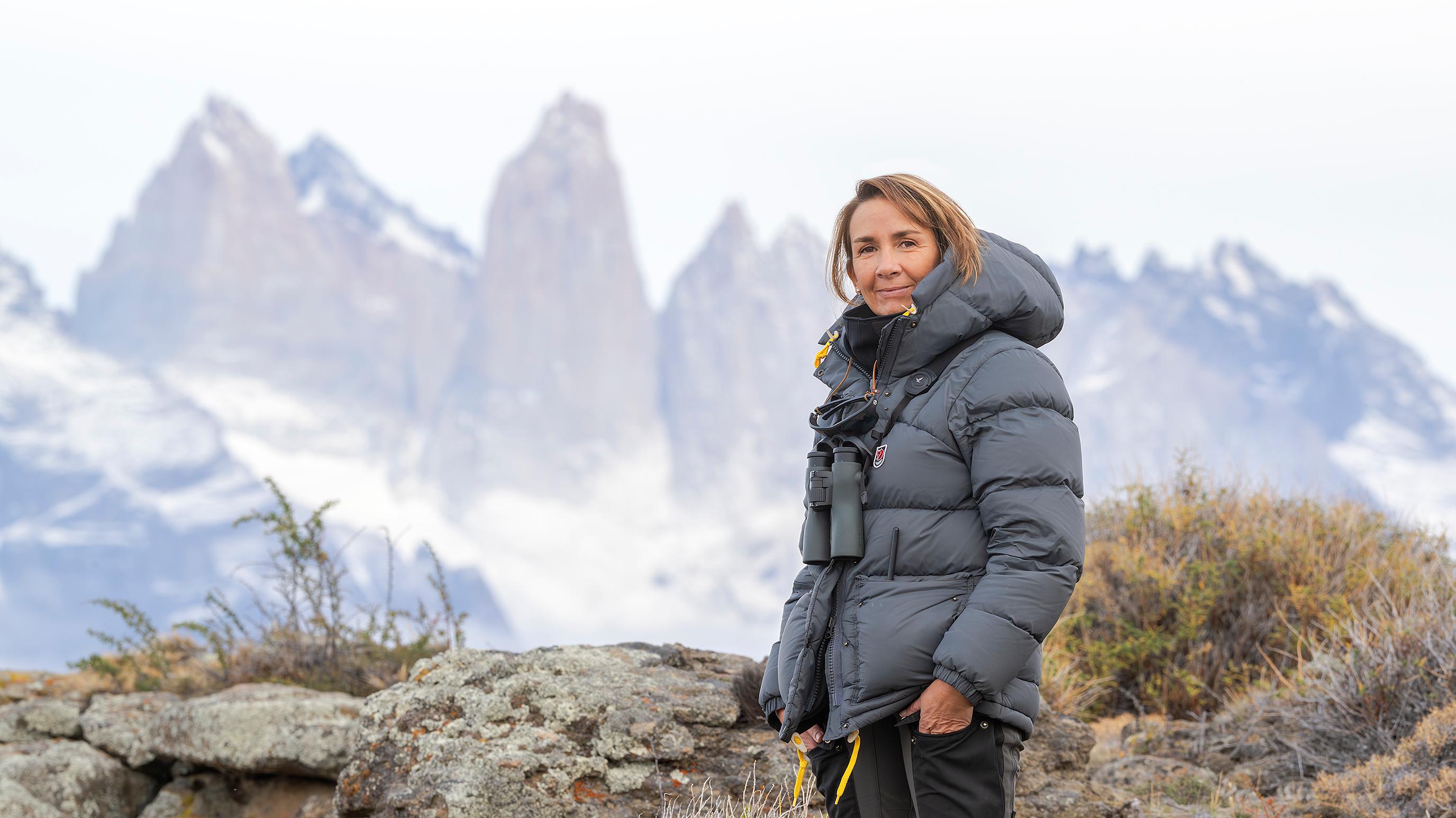
For Pía Vergara, nature is not just a setting. It is a space for learning, observation, and connection that has marked her life. A self-taught photographer and executive director of the Cerro Guido Conservation Foundation, she has built a career in which images of forests, birds, animals, and especially pumas became a way of approaching and understanding the natural world.
"For me, nature is everything; it is the basis of everything. I feel that without nature, one does not live," summarizes Pía, who also observes with concern the distance that currently exists between people and the natural world.
Her connection began at an early age. Born in Santiago, she grew up among horses, trees, and equestrian activities. Her parents introduced her to horseback riding, and much of her childhood was spent in contact with natural spaces. "I was always in among the horses' legs, the trees, and everything," she recalls.
Years later she studied Nursing and earned her degree as a Red Cross nurse, but photography ended up opening a completely different professional path.
First steps
Her relationship with the camera began in a self-taught way, first photographing her children and later becoming involved with the equestrian world. "I always liked photography. I took photos of my children and they turned out beautiful," she says.
After separating, she looked for an activity that would allow her to work with greater freedom and be close to her four children. That is how a venture linked to equestrian competitions was born, just as digital photography was beginning to make its way.
The project included a true mobile laboratory, with computers, printers, and specialized equipment. Photographing the riders, printing the images on site, and delivering them quickly was something novel for those years.
"I spent entire nights opening and closing little windows," she recalls with a laugh about her first steps with digital technology.
Her career also led her into journalism. For nine years she worked as a freelance photographer for Caras magazine, doing portraits, interviews, trips, covers, and reports. "It was a super lovely experience for me. I learned a great deal. It was a really good school," she acknowledges.
But there was a place to which she always returned: Torres del Paine. There she found what truly passionate her: nature photography and, particularly, animals.
"I used to go to the park a lot to track pumas. At first I went because I liked them, I took photos of them, and I liked being there alone."
Natural gaze
Over the years, pumas took a central place in her work. Her trips to the south allowed her to learn up close about the conflict between wildlife conservation and livestock farming.
That experience was decisive for the birth of the Cerro Guido Conservation Foundation. Pía began talking with the owners of the Cerro Guido estate and proposed studying the movements of pumas, understanding their behavior, and seeking ways of coexisting with livestock farming.
"I became very aware of the conflict that existed, especially with the puma, which would leave the park and be killed on neighboring estates," she explains.
What began as a research project became a conservation area and later a foundation dedicated to protecting biodiversity.
Today, her work as executive director takes up practically all her time. When she is at Cerro Guido, she takes every opportunity to go out into the field. She can stay from dawn until dark waiting for a puma, but she also observes birds, forests, landscapes, and, above all, the light.
Because for Pía, photography begins precisely there: in the ability to observe.
"I don't go out with the intention of looking for a photo. I go out with the intention of observing and seeing what appears to me," she explains.
Her method requires experience, patience, and sensitivity. "I'm going to see what the day has in store for me. To feel, to listen, to smell, and there the images begin to appear."
The seasons change, the light transforms, and the animals surprise. That capacity for wonder remains intact after decades behind a camera.
"Every day is different. The other day I was in the field at dawn, and an almost full moon appeared right above the Torres. In 30 years I had never been lucky enough to see something like that."
Today her main motivation lies in conservation. The camera continues to be a tool to record, communicate, and bring people closer to a nature that, for Pía, is indispensable.
Acoforag especially highlights her commitment to conservation and the sensitivity with which she portrays wildlife. Through her gaze, every forest, bird, or animal can become a story capable of awakening curiosity, respect, and awareness about Chile's natural heritage.

Comments (0)
No comments yet. Be the first to comment!
Leave a comment