

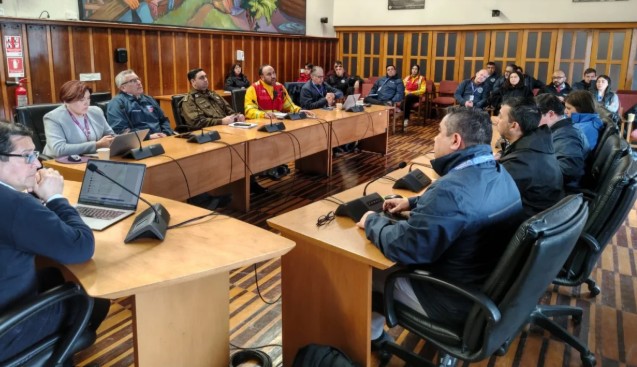
The Municipality of Puerto Montt activated a Disaster Risk Management Committee (Cogrid) to coordinate preventive measures with emergency agencies for the 2026-2027 wildfire season.
The initiative seeks to strengthen preparedness for a scenario marked by high temperatures and dry conditions, with special attention on interface areas where homes and communities face greater exposure.
According to figures from the Department of Disaster Risk and Emergency Management (GRD), measures implemented since December reduced the number of fires by 54.6%, from 108 to 49 outbreaks. During the same period, the affected area dropped by 98.8%, from 1,200 to 14 hectares.
One of the main pillars of the strategy has been the construction of more than 297,000 square meters of firebreaks, work carried out in coordination with the National Forestry Corporation (Conaf).
Municipal administrator Fernando Orellana highlighted the need to anticipate emergencies and maintain permanent coordination among institutions.
"Planning is essential, and that is why we have convened this Cogrid, which seeks to prevent, which is the best and safest investment for all residents," he said.
Municipal officials explained that preventive efforts have been intensified over the past two years, especially through the establishment of firebreaks in areas such as Valle Volcanes, Alerce and Chin Chin.
GRD coordinator Claudio Díaz stated that the conditions forecast for the 2026-2027 season make it necessary to reinforce preparedness. "We are going to have high temperatures, and that is why we are preparing to establish firebreak lines and carry out coordination work among different institutions," he indicated.
Meanwhile, Rodrigo Valderrama, coordinator of Conaf's Regional Coordination Center, emphasized that prevention improves the response to potential emergencies.
"The idea is to focus our efforts on prevention so that firefighting itself can be supported by these firebreak structures," he stated.
The meeting brought together representatives from the Fire Department, Carabineros, Bote Salvavidas and Saesa, as well as municipal officials from Public Safety, Environment, Cleaning and Beautification, Community Development, Operations, Traffic and Housing, along with representatives of territorial delegations.
The strategy aims to reduce risk in the most exposed areas and strengthen response capacity before the start of a season expected to be especially demanding.






Comments (0)
No comments yet. Be the first to comment!
Leave a comment