

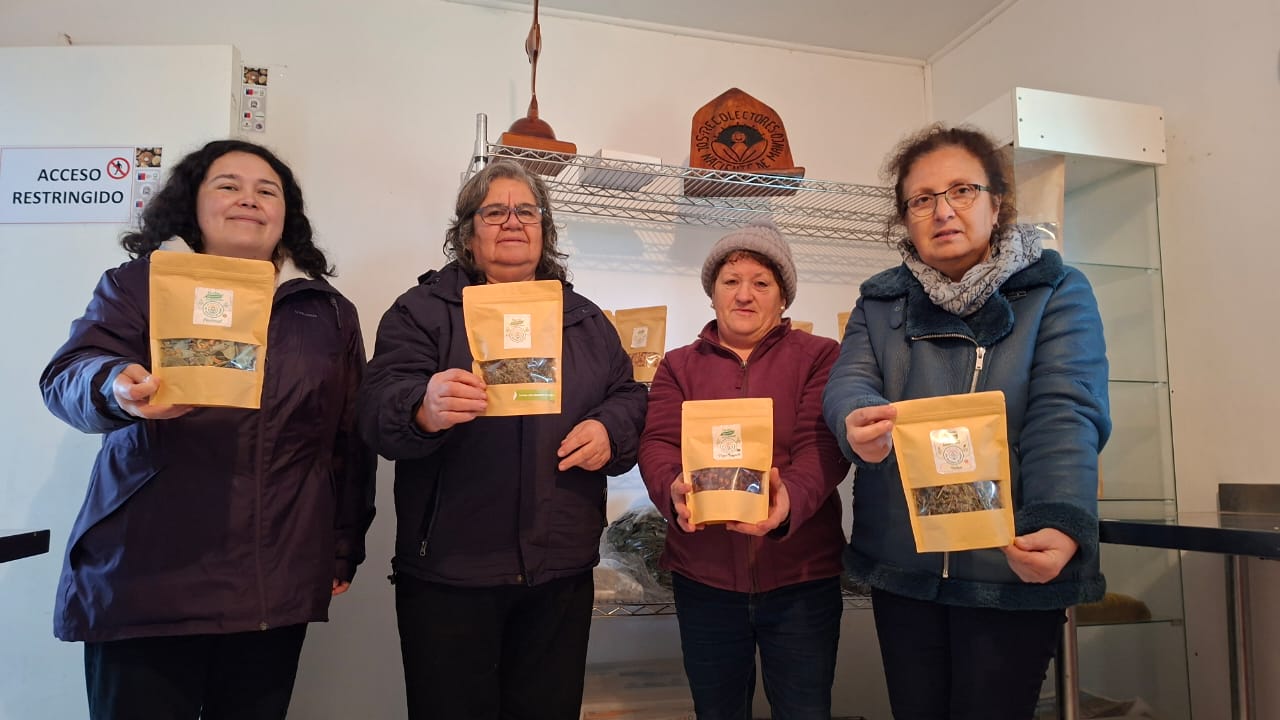
There is no heavy machinery or large-scale operations. The work begins on foot, with boots, sacks on their shoulders, and senses alert to identify the species that nature offers at the precise moment. This is how the members of the Sol Naciente de Manco Women Foragers Association work, in the commune of Florida, who have transformed the gathering of non-timber forest products into a way of life and of caring for the territory.
The group was formally founded in 2014 with around 30 members and today has about 15 people involved in its activities. Both women and men are part of the organization, although it has been the women who have historically led the rescue and transmission of knowledge about medicinal plants and their properties.
Its president, Mary Núñez, emphasizes that collective work has been fundamental to staying active despite the difficulties this activity faces.
Shared knowledge
The products they gather change with the seasons. Pennyroyal, mint, chamomile, St. John's wort, boldo, peumo, matico, rosemary, and various varieties of eucalyptus are among the species they obtain throughout the year. They also work with rosehip, one of the products with the greatest potential for developing new products.
The group recently acquired a machine that separates the pulp from the fruit, opening new opportunities to add value to their production.
However, the amount gathered never involves large volumes. As Mary Núñez explains, "we gather what we can carry on foot," a phrase that sums up the respect with which they carry out this work and the close relationship they maintain with the forest and its natural cycles.
The organization works on their own land, private properties, and on land they access thanks to agreements with forestry companies. Nevertheless, they acknowledge that forest fires and the decline of native forest have considerably reduced the availability of some species such as herbs, mushrooms, and fruits.
Patient work
The work continues in the association's processing room, where the herbs are washed, sorted, and dehydrated to preserve their medicinal properties. The space has a dehydrating oven, water access thanks to a deep well, and equipment obtained through various partnerships with collaborating institutions and organizations.
Once processed, the products are sold at local fairs, sold to forestry companies, or distributed through intermediaries. Among the preparations they make are medicinal blends such as the traditional "pectoral," used to relieve respiratory discomfort, as well as infusions intended for digestive wellness.
The members of Sol Naciente also constantly participate in training sessions given by universities and non-governmental organizations, incorporating new technical and technological tools that strengthen their work.
Living community
But perhaps the group's main value is not measured in kilos gathered or sales made. For many of its members, Sol Naciente has become a space for gathering, learning, and companionship.
Irlandia Romero, a member of the association, highlights the impact this work has on the daily lives of those who participate. "We come here, we laugh, we talk, we have a little tea, and that helps us enormously," she says, reflecting the spirit that characterizes the group.
Foraging thus becomes an activity that strengthens emotional health, a sense of belonging, and community ties in the rural world.
Despite the difficulties, the women foragers continue to seek new opportunities to add value to their products, pass on their knowledge, and keep alive an activity that combines tradition, sustainability, and local development.
From Acoforag we value the work carried out by the Sol Naciente de Manco Women Foragers Association, whose efforts demonstrate that the forest provides much more than wood. Non-timber forest products represent a valuable opportunity to drive sustainable rural economies, preserve natural heritage, and strengthen the communities that live alongside the territory every day.



Comments (0)
No comments yet. Be the first to comment!
Leave a comment