

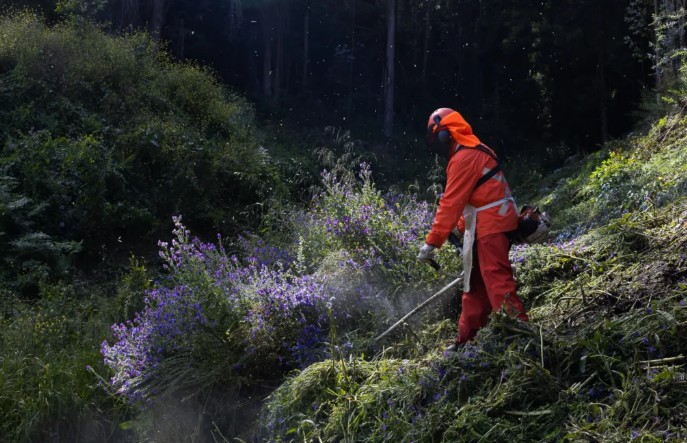
The Universidad de Concepción began this week clearing and weed removal work in different sectors of the Campus Concepción, as part of forest fire prevention measures for the 2026-2027 season. The work, which will extend until the end of December, aims to reduce the vegetation that could favor the spread of fire.
The intervention is part of the 2026-2027 Forest Fire Protection Program, which includes 32 measures for prevention, mitigation, preparation and emergency response.
The director of Servicios UdeC, Luis García Santander, explained that the work will concentrate on sectors where there is greater proximity between vegetation and buildings, as well as in areas connected to forested areas and neighboring populations, including Agüita de la Perdiz, Nonguén and Lo Pequén.
"Based on these criteria, we have prioritized the intervention of some strategic sectors, through clearing and weed removal work on the edges of property roads, perimeters of buildings and critical infrastructure, with the aim of reducing both the load and the continuity of vegetal fuel, generating protection strips that reduce the possibility of the spread of a potential fire," he stated.
For this season, it is projected to intervene close to 300,000 square meters, prioritizing the protection of critical infrastructure and the establishment of new safety rings around the campus perimeter.
Surveillance and prevention
The work is complemented by the participation of the goat brigade, made up of 60 goats that returned to the campus for the third consecutive year. Through grazing, the animals contribute to vegetation control and the maintenance of safety strips under medium-voltage power lines. They will remain on the university grounds until December.
The University has also reinforced its surveillance capabilities through aerial rounds with drones and ground patrols led by a forest brigade of seven professionals. In addition, there are two robotic cameras that use artificial intelligence to detect possible columns of smoke, with a range of up to 25 kilometers.
"From the Dirección de Servicios we understand that no single measure is sufficient on its own, so we have worked to strengthen different capabilities in a complementary manner. The results obtained to date have been positive, reaching today more than 1,700 days without registering forest fires on the campus," García highlighted.
The program also considers water supply points for emergency vehicles and potential aerial operations, along with coordination mechanisms with Bomberos, Conaf, Senapred and neighboring communities.
These actions give continuity to the work carried out during the 2025-2026 season, when more than 1,100 preventive rounds and vegetal fuel reduction work were carried out over an area exceeding 400,000 square meters.
The director of Servicios emphasized that prevention also requires the collaboration of the university environment. "As a University we are making an important effort to strengthen our institutional capabilities, but we also need the commitment and collaboration of our university community, neighbors and surrounding institutions to face the challenges of this season in a coordinated manner," he concluded.





Comments (0)
No comments yet. Be the first to comment!
Leave a comment