

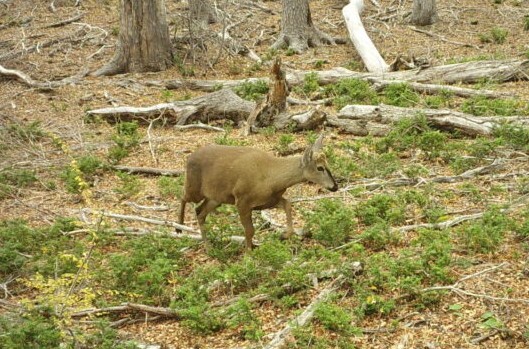
Three juvenile huemul specimens (Hippocamelus bisulcus) were recorded by the National Forestry Corporation (CONAF) in mountain sectors near Laguna del Laja National Park, in the Biobío Region. The finding occurred during a monitoring campaign with camera traps, carried out in coordination with teams from Ñuble National Reserve, within the framework of conservation efforts for this species.
The operation included the installation of 19 camera traps in three mountain ravines located north of the Laja Lake basin, specifically in high sectors of the Lavanderos and Los Enteros streams ravines. These are areas that had not been monitored previously and where there were no prior records of the presence of huemuls.
The devices allowed the recording of two juvenile males, apparently in good health, as they moved through a lenga forest. A third juvenile specimen, also male and with antlers present, was captured using a natural corridor that connects different mountain valleys. These spaces play a relevant role for habitat connectivity, as they facilitate the movement of wildlife between different sectors and access to refuge and feeding areas.
The regional director of CONAF Biobío, Álvaro González, highlighted the importance of these results. "This finding is very positive news for the conservation of the huemul in our region. It allows us to confirm its presence in sectors that had not been monitored previously and to expand knowledge about its distribution in the Biobío mountain range. It also demonstrates the importance of maintaining and strengthening the monitoring work of our wildlife," he indicated.
As part of the continuity of these actions, in January 2027 CONAF plans to install another 20 camera traps at the El Fuerte property, located east of Laja Lake. This new campaign seeks to investigate a possible north-south connection along the mountain range, also considering reports of sightings of a pair of huemuls on the southern shore of the lake.
"We will continue this work to gather more information about the movements of the huemul and its possible connection between different sectors of the mountain range. This information is fundamental to guide conservation measures and protect its habitat," added the regional director.
The monitoring of the huemul carried out by CONAF in the current territories of Ñuble and Biobío dates back to the late 1970s, when park rangers began the first follow-up campaigns in Ñuble National Reserve, a territory that at that time was part of the Biobío Region. Since then, the work has been strengthened through different observation techniques and, since 2011, with the incorporation of camera traps.
In addition to the huemul, the campaign allowed the recording of other wildlife species, including the lesser grison (Galictis cuja), the culpeo fox (Lycalopex culpaeus), the puma (Puma concolor) and the rufous-legged owl (Strix rufipes).




Comments (0)
No comments yet. Be the first to comment!
Leave a comment