

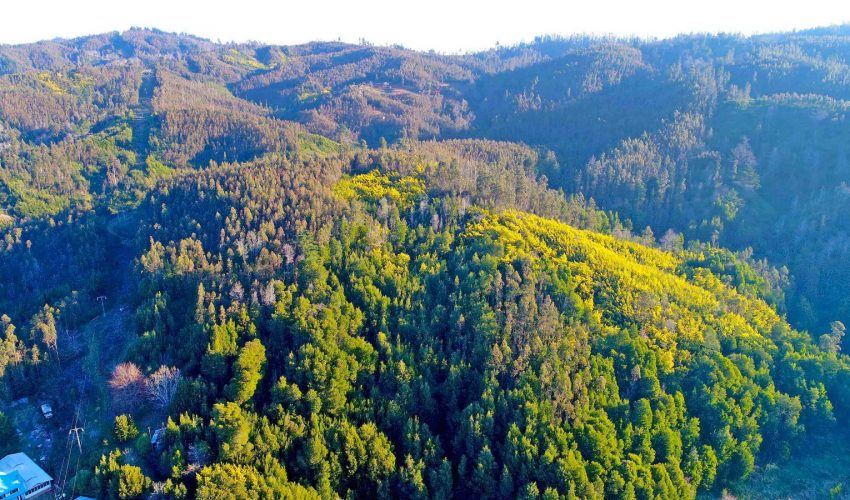
In his first interview with Diario Concepción, the head of the Agriculture portfolio, Jaime Campos, warned that Chile's forest heritage has declined drastically.
In the same instance, the Secretary of State stated: "We intend to create a new forestry instrument that will allow us to reach the 1.5 million hectares with forestry aptitude that to this day have not been planted."
This is an initiative promoted by the Executive that is particularly relevant for the area, since, as the head of Agriculture himself acknowledged, "historically Biobío has been Chile's forestry capital."
Added to the above is that a forestry plantations law could generate 215,000 direct and indirect jobs at the national level. In the Biobío Region, it is estimated that there are around 100,000 hectares without forest on soils suitable for the activity, in addition to nearly 50,000 hectares affected by fires.
On how to address the between 300,000 and 400,000 hectares damaged by forest fires in the country, Campos explained at the time that "there is a task force that I designated on the matter, from which very soon you will learn specific news. For the Biobío Region and the province of Concepción this is of notable importance," he announced.
Asked about the progress of the future Forestry Plantations Law, from the Ministry of Agriculture they indicated that "Chile needs to once again have a long-term forestry policy. We have a sector that generates hundreds of thousands of jobs, contributes to the development of our regions and plays a fundamental role in the face of climate change."
Likewise, from the public entity they explained that "what we are proposing is a comprehensive agenda to recover investment, strengthen SMEs, protect and recover our forests and move toward sustainable forestry development. The aim is to promote a sustainable activity, recover native forest, increase carbon capture and generate employment and economic activity in our territories. The goal is not to return to the past, but to build a new forestry policy for the future."
Assessment by the trade associations
Alejandro Casagrande, president of the National Wood Corporation (Corma) Biobío and Ñuble, stated that the association values the Ministry of Agriculture's promotion of a new Forestry Promotion Law. "This must be a State policy that transcends governments, provides stable rules and incentives and especially supports small and medium-sized landowners. It must also help them reduce the risks of the activity, with insurance against fires and other catastrophes, technical assistance and support for the annual management of their properties," he proposed.
According to the trade leader, in Biobío there is a concrete opportunity to plant again. "It is estimated that there are around 100,000 hectares without forest on soils with forestry aptitude, in addition to nearly 50,000 hectares affected by fires that require recovery, through plantations or native forest restoration, as applicable."
Likewise, the president of Corma Biobío and Ñuble referred to theZero Study,presented at ENADE by Juan Carlos Jobet, former minister and dean of Universidad Adolfo Ibáñez, which dimensions the national potential. "It considers one million hectares of new forestation and the productive management of 700,000 hectares of native forest regrowth, with a projection of 215,000 direct and indirect jobs. Plantations contribute to work and local development, capture carbon and provide renewable wood. The sustainable management of regrowth can improve the health and productivity of native forest, generate income and maintain its environmental functions," he highlighted.
For the timber association, according to Casagrande, increasing the forestry base alone is not enough. "The opportunity is to produce better: raise productivity, recover the forestry base, strengthen fire prevention and promote innovation, processing and added value. Thus, forestation and native forest management can translate into more employment, regional investment and industrial reactivation in Biobío."
For his part, Víctor Sandoval, president of PymeMad Biobío, stated: "We value that a forestry promotion law is being promoted. It is a very positive signal for the sector and, in particular, that the focus is on small and medium-sized landowners. From the perspective of small and medium-sized sawmills, what we are interested in highlighting is that this promotion also considers timber species oriented toward construction, such as radiata pine, which are the ones that generate the raw material we work with."
"Many of our members do not have their own forest heritage and depend on supply from third parties. Therefore, ensuring the availability of wood in the medium and long term is key to the continuity of timber SMEs and the employment they generate in the regions," Sandoval added.
Measures by the Regional Government
From the Regional Government they highlighted that Biobío is the country's main forestry region and that this industry is fundamental to the local economy. "In the midst of the labor crisis we are facing, recovering its productive capacity is a priority. We are promoting an investment of $9.8 billion to support the reforestation of small and medium-sized landowners, with the recovery of more than 4,000 hectares and benefits for 450 families. We need to recover forestry activity, generate new job opportunities and strengthen a strategic industry for regional development," they emphasized.
Source:Diario Concepción


Comments (0)
No comments yet. Be the first to comment!
Leave a comment