

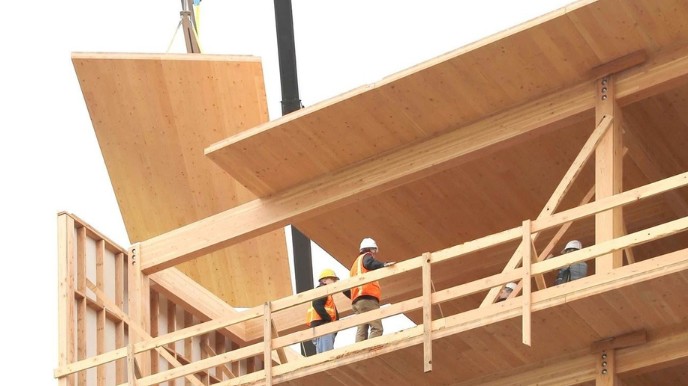
Published in 2024 in the journal Construction and Building Materials, the article "Flexural performance of full-scale two-span Nail-Laminated Timber Concrete composite slabs" presented the results of a novel full-scale experimental program. In this program, composite slab prototypes were constructed and tested with the aim of characterizing their flexural performance and validating predictive numerical models.
A Step Forward in Hybrid Construction
In recent decades, timber construction has evolved from low-rise housing towards increasingly ambitious projects. In this context, hybrid systems—integrating timber with materials like concrete—have become established as a strategic alternative. This combination leverages the strength and ductility of timber with the stiffness and mass of concrete, creating competitive structures for new architectural and engineering challenges.
The work focused on continuous nail-laminated timber (NLT) slabs, onto which a top layer of concrete was applied to create a composite system. The interaction between both materials was ensured through shear connectors, allowing them to work together under load. The continuity of the slabs reduces deflections that can occur in simply supported slabs.
The prototypes corresponded to continuous two-span slabs over three supports, subjected to distributed loads until failure. This design allowed for studying the behavior in both positive and negative moment zones at the central support, a situation scarcely explored until now in this type of element.
In addition to the tests, finite element (FE) numerical models were developed to simulate the slabs' behavior and compare their predictions with the experimental results.
Main Results
The tests demonstrated that NLT-concrete composite slabs achieve superior levels of stiffness and flexural strength compared to NLT slabs without concrete collaboration. Among the most relevant findings are:
Increased load-bearing capacity and stiffness, with efficiencies of the concrete slab collaboration ranging between 64% and 74%.
Differences between typologies: notched slabs achieved the highest capacity (~129 kN), bolted slabs the lowest (~96 kN), and combined typologies showed intermediate and stable performance.
Close correspondence with numerical models, confirming the predictive capability of the methodologies used.
Controlled failure modes, with stable and predictable behavior throughout the loading range.
These results constitute a novel contribution to the knowledge of timber-concrete hybrid slabs, providing large-scale experimental evidence and modeling tools for future designs.
What It Means for High-Rise Construction
The study confirms that this composite system is technically feasible for mid- and high-rise buildings. Its experimental validation broadens the range of available solutions for timber construction, which seeks to respond to new urban and structural demands.
The possibility of integrating NLT with concrete opens an additional path within the development of hybrid systems. By addressing not only fabrication and testing but also computational simulation, this work provides a robust reference framework for the practical application of composite slabs in real projects.
This advance connects directly with the research lines promoted by CENAMAD, aimed at developing and optimizing high-performance hybrid construction systems. The evidence provided by this study reinforces the goal of mainstreaming timber solutions for high-rise construction, always with an emphasis on structural safety and efficiency.
Source:Cenamad








Comments (0)
No comments yet. Be the first to comment!
Leave a comment