

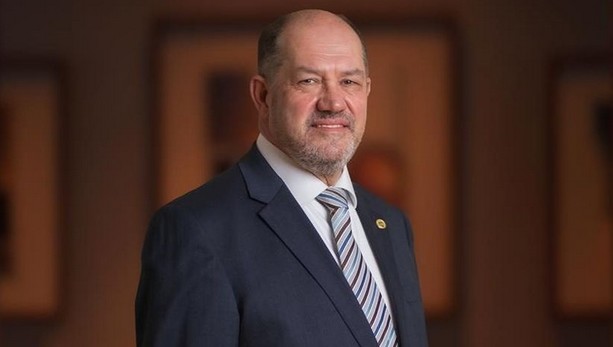
In an area affected since 1997 by arson attacks and armed assaults, which have left more than 60 dead and billions of pesos in damages to both infrastructure and public and private property, former prosecutor of La Araucanía Francisco Ljubetic (67) will assume the role of regional presidential delegate in the area.
For having pursued violent organizations that carried out attacks, he emphasizes that these are "organized groups, which have planning, have resources, and possess weaponry." And regarding any dialogue process, he establishes the renunciation of violence as a condition.
In the final part of his work as a prosecutor, he was responsible for initiating the investigation into the homicide of the Luchsinger Mackay couple, perpetrated in the early hours of January 4, 2013, in the commune of Vilcún. Previously, in the first years of his tenure, he had to investigate the responsibility of the leader of the Arauco Malleco Coordinator (CAM), Héctor Llaitul, in the failed armed ambush against prosecutor Mario Elgueta and the police officers accompanying him, which occurred on October 16, 2008. For this case and other crimes, Llaitul received a 15-year prison sentence. However, in 2015, he obtained the benefit of conditional release.
When Ljubetic's name had already emerged as the regional authority, various internet portals linked to radicalized Mapuche activism disseminated statements from Llaitul on the matter.
"The appointment of Ljubetic clarifies the line that the new government will take regarding the containment of our political and cultural stances of struggle, and of the historical conflict that has persisted to the present day," said the CAM spokesperson, who since 2024 has been serving a new sentence; this time 23 years in prison, for crimes under the State Security Law and other offenses contemplated in the Penal Code. Likewise, among his expressions, Llaitul called for "the struggle" against the State. "We propose that communities must be organized and prepared to defend everything conquered in territorial and political matters," he emphasized.
—What is your opinion on the threatening statements by Llaitul prior to your appointment as presidential delegate in La Araucanía?
—The truth is that we will refrain from commenting on those statements. What matters to us is precisely to work from day one on everything necessary and on the actions deemed appropriate to achieve security in the region. That is our guiding principle and the actions to be implemented will have that ultimate purpose.
—At this moment, before assuming office, are you in favor of continuing to renew the state of exception in La Araucanía?
—That is a decision of the President of the Republic and his proposal must be approved by Congress. Among a set of measures that have been adopted is this one, but obviously the corresponding evaluations always have to be made. Its maintenance will go hand in hand with the analysis conducted. During the elapsed time, there have been advances in the control of violence. Therefore, it is one of the tools and means that must be evaluated by the President.
—Considering that this exceptional measure has been in effect since May 2022, is security still the main problem in the region?
—Indeed, this issue persists. There have been cycles and one might tend to think that violent incidents have at least decreased. However, as we well know, and as history has shown, nothing is permanent in this matter, and a resurgence is also one of the possibilities considered for the future.
—What is the strategy to confront this potential reactivation of attacks and other forceful actions?
—At the behest of (President-elect) José Antonio Kast's program, we will intensify actions precisely to achieve control of these violent incidents. Our objective is their reduction, so as to be able to give citizens this long-awaited desire to live in peace and tranquility. Only in this way can the region improve its indicators from an economic point of view.
—In what way can the state of exception be intensified?
—One of the initiatives that must always be in view is effective coordination with the other institutions and agencies of the State. The contributions of all, as well as experience, are the best ingredients to be able to adopt the most appropriate decisions.
In that direction, Ljubetic emphasized that as the Executive's representative in the area "and once I have assumed the position, I hope to maintain and intensify contacts, with a view to that objective and also to others that will have to be put on the table, on a more global level, to achieve control of the episodes of violence."
—The state of exception is in effect in all 32 communes of La Araucanía. There are voices that have suggested that the military presence should be focused on localities with the highest number of violent incidents and thus concentrate human resources and means there. Should that alternative be evaluated?
—Any initiative is important, but the relevant thing is to have a survey of reality. We know that this violence problem affects the southern macro-zone, from Biobío to Los Lagos, inclusive. And although one might say that the problem of violence is more pronounced in some sectors, that does not exclude the possibility that it could, indeed, arise in other places in the territory. This prevents us from having a narrower vision that is confined to certain geographical spaces.
For the same reason, Ljubetic advocated for "additional coordination work among the four regions that present incidents of violence," since "it is evident that the experience in each of them will contribute, when proposing and, subsequently, executing concrete actions in the direction we all seek to achieve control of the territory and security."
—Leaders of the Mapuche Movement for Peace, such as Richard Caifal and Hugo Alcaman, upon learning of your designation, stated that "peace in La Araucanía will be achieved when, at the same time, the existing laws of the Rule of Law are applied and the demands of the Mapuche people are answered." Essentially, they ask for security and dialogue. What would you respond to them?
—This is a reality of the region. The last Census shows that more than a quarter of the population of La Araucanía is or declares itself of Mapuche origin. Of course, that is something that must always be present for decision-making. Personally, I highly value the observations. Measures cannot be taken that are not preceded by adequate dialogue.
The next delegate argued that "this does not mean that the government has to limit itself in how, when, and in what form it makes decisions." And he emphasized that "clearly, dialogue and conversation must always be taken into account to learn about other visions and proposals that enrich the measures finally adopted."
—Among the instructions and emphases with which the President-elect has mandated you, are there any that have surprised you or were outside your frame of reference?
—No, there have been no surprises, because the information emanating from the President-elect has been quite fluid. Furthermore, his government program outlines which are the essential matters, topics, and areas that must be addressed. In La Araucanía, one of them is security, just as in the northern zone it is the migratory problem and the situations of sustained violence through organized crime.
Given the above, Ljubetic stressed that "there is clarity regarding what must be addressed and how it should be done, which is something that will be defined in the coming weeks, through the guidelines and criteria of the Presidency on the matter."
—You stated in this same conversation that to the extent that security is achieved, the region's economic indicators, marked by the disincentive to investments, can be improved...
—Citizens should be at ease, because there is clarity on the issues intended to be addressed. And that does not mean that in La Araucanía others cannot be confronted, particularly the situation of disadvantage in its development and growth. It is the poorest region in the country and we have several communes that are within the statistics that place them as vulnerable in this aspect. For the same reason, it is a highly complex issue, but one that corresponds to a global concern. To the extent that the different facets of the situation La Araucanía is experiencing are resolved, it is likely that positive effects will begin to be seen, both by those who live in the region and by those who invest or intend to carry out projects in the area.
Source: El Mercurio



Comments (0)
No comments yet. Be the first to comment!
Leave a comment