

In the early 1980s, Gonzalo Mardones worked on a family-owned livestock and forestry farm in the Panguipulli area of southern Chile. Trained as a veterinarian, he never imagined that the native forest surrounding the pastures—composed of coigüe, raulí, and tepa trees—would become the core of an industrial project that now supplies railways, road networks, ports, and international markets. At that time, the forest was seen solely as a preservation area, with no defined productive role.
The milk price crisis, caused by the import of subsidized products from Europe, changed the scenario. "For every liter of milk we produced, we lost money. We didn't eat the cows, but we sold them," recalls Mardones. That breaking point forced a reevaluation of the land's use and a new perspective on the forest.
Turning Point
With technical support from the Austral University of Chile, the family initiated forest management plans and started a sawmill. The first major client was the State Railways, which demanded coigüe wood for sleepers. The business grew rapidly, to the point of surpassing the farm's own capacity. They began buying wood from neighbors, then from third parties, and finally decided to sell the farm to focus entirely on industrial activity.
During the 1990s, the company multiplied its sales volume and began identifying a critical limitation: untreated wood had a very short lifespan. Untreated sleepers deteriorated in less than five years, leading to high replacement costs and safety issues. In contrast, Mardones observed that in the United States, which has the world's most extensive railway network, 95% of sleepers are made of preserved wood, with an average lifespan exceeding 30 years.
That diagnosis was decisive. In 1998, after studying international experiences, the company invested in creating an industrial preservation plant in Yumbel, Biobío Region, incorporating U.S. technology and know-how. Thus, Mardones – BPB Creosote Treaters S.A. was born as a pioneer in native wood impregnation in Chile.
Technological Leap
Since the plant's startup, the company has supplied sleepers for the Valparaíso Metro and the railway sections La Calera – Alameda and Chillán – Puerto Montt (over 1,000 km of tracks). Today, nearly two million preserved wood sleepers support that network. The impact has been direct and measurable: State Railways went from replacing between 200,000 and 250,000 sleepers annually to only 45,000 or 50,000, reducing operational costs and improving system safety.
The key lies in the industrial process. The Yumbel plant is the only one in Chile that impregnates native wood using controlled temperature and pressure, with large autoclaves. The preservative, a mixture of creosote and heavy oil, protects the wood against fungi, insects, and moisture, extending its lifespan to 30 or even 40 years, depending on usage conditions.
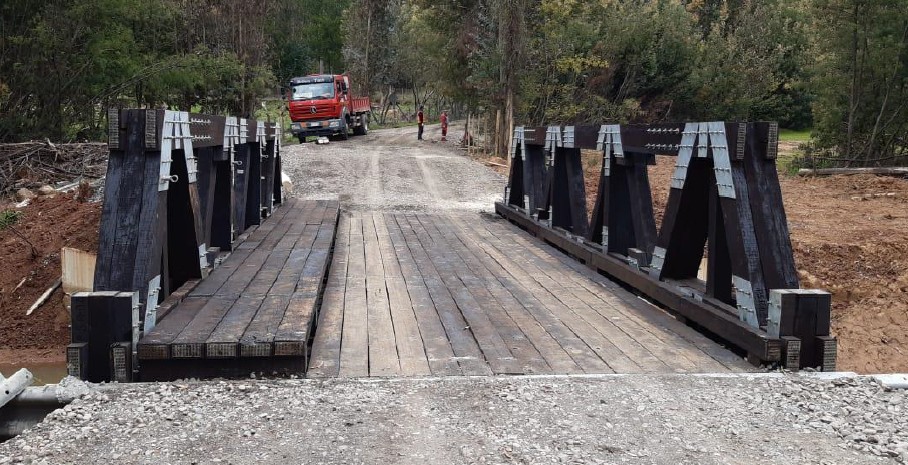
Diversification was another strategic step. Mardones Ingeniería expanded its offerings to include rural bridges, walkways, docks, and port defenses. Chile has about 3,000 wooden bridges, many with century-old designs and built with untreated wood, whose lifespan does not exceed five to seven years. Replacing them with concrete structures would have an estimated cost of over US$1.7 billion, a figure difficult for the country to address in the medium term.
Strategic Infrastructure
Faced with that scenario, the company developed preserved wood solutions with modern structural designs, capable of supporting full loads of up to 45 tons. To date, it has installed 11 engineered bridges in the Biobío and La Araucanía regions, with projected durability exceeding 50 years.
In the port sector, its products are used as defenses in artisanal fishing docks, where the wood acts as a flexible element protecting both vessels and concrete structures.
The model's reach has crossed borders. Mardones Ingeniería has exported sleepers to Colombia, Peru, Bolivia, Costa Rica, South Africa, New Zealand, South Korea, Saudi Arabia, and Egypt, demonstrating that Chilean native forest, when well-managed and transformed with technology, can compete in demanding international markets.
For Gonzalo Mardones, the challenge is also cultural. "Closing off the forest and not managing it is an environmental and social mistake," he states. In his view, a young, well-managed forest captures more carbon, generates employment in rural areas, and contributes to decentralization. Sustainable management of native forest, he argues, is not a threat but a strategic opportunity for Chile: durable infrastructure, a lower carbon footprint, and territorial development with identity and local added value.
From Acoforag, we value the trajectory of Mardones Ingeniería en Madera as a concrete example of how responsible management of native forest, combined with innovation and long-term vision, can transform into strategic infrastructure for the country.
The feature inAcoforag Magazine





Comments (0)
No comments yet. Be the first to comment!
Leave a comment