

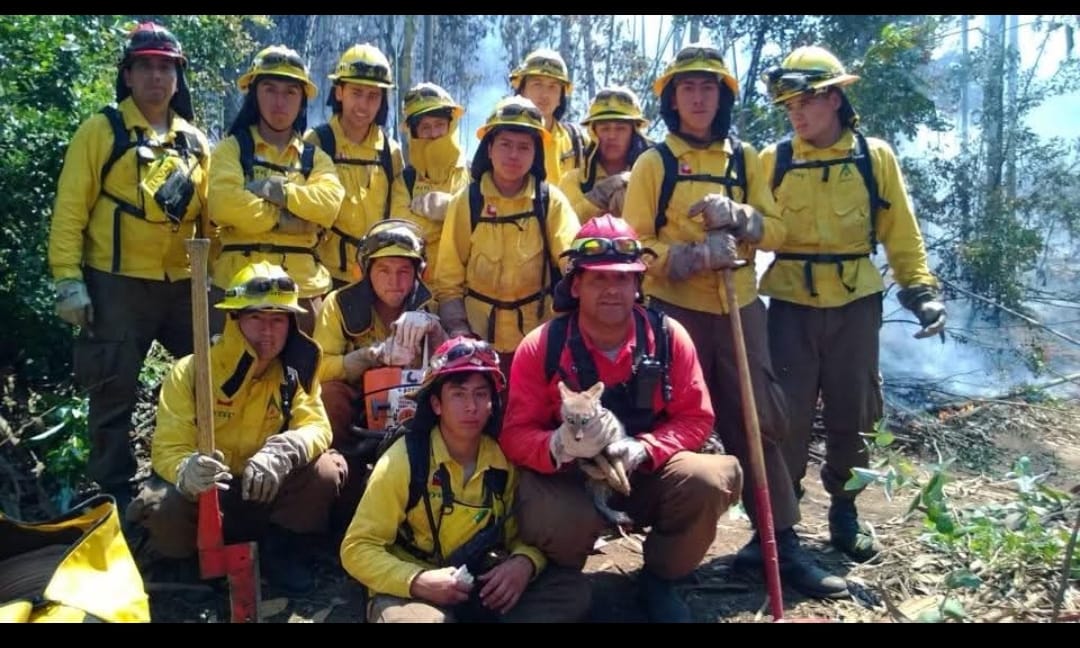
Narciso Guarda Aguilar was born on December 2, 1970, in Lago Ranco, Los Ríos Region. His childhood unfolded in various rural areas—Puerto Lápiz, Itropulli, and Huequecura—following a farming family that moved wherever there was work. Raised in the countryside, he learned from a young age to coexist with nature, to work the land, and to accept physical effort as part of daily life.
His formal education ended at sixth grade, a common reality for many rural families at the time. However, he later completed his secondary education by taking independent exams while already working. He was never drawn to office life: his place was always outdoors, in the field, where—as he himself says—he truly feels alive.
Early Vocation
At 16, he had his first paid job as a forestry brigade member at Forestal Pedro de Valdivia, thanks to a handwritten notarized permit from his father. That income marked the beginning of a career that would define his life. The first day was far from easy: a serious vehicle accident left Narciso unconscious for nearly 20 hours after the truck transporting the brigade overturned.
Far from driving him away from the trade, the experience reinforced his commitment. Camaraderie, discipline, and teamwork became pillars of his identity. In those years, the brigades operated with strict, almost military training, a discipline that Narciso still strives to preserve in his way of working and leading.
Learning by Doing
After working for private forestry companies, he joined Conaf in the late 1980s, an institution he remains linked to until today. He started as a temporary brigade member and went on to perform practically every role within a brigade: chainsaw operator, pump operator, tool manager, first aid, crew chief, and finally brigade chief.
His rise was not marked by academic degrees, but by experience accumulated in the field. "It's experience that counts," he recalls being told when he was offered to lead a brigade of 23 people in La Cumbre, San Juan de la Costa. In 2006, he took his first formal course as a brigade chief, and that same year Conaf decided to grant permanent contracts to temporary brigade chiefs, giving him job stability for the first time.
Extreme Fires
With almost 40 years of service, Narciso has been a direct witness to how forest fires have changed. "The intensity has doubled in the last 20 years," he states. Climate change, high temperatures, stronger winds, and extreme drought have turned vegetation into highly dangerous fuel. Today, some fires even generate their own weather systems, becoming almost uncontrollable.
Among the fires that marked him the most are Las Torres del Paine and, especially, the 2017 megafire in Santa Olga. He remembers the initial arrival at the town when there was still hope, and the return the next day after the evacuation, finding only desolation. "Seeing people who have lost everything marks you forever," he notes, emphasizing that resources should not be spared when lives are at risk.
Beyond Borders
His experience also took him abroad. In 2011, he participated in training firefighters in Ecuador, and in 2022 and 2024, he was part of Chilean delegations that fought fires in Canada, in the province of Alberta. There he worked on active fires for over 80 days, facing underground fire and long shifts.
Contact with brigade members from countries like Australia, New Zealand, the United States, and Mexico reaffirmed his conviction that camaraderie is universal. "Chilean brigade members are very well regarded abroad," he comments with pride.
Personal Costs
The life of a brigade member also carries a high emotional cost. Narciso acknowledges that during fires, he often operates on "autopilot," and the toll appears afterward. Added to this is the deepest pain of his life: the death of his eldest daughter, Mariana, a Carabineros officer, who passed away in 2022 from an aggressive cancer.
Today, from his role as a forest fire control assistant at Conaf, he continues to contribute from experience and guide new generations. For him, being a brigade member is not just a job: it is a way of life, born in the countryside, tempered by fire, and sustained by an unwavering commitment to protecting forests and people.
From Acoforag, we highlight and value the career of Narciso Guarda Aguilar, an example of commitment, experience, and vocation in the service of protecting forests and people. His story reflects the silent effort of hundreds of brigade members.
Feature in theAcoforag Magazine




Comments (0)
No comments yet. Be the first to comment!
Leave a comment