

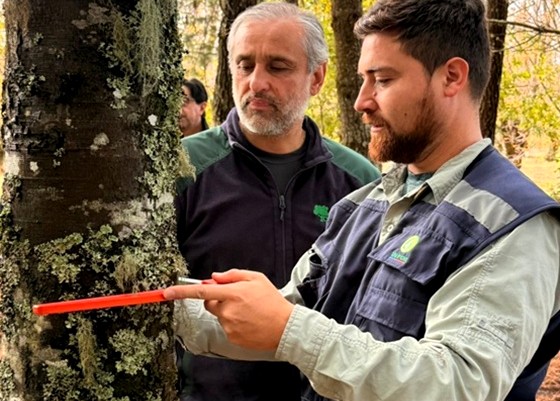
At the Huililemu property, located in the Mariquina commune, Los Ríos Region, professionals and researchers from the Forestry Institute (Infor) and the National Forestry Corporation (Conaf) conducted a technical visit to measure and evaluate the status of the oak progeny and provenance trial, a long-term research initiative aimed at identifying which individuals of the oak species show the best development, growth, and adaptation based on their genetic origin and place of provenance.
This type of trial allows for knowledge of both the mother of the collected seed and the location where that tree grew, key information for selecting the best genetic material and thereby strengthening plantations, ecological restoration processes, and native forest conservation strategies.
During a recent technical visit, led by the regional director of Conaf Los Ríos, Óscar Droguett, and the manager of the Infor Los Ríos headquarters, Gerardo Vergara, accompanied by technical teams from both institutions, field measurements were taken to assess the status and evolution of this trial, established in the year 2000 with support from the Austral University of Chile and forestry companies, with funding from Fondef of Conicyt.
The regional director of Conaf Los Ríos, Óscar Droguett, highlighted the continuity and relevance of maintaining this work, emphasizing that “this trial was established in the year 2000, so we have already been working on these oak plantations for over two decades. For the Corporation, it is essential to continue developing this work together with Infor, as this trial directly contributes to the production of seeds of this species, allowing us to strengthen the work of the Huililemu nursery and the production of plants for various restoration and native forest management actions.”
The initiative allows for detailed knowledge of each tree’s origin — both the mother of the seed and its place of provenance — essential information for selecting quality genetic material and guiding decisions in plantations, ecological restoration, and conservation.
For his part, the Infor researcher and manager of the Los Ríos headquarters, Gerardo Vergara, highlighted the strategic value, stating that “having this trial here, with different oak provenances from across the country, constitutes a true biological reserve. This will allow us to identify which provenances develop best and can be used in productive and restoration actions for this species so valuable to the south of the country.”
The trial currently considers nearly 100 oak families, evaluating variables such as survival, height and diameter growth, volume, straightness, and stem characteristics. This information is key to generating evidence-based technical recommendations.
The researcher and forest genetics specialist at Infor, Braulio Gutiérrez, explained that the objective is to conserve a large part of the oak’s genetic variability and bring together different provenances in one place to evaluate their behavior. “This trial allows us to guide users on which genetic materials are most suitable according to different conditions and productive or restoration objectives. Furthermore, maintaining this trial over the long term is fundamental because, as the trees grow, very valuable information about their development is generated, which allows us to project planting alternatives with native forest species and improve future management decisions,” he indicated.
It is worth noting that the results of this research will not only strengthen the development of oak as a key species of the native forest but will also open the door to new similar initiatives with other species, contributing to more sustainable, productive, and resilient management of forest ecosystems in Chile.






Comments (0)
No comments yet. Be the first to comment!
Leave a comment