

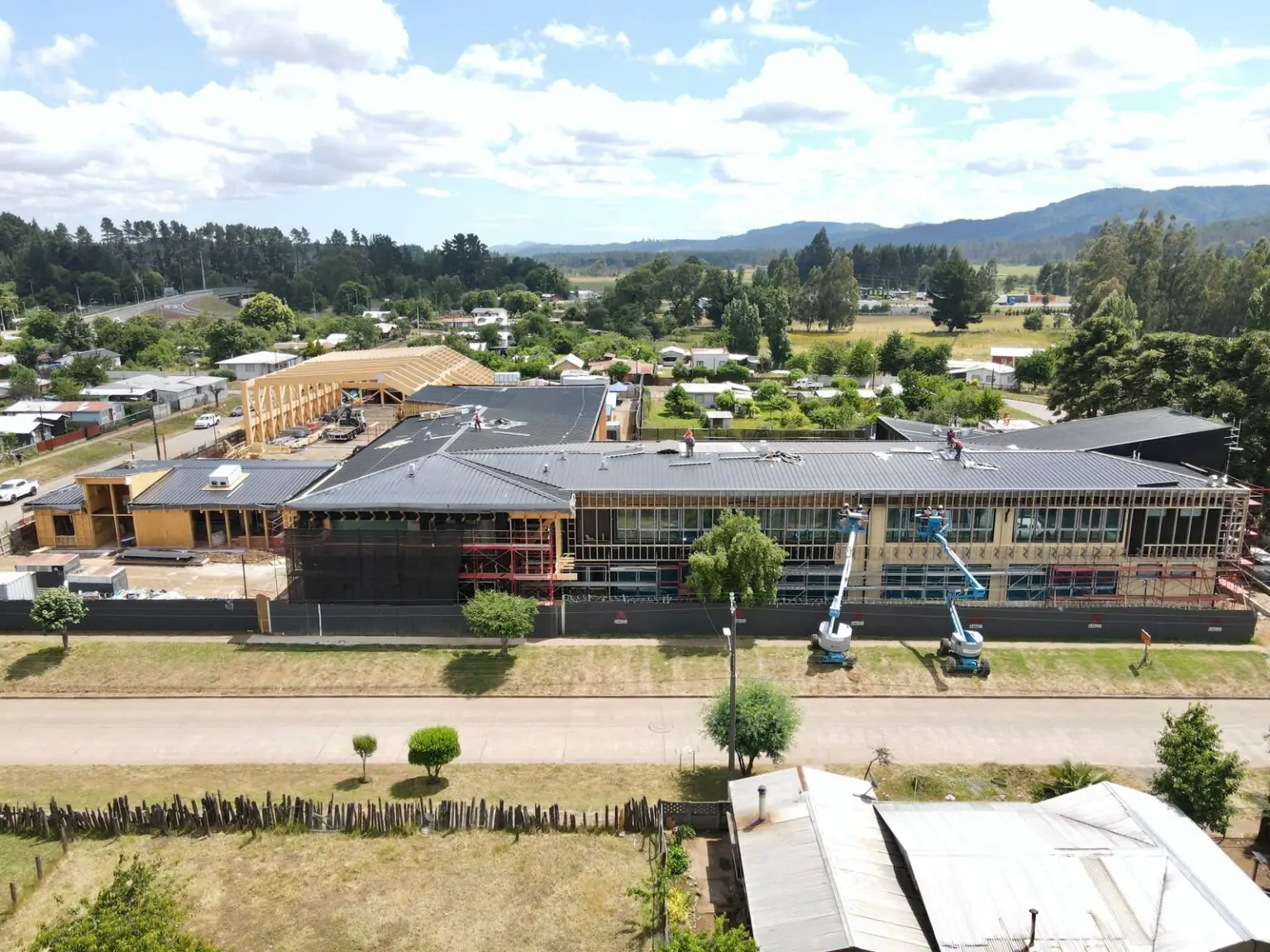
In 2027, children in the Pailahueque sector, in the commune of Ercilla, Malleco province, will begin their school day in a building that raises the standard for rural public education infrastructure. This involves 4,068 m² distributed across classrooms, dedicated spaces for early childhood education, a library, administrative areas, a dining hall, a kitchen, and a gymnasium. The entire complex has been built using wood, placing this project within a development trend that is beginning to take shape in Chilean public construction.
The project's progress currently stands at 92%, making its large scale and the way it was conceived clearly visible. The construction does not follow the traditional logic of the industry. Here, each element was designed to be manufactured off-site and then precisely assembled on the ground. This process has allowed for shorter timelines and reduced subsequent interventions, in a context marked by demanding climatic conditions, where rain and humidity necessitate technical decisions from the outset.
The replacement of the Salvador Allende School in Pailahueque arises as a response to infrastructure that no longer met the necessary conditions for the educational process. The new facility, funded by the Regional Government of La Araucanía, involves an investment exceeding 12 billion Chilean pesos and aims to improve the conditions in which students and teaching staff carry out their work, in addition to doubling the current enrollment of 150 students.
Choosing CLT as the Protagonist
A central aspect of the project has been the use of industrialized wood solutions provided by Hilam Arauco, responsible for supplying CLT (Cross Laminated Timber) panels and glued laminated timber elements. These products form the basis of the building's construction system and have enabled the realization of a large-scale project under high standards of precision, technical performance, and sustainability. The use of technology developed by Hilam not only provides structural capacity and assembly speed but also positions the project as a national reference in public mass timber construction, demonstrating the potential of wood industrialization for high-standard educational infrastructure in Chile.
Executed by Constructora Artigas, the country's most significant public mass timber project – according to the construction company's executive director, Cristóbal Artigas – "is not just an engineering milestone; it is a declaration of principles and pre-established values (…) We understand that educational infrastructure is the engine of social progress. By delivering classrooms with superior thermal and acoustic comfort, we are providing dignity with a standard never seen before," he states.
From the construction company, it is stated that the use of CLT and laminated timber was not an isolated choice. As Artigas explains, the decision was made from the bidding stage as part of "a comprehensive precision industrialization strategy, adopted from the project design bidding phase as a structural development concept. Modern methods of construction (MMC) were chosen to speed up the structure's erection, this time using a non-traditional mechanized system," which ensures that every joint and every support arrives on site with a degree of accuracy that reduces subsequent adjustments.
This level of precision also translates into the building's performance. The envelope was designed to respond to the climatic conditions of La Araucanía, where relative humidity is often high for much of the year. Before closing the construction packages, the wood underwent stabilization processes to reach its hygroscopic equilibrium, avoiding problems associated with condensation or deterioration over time. During assembly, every cut and every joint was protected to prevent water absorption, thus safeguarding the stability of the structural system.
Thermal performance appears as one of the aspects that will have the greatest impact on the future operation of the facility. Wood, due to its behavior, allows for more stable interior conditions, which reduces energy demand. Added to this is an envelope configuration that incorporates high-density insulation and solutions that limit air infiltration. Together, these decisions aim to reduce energy consumption without resorting to complex systems, which is especially relevant in areas where operating costs directly impact the public budget.
From Timber Ingeniería y Construcción en Madera, the company responsible for manufacturing the structural elements, it is explained that the use of CLT was defined based on its performance within the project. Carlos Berzosa, its owner and general manager, says the key was to use each material where it was most efficient, combining mass timber with light-frame systems in interior partitions and cellulose panels in roofs, among others. "To achieve projects that are feasible in terms of costs," he says, "CLT must be used where it is productive and efficient. (…) What needs to be done is to optimize the materials."
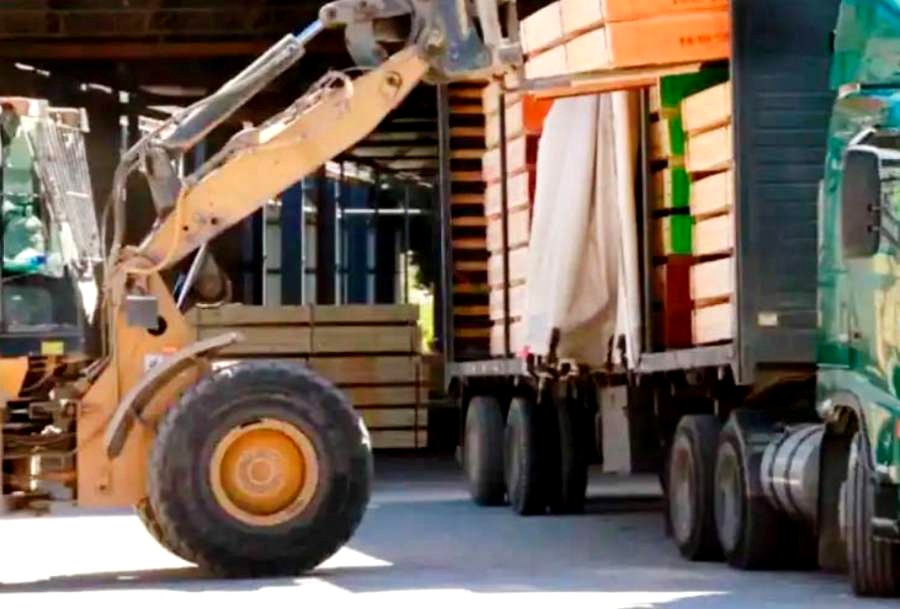
Logistics was an important aspect of the project's assembly. Each component was sent to the site according to progress, avoiding unnecessary stockpiling and allowing the assembly to be carried out continuously. Thus, the process was organized into modules. Alexander Ziegler, from the technical team at Timber Ingeniería y Construcción en Madera, describes that the first volume corresponded to the dining hall, which allowed for adjusting logistics and training the teams in the assembly system. From there, the work progressed to two-story classroom buildings, administrative areas, and spaces for early childhood education. This way of working allowed different stages to develop simultaneously. While one module was finishing, another was starting its structure, generating a rhythm that reduced time without compromising the quality of the process.
Sustainable Building Certification
In the environmental sphere, the project aligns with the standards of the Sustainable Building Certification (CES). Wood plays a dual role here. On one hand, it acts as a structural material. On the other, it contributes to emission reduction by storing carbon during its useful life. Added to this is a reduction in waste generation. The project recorded a waste volume of only 0.06 m³/m². This value represents a reduction of more than 50% compared to a traditional project, whose standards range between 0.21 and 0.27 m³/m², according to the 2025 Construction Labor Productivity Indicator (IPLC).
In this regard, according to Cristóbal Artigas, "CLT was chosen as the 'backbone' to exceed the standards of the CES certification. It arises from the need to meet strict energy efficiency and environmental quality requirements from the project's conception."
The incorporation of panels integrated with vapor control membranes and high-density rock wool allows for configuring an envelope with very limited levels of air infiltration. Added to this is the design of construction packages that articulate the mass of the CLT with high-density insulation solutions, which helps reduce the presence of thermal bridges and improve the overall performance.
Source:Madera 21




Comments (0)
No comments yet. Be the first to comment!
Leave a comment