

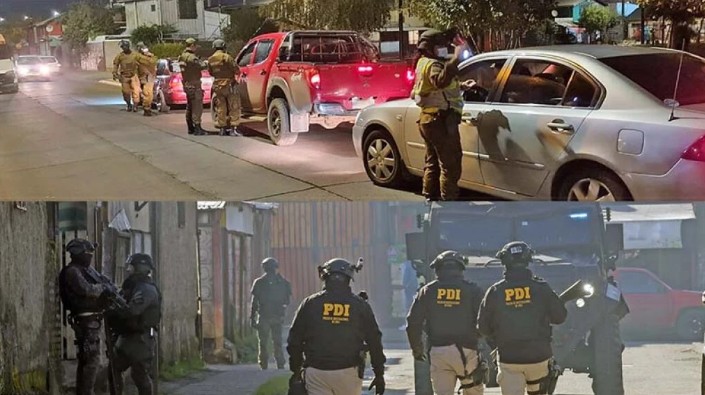
Organized crime has doubled its presence in the Chilean penal system over the last decade, although less than a third of cases end in convictions. This was revealed by a report prepared by the Center for Studies in Security and Organized Crime (Cescro) of the Universidad San Sebastián, which analyzed the evolution of criminal prosecution between 2014 and 2024, identifying significant challenges for the Public Prosecutor's Office and the police, especially in regions like Biobío.
The research concluded that cases linked to organized crime increased by 167.7% in the country, rising from 39,795 terminations in 2014 to 106,544 in 2024. Furthermore, according to the report, these crimes doubled their weight within the penal system, going from representing 2.4% of total cases to 5.2%.
"Cases related to organized crime, although few compared to the total number of crimes entering the Public Prosecutor's Office—no more than 5%—have indeed seen a significant increase over the last ten years. We went from around 2% to 5% of crimes," stated Camila Astraín, researcher at the Center for Studies in Security and Organized Crime of the Universidad San Sebastián.
One of the main findings of the study points to the difficulties in achieving effective convictions. According to the report, currently only 27.8% of cases associated with organized crime end in convictions.
Camila Astraín, researcher at the Center for Studies in Security and Organized Crime of the Universidad San Sebastián, explained that the analysis allowed for observing a sustained growth of this phenomenon in the country.
"All the remaining cases were finalized by some other type of judicial or non-judicial termination; that is, where there was no involvement of a court," Astraín detailed.
The report also highlights a sharp increase in provisional filings, a mechanism used when there is insufficient background information to continue an investigation.
According to the research, this type of closure increased by 264.8% in the last decade and today represents 33.5% of terminations nationwide.
"Provisional filings concentrated the largest number of closure types presented, which we believe reflects the challenges, not only in terms of the volume the system as a whole faces, but also how to conduct criminal prosecution for these types of crimes, which are more complex," the researcher stated.
REALITY IN BIOBÍO
In the case of Biobío, the study positions the territory as the third region in the country with the highest number of cases associated with organized crime, concentrating 6.6% of the national total over the last ten years.
During that period, concluded cases increased by 175.6%, recording a total of 46,536 judicial and non-judicial outcomes related to crimes linked to drugs, weapons, and violence, according to the report.
"The main cases were associated with drugs, weapons, and violence. They have also seen an increase when comparing 2014 with 2024 of 170%," Astraín indicated.
The most frequent dimension in the region corresponds to crimes associated with drugs, which according to the study represent 64.8% of cases.
Within this category, micro-trafficking, illicit drug trafficking, and other crimes covered by Law 20,000 predominate.
In second place are crimes related to weapons, equivalent to 24% of cases, according to the report, where illegal possession, carrying of weapons, and unjustified shootings in public spaces stand out.
Violence associated with organized crime represents 6.3% of cases, according to the research, and includes high-impact crimes such as homicides, kidnappings, and extortion.
The report also warns that the region presents more unfavorable indicators than the national average regarding convictions and provisional filings.
"When we analyze the types of terminations applied, here we see that the region was slightly worse than what appears at the national level, because instead of 27.8% of convictions, in the Biobío region it is 25.8%, and provisional filings at the national level are 33.5%, while in the Biobío region they reach 39.5%," the researcher specified.
SYSTEM CHALLENGES
The study also addresses the future challenges facing the criminal prosecution system, especially in light of the increase in complex crimes and new criminal modalities.
Among these, the need to improve institutional coordination, strengthen investigative specialization, and increase technical capacity to deal with digital crimes and organized criminal structures stand out.
"There are several challenges. On one hand, there is how to more effectively manage the increase in the volume of cases, but also others that have to do with specialization in the type of investigation required," Astraín explained.
The researcher added that many of these crimes operate under complex and digital modalities, which makes obtaining evidence difficult.
"Cybercrime is one of the main challenges where the system is also showing inefficiencies in its prosecution. So, the specialization of the different agents in charge, police, prosecutors, and the dynamics to generate probative evidence in these cases, we believe are the main challenges facing the system as a whole," she concluded.
Source:La Tribuna






Comments (0)
No comments yet. Be the first to comment!
Leave a comment