

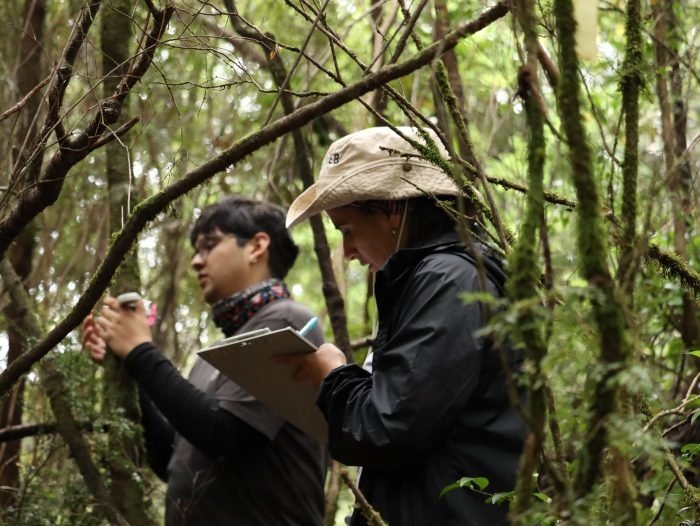
In the heart of the Isla Grande de Chiloé, where moss carpets the ground and biodiversity intertwines in ancient ecosystems, a scientific team is advancing in understanding the evolution of forests. For ten years, researchers closely followed the life, growth, and death of more than 2,500 trees in an area known as the "tepual."
This work, developed at the Senda Darwin Biological Station and led by Dr. Álvaro Gutiérrez, researcher at the Institute of Ecology and Biodiversity (IEB) and academic at the University of Chile, was published in the scientific journal Annals of Forest Science. The study offers a unique window into the "dynamic maturity" of temperate rainforests, key ecosystems for carbon capture and the protection of endemic species.
"Each tag is like giving a name to a tree. Ten years later we can return, find it, and understand a little more of its story: whether it grew, got sick, or died," explained Gutiérrez.
A forest turned into a natural laboratory
The monitoring began in 2012 in an ancient tepual-type forest located in Chiloé, where the team delimited one hectare and divided the terrain into 400 quadrants to map each tree individually.
Each specimen with a diameter greater than five centimeters was identified, measured, and marked with a metal plate. In total, they recorded 15 different species within one of the best-preserved remnants of the temperate rainforest of southern Chile.
"This idea was born with Juan Armesto (prominent Chilean ecologist and one of the pioneers in the study of temperate forests in southern South America), who promoted having a long-term plot of this size in Chile, something that did not exist at that time," recalled Gutiérrez.
The work allowed reconstructing what happened to each tree over the decade: which ones grew, which ones died, and how the entire forest structure evolved.
Forests that change slowly
The results showed that these ecosystems undergo very slow transformations; the average tree growth was only two millimeters per year, while mortality exceeded the birth of new specimens.
During the studied period, about 2.7% of the trees died annually, compared to 1.2% of new individuals. Even so, the forest continued to accumulate biomass thanks to the growth of the largest trees.
"Trees live on a completely different scale from ours. Sometimes we feel that ten years is a long time, but for a forest it is almost nothing. We lack a lifetime to fully understand how these systems change," noted the researcher.
Scientists describe this phenomenon as "dynamic maturity": ecosystems where trees are constantly born and die, but whose general structure remains stable over long periods.
The first signs of climate change
The study also incorporated meteorological data obtained at Senda Darwin, where drier summers and higher maximum temperatures were detected over recent decades.
According to the researchers, these changes could alter fundamental forest processes, such as regeneration or tree mortality, although their effects may take decades to become visible.
"Forests have a lot of inertia. Even if there are changes in the climate, they do not react immediately. Sometimes the effects are only seen after 20 or 30 years," explained Gutiérrez.
The team will continue monitoring the plot in the coming years to understand how these ecosystems will respond to the advance of climate change and long-term environmental transformations.
Source:Cooperativa


Comments (0)
No comments yet. Be the first to comment!
Leave a comment