

Within the framework of the Technological Absorption Program for Innovation (PATI) in Computer Vision promoted by Corfo, the Center for Industry 4.0 (C4i) of the University of Concepción took a key step in the development of technology applied to the forestry industry.
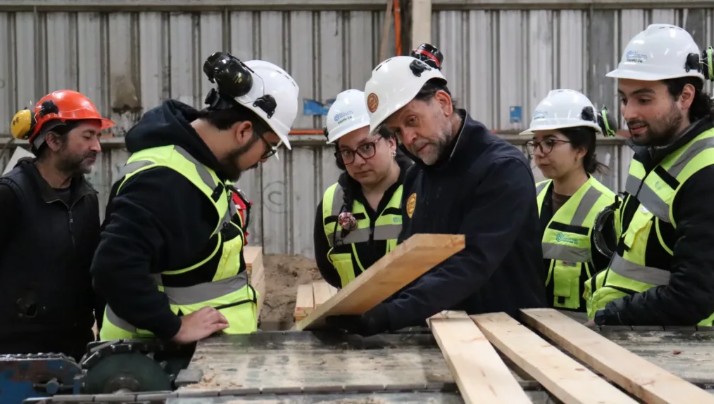
At the facilities of the company Patagonia Painting Company, located in the commune of Mulchén, Biobío Region, a training session on radiata pine wood characterization was held, a fundamental activity for the program's progress and the subsequent training of the artificial intelligence algorithms that the team is developing.
The session was organized by the team and executed by the wood quality specialist company Lumber Quality, bringing together those in charge of the different teams at the sawmill along with the technical team of the Computer Vision PATI. The main objective was to provide engineers with the conceptual and practical tools necessary to correctly identify the characteristics and defects present in the wood, knowledge that will serve as the basis for labeling the data with which the automated detection system will be trained.
A two-stage training
The training was structured into two complementary blocks. The first part took place in the sawmill's meeting room, where a theoretical session was held by the General Manager and Founder of Lumber Quality, a consultancy based in Concepción specialized in Quality Management and Control for the wood sector, Pedro Hidalgo.
During this training session, the characteristics of radiata pine, its individualization, description, and the selection criteria that allow differentiating one defect from another were thoroughly addressed.
The second stage took the group to the wood processing plant, where participants were able to review complete boards on-site and identify each of the characteristics worked on in the room live. This analysis, combining the theoretical basis with practical observation, will allow the team to manually label the characteristics present on the boards previously captured by the camera arch installed on a sawmill conveyor belt, thus laying the groundwork for training the artificial intelligence algorithm.
Voices from the session
C4i Project Engineer, Loreto Rojas, highlighted the team's commitment to industry standards: "We were learning about identifying defects in wood, so that all the technological developments we make are of the highest quality, respecting the standards that different companies have regarding their degree of wood acceptance."
Pedro Hidalgo, from Lumber Quality, emphasized the relevance of the work being developed by C4i and the challenge of applying computer vision to a material of variable nature: "Wood is a living element, sometimes it is cut and will generate a lot of difference between one board and another, which is a tremendous challenge they are undertaking. They are going to create a tremendous tool for the industry that urgently needs it."
For his part, Claudio Weiss, manager of Patagonia Painting Company, valued the instance and highlighted the project's horizon: "The idea is to develop this to obtain a visual classification system through a scanner with the technology being developed by the C4i team."
The next step: training artificial intelligence
This training marks the beginning of a decisive stage for the Computer Vision PATI. With the knowledge acquired, the engineering team is in a position to advance towards training the artificial intelligence model, a process in which the data collected in the field will be labeled and used so that the system learns to autonomously recognize and classify the characteristics and defects present in the wood.
The ultimate goal is to have a tool capable of operating in real-time within sawmill production lines, optimizing classification processes and reducing the time, errors, and fatigue that the manual process of identifying wood characteristics can cause, thereby raising the quality standards of the region's forestry industry.





Comments (0)
No comments yet. Be the first to comment!
Leave a comment