

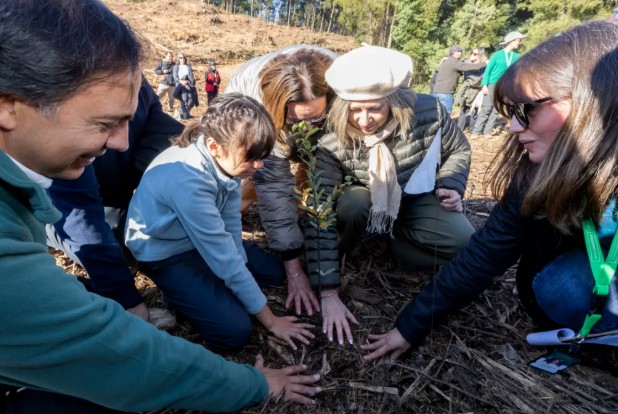
Three years after its launch, UdeC Nature Campus marked a new stage in its development with an institutional signal of high value: the new Rectorate of the University of Concepción reaffirmed on the ground the institution's commitment to biodiversity protection and human well-being. The ceremony was held in the project's restoration area, where a symbolic planting highlighted the challenge of recovering degraded native ecosystems and projecting this university territory as a legacy for future generations.
The activity brought together university authorities, members of the technical team, representatives of the UdeC community, and guests linked to conservation, sustainability, and territorial engagement work. On the ground, the ceremony sought to highlight not only the project's progress but also its institutional projection.
The milestone centered on a symbolic planting in the ecological restoration zone, conceived as a concrete sign of the university's commitment to landscape recovery.
Rector Jaqueline Sepúlveda Carreño stated that the commemoration of these three years is not just a symbolic ceremony, but rather "marks a new beginning. And why is this beginning so important? Because, precisely, it aligns with what is the new program or project of the rectorate, which seeks to advance from a concept of sustainability to something much more holistic."
A signal from the territory
During the event, the director of UdeC Nature Campus, Cristian Echeverría Leal, highlighted that the commemoration allows us to look at what has been achieved, but also to open a new stage of work for the project.
"Nature Campus is a long-term strategic decision of the University of Concepción. In these three years, we have built a scientific, technical, and institutional base to conserve, restore, and reconnect people with nature. Today we reaffirm a fundamental principle: biodiversity and human well-being are not separate dimensions, but part of the same responsibility," he stated.
The project was officially launched on May 26, 2023, and is structured around five lines of action: In-Situ Conservation, Ex-Situ Conservation, Ecological Restoration, Biocultural Environmental Education, and Integral Health. From this perspective, it seeks to integrate research, training, outreach, and territorial action within the same university space.
Echeverría emphasized that ecological restoration requires a sustained view over time, especially in territories that have been transformed for centuries by different human uses.
"Restoring nature is not just planting trees. It is activating an ecological, social, and institutional process that requires planning, monitoring, and permanent commitment. What we do today has symbolic value, but also expresses a deep conviction: the University puts its knowledge, its formative capacity, and its territory at the service of ecosystem regeneration," he added.
Restore, educate, and connect
After the welcome remarks, authorities and guests participated in the symbolic planting alongside community representatives. Then, attendees organized into groups guided by Nature Campus monitors to join the planting of native species in sectors defined by the technical team.
The activity highlighted one of the project's main challenges: advancing the restoration of native ecosystems degraded or absent from the local landscape for centuries, transforming university lands into a living laboratory for conservation, environmental education, and applied research.
"Nature Campus invites us to look at the landscape with a long-term perspective. It is not only about recovering vegetation cover, but about rebuilding relationships: between biodiversity and the city, between science and community, and between the University and the territory of which it is a part," Echeverría stated.
During the on-site tour, the technical team explained the stages of the restoration process, species selection, initial care, and the importance of subsequent monitoring. It was also highlighted that these actions are part of a planning aimed at recovering ecological functionality and strengthening native biodiversity.
Likewise, the rector stated, "our university specifically, and I imagine the vast majority of them, has a strong commitment to public vocation. So, when we generate public goods, like these, for example, as well as social mobility, we are precisely aiming to strengthen the public vocation of our university, because we not only care about training processes, generating research that has an impact on communities and territories, but we also have a commitment to one of the biggest problems affecting the world, which is the triple crisis, the climate crisis, the environmental crisis, and the biodiversity crisis. And this project aims precisely to act against this, against the great threat that the world faces today."
Human well-being and connection with nature
The deputy director of UdeC Nature Campus, Andrea Fernández Covarrubias, highlighted that one of the project's particularities is understanding conservation from an integrative perspective, where biodiversity, health, education, and quality of life are part of the same conversation.
"Nature Campus not only seeks to conserve and restore ecosystems, but also to generate experiences that allow rebuilding the link between people and nature through learning, care, and integral well-being. In an urban context like Concepción, having a space with these characteristics within the university represents a strategic opportunity to bring the community closer to ecosystems, promoting environmental education, health, and new ways of inhabiting the territory," she stated.
In that line, Fernández explained that the project has advanced in initiatives of biocultural environmental education, integral health, and outreach activities with different groups from the internal and external community.
"When we talk about human well-being, we are not only referring to contact with natural environments, but to understanding the interdependence between people's health and the health of ecosystems. Nature Campus seeks to make this relationship visible, promoting a culture of co-responsibility and care for the territory," she added.
A living university space
Three years after its implementation, UdeC Nature Campus is projected as a living university space, where conservation, ecological restoration, biocultural environmental education, integral health, interdisciplinary research, and community participation converge.
For Andrea Fernández, this anniversary also allows highlighting the formative and community role of the project. "Nature Campus represents an opportunity to rethink the role of the university in relation to the city and the territory. It is more than a conservation space; it is projected as a living laboratory where research, training, and outreach are directly integrated with ecosystems and communities. Here, the territory becomes an open classroom, a space for meeting and collective learning," she stated.
The commemoration closed with an invitation to continue projecting this work from a collaborative, scientific, and territorial perspective, consolidating Nature Campus as a strategic initiative of the University of Concepción and as a biocultural legacy for future generations.





Comments (0)
No comments yet. Be the first to comment!
Leave a comment