

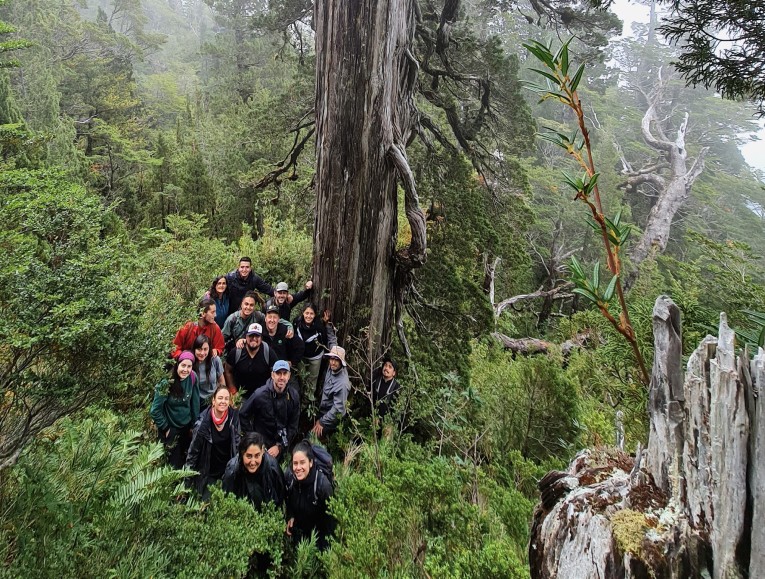
The Faculty of Forest Sciences and Nature Conservation (FCFCN) has launched its new Forest Restoration Laboratory, an initiative that seeks to strengthen applied research to address some of the country's main environmental challenges through the recovery of degraded ecosystems and the conservation of native forests.
Directed by Dr. Juan Ovalle, Associate Professor at the Faculty, the laboratory aims to generate excellent scientific knowledge, train new generations of specialists, and transfer concrete solutions to the public and private sectors. "Ecological restoration requires understanding how plants, soil, and microsites interact to design strategies that increase the success of interventions and allow for the recovery of more resilient ecosystems in the face of climate change," states Dr. Ovalle.
The laboratory conducts research throughout the entire restoration process, from the propagation of native species and the production of high-quality plants in nurseries, to plant nutrition, microsite conditioning, and comprehensive forest rehabilitation. One of its main pillars is the training of human capital. The team brings together undergraduate, master's, and doctoral students from the University of Chile and other institutions, who develop research in areas such as functional traits of seeds and silvicultural management as an adaptive restoration measure against recurrent droughts in central Chile. Added to this is the Diploma in Plant Propagation in Nurseries, a pioneering initiative aimed at strengthening technical capacities for the production of plants intended for restoration.
The laboratory also stands out for its extensive scientific collaboration network. At the national level, it maintains links with centers of excellence such as CAPES, IEB, CR2, and AMTC, while internationally it develops research and internships with institutions such as the Polytechnic University of Madrid and Virginia Tech, in addition to collaborating with prominent researchers in ecology, silviculture, and ecosystem restoration.
Knowledge transfer constitutes another strategic axis. The team works alongside public agencies such as CONAF, the Ministry of the Environment, INFOR, and INIA, supporting project development, the preparation of technical guidelines, and the training of professionals through postgraduate and extension courses (Courses in Huinay and Torres del Paine). Likewise, it collaborates with companies such as CODELCO in the design of adaptive restoration and environmental compensation protocols, in addition to maintaining alliances with specialized nurseries to improve the quality of forest plants produced in Chile.
Although its inauguration is recent, the group that brings the laboratory to life has already driven important scientific and technical contributions, including the publication of reference books on restoration and propagation of native plants, internationally relevant research on the effects of aridity on Mediterranean forests, and proposals to strengthen the conservation of emblematic species such as the Chilean palm.
With this initiative, the University of Chile reaffirms its commitment to developing excellent science in service of society, consolidating a platform that integrates research, training, and collaboration to contribute to the recovery of forest ecosystems and address the country's environmental challenges.

Comments (0)
No comments yet. Be the first to comment!
Leave a comment