

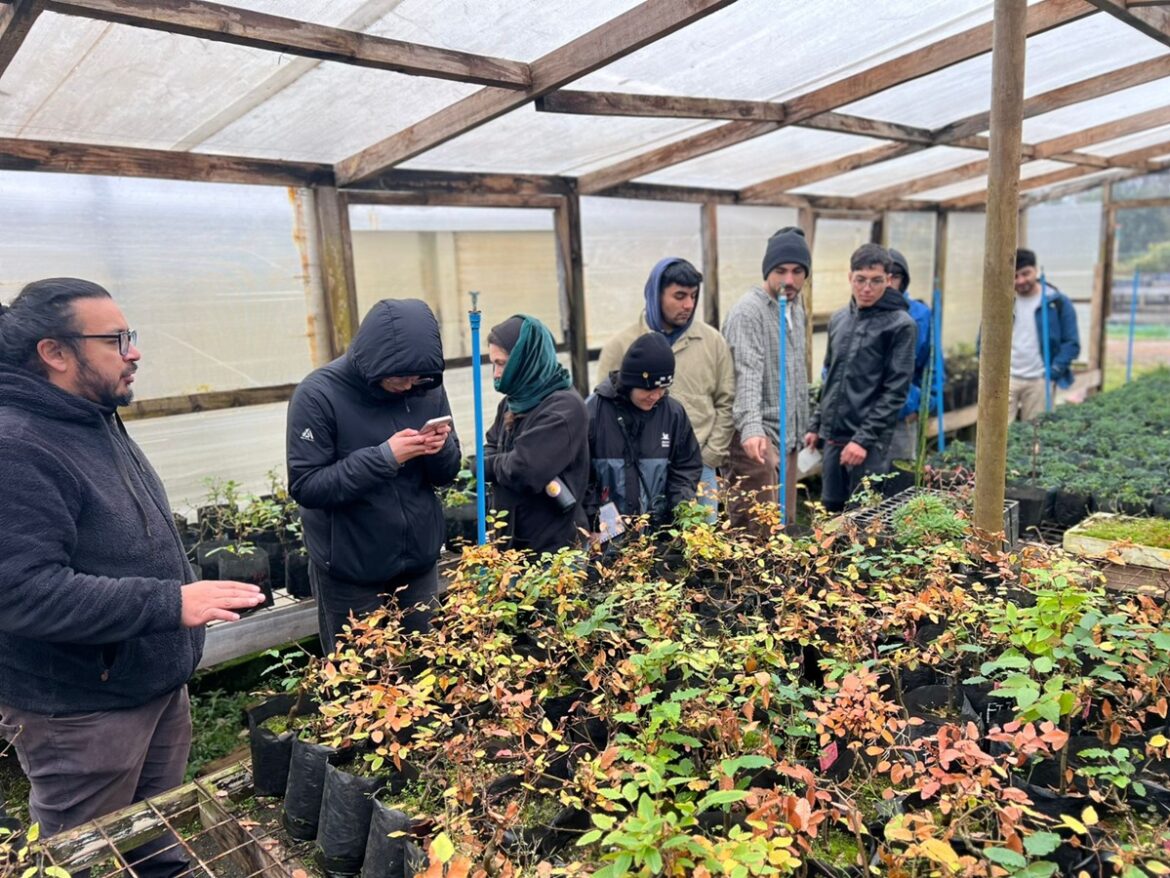
Practical application of learning in the field is a constant in the training of Forestry Engineering students at the Universidad Austral de Chile. In the context of the "Forest Protection" course, the Huillilemu nursery, located in the commune of San José de la Mariquina, was visited to learn about seed orchards and production processes for native species of commercial value, especially those of the Nothofagus genus, such as roble and raulí, along with other evergreens like ulmo.
According to the course instructor, Dr. Cristian Montalva, it is important to see these processes on-site because "they allow students to connect the content reviewed in class with real situations of plant production, health management, and plant quality. These experiences are relevant to understanding the importance of producing healthy, high-quality plants, especially when considering forest establishment and development."
For the students, this type of field experience is essential. "During the visit, we toured the nursery and greenhouse of the property, where we observed the production of plants from various species of commercial interest, highlighting coihue, raulí, alerce, ulmo, canelo, and, as a novelty, the hybrid 'rora' (roble-raulí). We also closely observed the process of preparing seedbeds and the land, as well as the different production systems, such as tubes and seedbeds. This allowed us to better understand the use of fertilizers and other management practices aimed at improving efficiency in plant production," explained student Felipe Soto.
"Personally, I was able to talk with the person in charge of the visit, whom I asked about the critical and secondary factors for the proper establishment of a nursery. In the case of Huillilemu, site conditions allow factors such as radiation, water supply, energy availability, and land characteristics to not pose major limitations when organizing and defining the type of production. However, among the secondary factors, labor availability, accessibility, and distance to markets can present some difficulties due to the location. Even so, these conditions are offset by the favorable critical factors mentioned earlier," added the student from the Faculty of Forest Sciences and Natural Resources.
Also participating in this activity were exchange students from Institut Agro Montpellier, France, Camille Charton and Thelma Lapouge, who commented that "this class allowed us to observe the treatments carried out to collect, conserve, and select seeds and trees of native species. Since we don't have silviculture classes in France, it was interesting to learn how this work is done in Chile. We learned how young plants are used in forests, their production conditions, and the treatments they receive. We also saw different types of seeds, an aspect that often doesn't get much attention when we are usually in the forest."
Additionally, they valued "the explanations from the person who received us, which were very interesting and comprehensive."



Comments (0)
No comments yet. Be the first to comment!
Leave a comment