

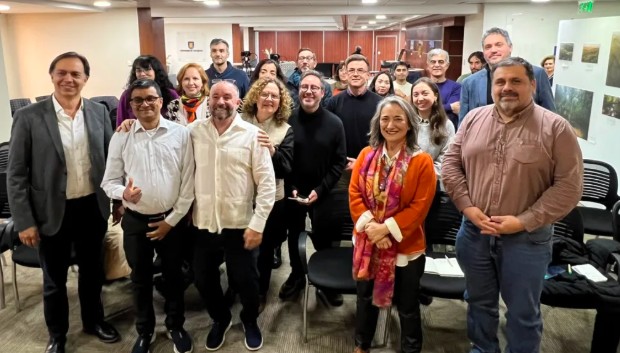
How to finance large-scale ecosystem restoration and forest protection? That was one of the questions that motivated a meeting organized by the Landscape Ecology Laboratory of the University of Concepción and South Pole, where specialists discussed the role of forest carbon markets in climate action.
During the seminar "Towards a net-zero emissions world: jurisdictional REDD+, ART TREES and forest carbon markets," attendees analyzed the evolution of this market, the search for quality and scale in REDD+ projects, and the integrity of reductions and removals under ART TREES, one of the main references for jurisdictional forest carbon programs covering entire regions or territories.
Likewise, progress of the Chile J-REDD+ project, promoted by South Pole, was presented, along with the challenges posed by its eventual implementation in the country.
One of the main consensuses was that the development of this type of initiative requires much more than financing. It also demands robust scientific evidence, rigorous standards, governance mechanisms, and spaces for dialogue that allow building trust among public institutions, the private sector, academia, and international organizations.
The Director of Sustainability at the University of Concepción and of LEP UdeC, Cristian Echeverría Leal, commented that the collaboration between both institutions arose from a strategic complementarity aimed at contributing scientific knowledge and international experience to this discussion.
"LEP brings a consolidated scientific trajectory in landscape ecology, spatial analysis, land use change, native forest degradation, ecological restoration, and territorial planning, while South Pole provides experience in carbon markets, nature-based solutions, and development of climate programs at different scales," he highlighted.
In this way, the meeting allowed sharing evidence, methodologies, and experiences that can contribute to future public, private, and academic decisions related to forest carbon, ecological restoration, and territorial management.
Regarding next steps, Keegan Eisenstadt, Global Senior Director for Nature-Based Solutions at South Pole, points out that the project is in a pre-feasibility stage aimed at evaluating its technical, institutional, and governance viability. If favorable results are obtained, it would advance to a design phase that would incorporate safeguards, monitoring, and validation under ART TREES before eventual implementation.



Comments (0)
No comments yet. Be the first to comment!
Leave a comment