

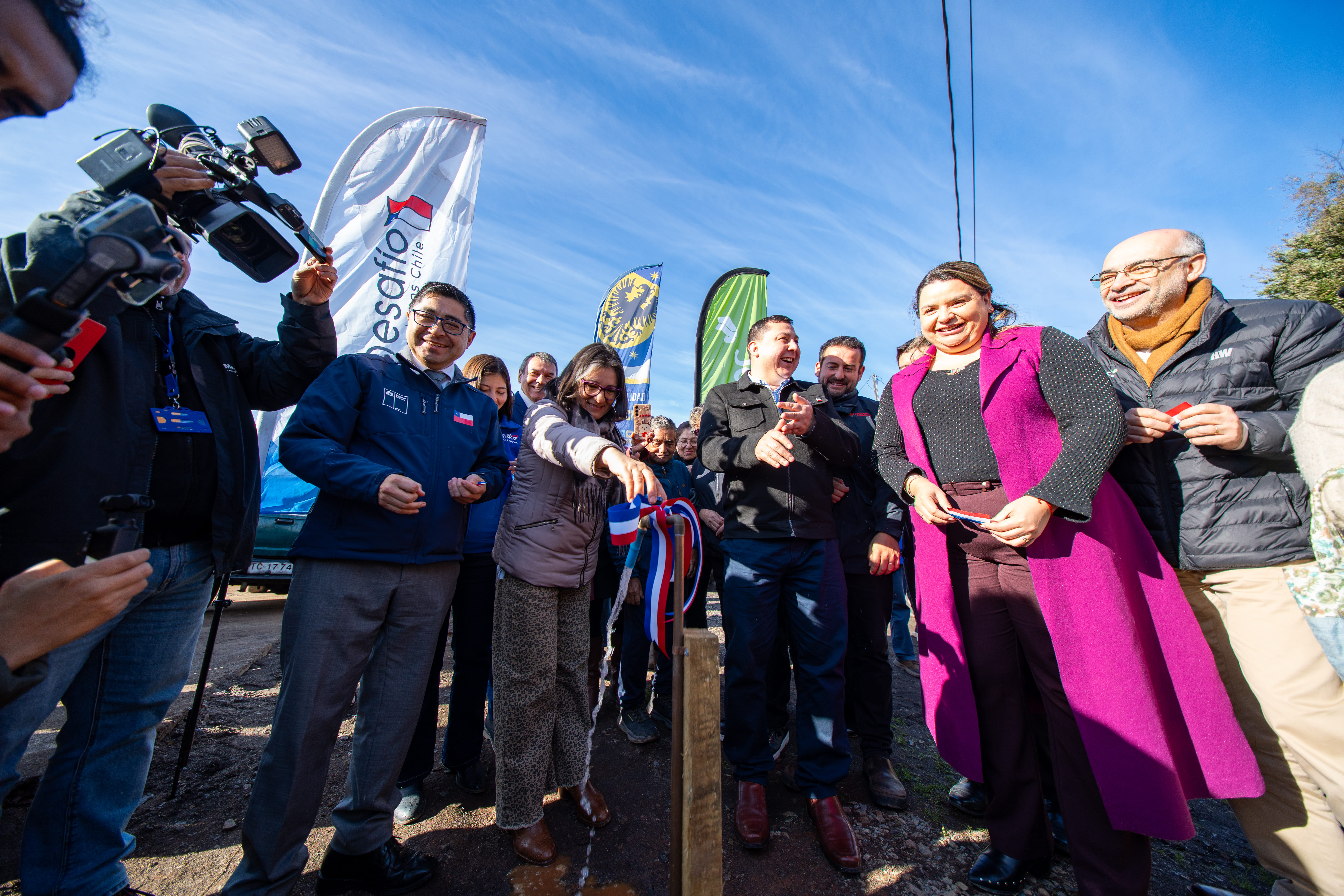
In a race against time and before the arrival of winter rains, the public-private partnership led by CMPC and Desafío Levantemos Chile managed to rehabilitate in record time the rural drinking water system of the Lo Tato sector in Concepción. The initiative, which recovered nearly 50 household connections after they were destroyed by the January forest fires, definitively restores health security and dignity to more than 100 families who risked being completely cut off due to the collapse of rural roads.
Andrés Sáez has lived in Lo Tato with his family for five years. After what happened, he commented: we lived with the constant fear of running out of water from one moment to the next. There were very difficult months where many neighbors had to wash with jugs and depend on water trucks, carefully rationing every liter to last two or three days. Seeing today that the APR is already working permanently gives us peace of mind. He added that, “this catastrophe taught us to value this resource much more and leaves us with the great lesson that as a community we must remain united, taking care of each other and working on prevention to avoid going through a similar scenario.”
The catastrophe at the beginning of the year severely affected the families of this sector, where since 2014 the neighbors themselves had organized with great effort to build their community and autonomously construct their own water system. After the fires, the only temporary option available had been supply via water trucks. However, the latent danger before winter was the geographical factor; being a rural area, rains cause roads to collapse and close, which would have completely prevented the passage of trucks, leaving the community in total water isolation.
The new project neutralizes this threat and permanently restores basic supply to the area. In this regard, the Regional Presidential Delegate of Biobío, Julio Anativia Zamora, commented on the importance that public-private collaboration has had in the reconstruction of the areas affected by the fire. He added that: This milestone motivates us because there are still pending matters to address in reconstruction, and in the various emergencies regarding citizen security, unemployment, and health, aspects we must face with the same motivation.
The initiative was a joint effort coordinated by Desafío Levantemos Chile, funded by CMPC on behalf of the Chilean Wood Corporation (Corma), and had the technical support of the Directorate of Hydraulic Works (DOH) along with the donation of materials from the Presidential Delegation. All this deployment was fundamentally based on working hand-in-hand with the affected community of Lo Tato itself.
Regarding the importance of this public-private collaboration model, Francisco Reveco, Manager of Industry and Forest Relations at CMPC, stated that “for CMPC, this project demonstrates what we can achieve when we articulate public-private capacities with communities. Arriving on time, before winter, was not only an operational urgency but a responsibility towards the families of Lo Tato. Today we contribute to restoring a basic service, but above all, to recovering security and dignity for more than 100 homes.”
This emergency demonstrated the urgent need to support local drive through robust, modern water infrastructure prepared to protect the rural population against future climate crises. In this regard, the operational director of Desafío Levantemos Chile, Nicolás Canales, explained that: At Desafío we are clear that efficient solutions must arrive when people need them most. Winter does not wait, and it gives us peace of mind to know that these one hundred families of Lo Tato will face the rains with the security and dignity of having drinking water in their homes. He added that, “this achievement is the result of a public-private collaboration model that shows that, when we work together with the community, CMPC, and the authorities, we are capable of achieving the impossible.”
For his part, the mayor of Concepción, Héctor Muñoz Uribe, emphasized the direct impact of the work on the quality of life and resilience of the commune: “This work has a direct impact on the daily lives of our neighbors. Restoring drinking water in Lo Tato is not just about reinstating a basic service; it is about strengthening the resilience of a community that has had to rise after a tragedy. When we manage to have the State, companies, and civil society work together, we advance faster and with solutions that truly improve the quality of life in our commune.”
The rapid rehabilitation of the Lo Tato system is part of a larger recovery strategy in the region. Specifically, this corresponds to one of the five priority projects led by the Presidential Delegation of Biobío to rebuild critical infrastructure damaged by the 2026 emergency, where the remaining water solutions in the area are being coordinated and led by other companies committed to the territory, such as Arauco and Aguas Andinas.






Comments (0)
No comments yet. Be the first to comment!
Leave a comment