

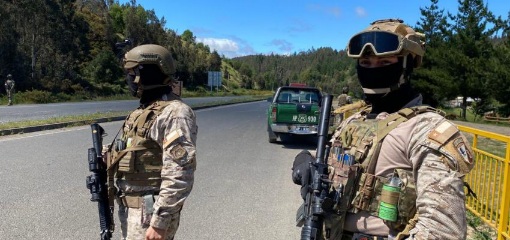
During the day this Friday, June 19, the first session of the Macrozona South Task Force was held, one of the seven instances announced by President José Antonio Kast as part of the new institutional framework promoted in the area of security.
The initiative was created with the objective of coordinating and strengthening the State's response to organized violence affecting the regions of La Araucanía, Biobío, and Los Ríos, through the joint work of security, intelligence, and defense agencies.
In this first meeting, the focus was on identifying the factors that currently limit or hinder the ability of institutions to prevent, detect, monitor, and investigate acts of violence in the area.
To this end, each participating agency presented its main gaps related to access to information, inter-institutional coordination, human resources, technological capabilities, and operational procedures.
The Minister of Public Security, Martín Arrau, highlighted the scope of this new state coordination body.
"This Task Force represents the Government's will to confront terrorism and organized violence in southern Chile with the full capacity of the State. For the first time, formally, the Armed Forces, the police, and intelligence agencies work at the same table with a common goal: to restore peace and security to the families of La Araucanía, Biobío, and Los Ríos. We will not back down," he stated.
Weekly Work and Gap Diagnosis
The Task Force is part of the Ministerial Strategic Unit (UME), headed by Eduardo Bennett, and will operate through weekly work cycles.
As a result of this first session, a Registry of Gaps and Institutional Requirements will be prepared, a document that will compile the needs raised by the participating agencies.
Subsequently, in a second session, these gaps will be reviewed and prioritized with the purpose of defining concrete lines of action. These measures may translate into coordination improvements, procedural adjustments, institutional strengthening, or proposals of a regulatory nature.
According to reports, the ultimate goal is to generate solutions that help guide decision-making by authorities and sustainably strengthen the State's coordinated response to organized violence in the south of the country.
Participation of Public Agencies
The Macrozona South Task Force brings together thirteen institutions: the Ministry of the Interior, the Ministry of National Defense, the National Intelligence Agency, the Army, the Navy, the Air Force, the General Directorate of National Mobilization, the General Directorate of Maritime Territory and Merchant Marine, the General Directorate of Civil Aviation, Carabineros, the Investigations Police, the National Cybersecurity Agency, and Gendarmerie.
Additionally, it has the collaboration of fourteen additional agencies, including the Regional Governments of La Araucanía, Biobío, and Los Lagos, along with sectoral ministries and oversight and financial entities such as the Internal Revenue Service, the Financial Analysis Unit, and the National Customs Service.
Source:Diario Concepción





Comments (0)
No comments yet. Be the first to comment!
Leave a comment