

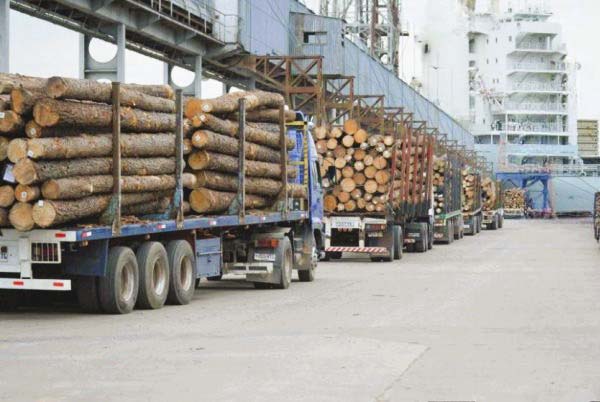
Forest exports from the Biobío Region reached US$213.6 million in April 2026, a figure representing a 21.5% decrease compared to the same month last year, according to the latest sectoral report from the National Institute of Statistics (INE).
Despite the decline, the forestry sector maintained its position as the region's main export sector, accounting for 61.7% of total regional exports, which amounted to US$346.2 million in April.
The results reflect the complex situation currently facing the forestry industry, marked by lower levels of international demand and a sustained drop in export values over recent months.
Pulp continued to lead regional forestry shipments by a wide margin, representing 62.1% of the sector's total exports, followed by sawn wood and wood fiberboard.
Pulp leads exports but records the biggest drop
The manufacture of pulp, paper, and cardboard was the economic activity with the greatest impact on the decline in Biobío's forest exports.
During April, this segment exported US$138.6 million, registering a 24.9% decrease compared to the same period in 2025. In absolute terms, the reduction amounted to US$46 million.
Meanwhile, forestry activities associated with wood products exported US$74.6 million, experiencing a 14.4% decline year-on-year.
Among the main exported products, pulp stood out with sales of US$132.6 million. However, this product showed a year-on-year drop of 26.1%, equivalent to US$46.8 million less than in April 2025.
Sawn wood ranked second with exports of US$29.4 million, registering a 23.1% decline. It was followed by wood fiberboard with US$13.9 million (-19%), plywood with US$11.9 million (-4.1%), and wood profiles and moldings with US$8.9 million (-12%).
Together, these five products accounted for more than 92% of all regional forest exports during the analyzed period.
China remains the main market for the regional forestry sector
China maintained its position as the primary destination for Biobío's forest exports, accounting for 47.8% of the sector's shipments.
During April, exports to the Asian giant reached US$102.1 million, although they registered a 12.2% decrease compared to the same month last year.
The United States ranked as the second most relevant market, with purchases of US$38.1 million, a figure representing a 25% drop.
Further behind were Mexico, Peru, and Guatemala, which together completed the group of the top five destinations for regional forest products.
While Mexico showed a slight decline of 5.6%, Peru and Guatemala stood out for increasing their imports of forest products from Biobío. Peru recorded a 25% growth, reaching US$7.4 million, while Guatemala increased its purchases by 13.4%, totaling US$6.5 million.
The top five markets concentrated 76.7% of regional forest exports during April.
The April results confirm a contraction trend that has affected forest exports for much of the past year. Between January and April 2026, cumulative shipments reached US$902.1 million, representing a 14.3% decrease compared to the same period in 2025.
Despite this scenario, the forestry sector continues to be one of the most relevant economic activities for the region, both for its contribution to exports and its impact on employment, industrial activity, and the development of territories linked to the forestry chain.
The behavior of international markets, particularly China and the United States, will continue to be a determining factor for the recovery of regional exports in the coming months.







Comments (0)
No comments yet. Be the first to comment!
Leave a comment