

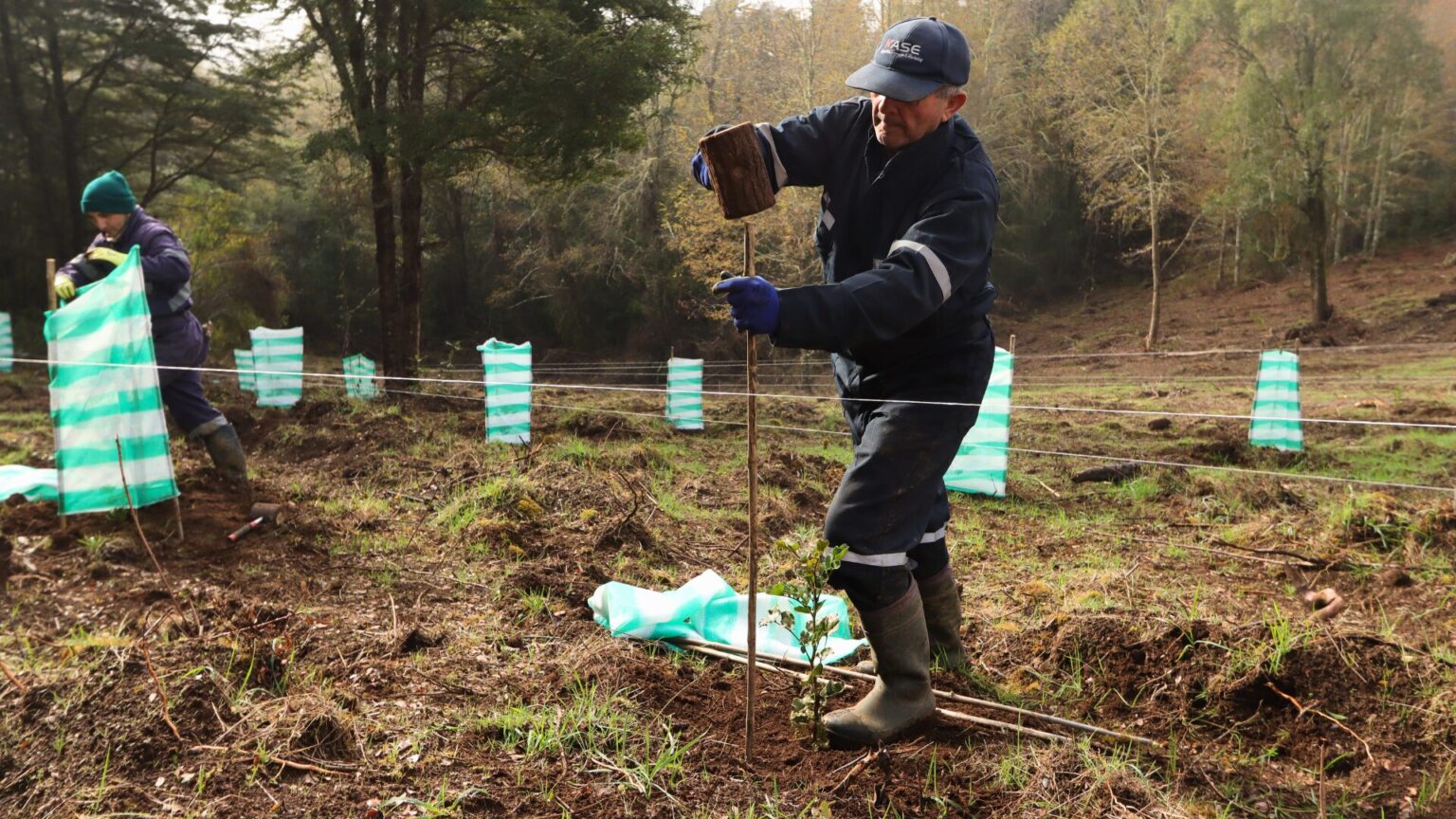
Chile recently received from the World Bank, specifically from the Forest Carbon Partnership Facility (FCPF), the second payment for results by demonstrating carbon emission reductions in native forests, totaling 15 million dollars. Thanks to this financial support, Conaf is carrying out various actions in six regions of the country, between Maule and Los Lagos, such as restoring native forests, reforestation, strengthening sustainable management, and preventive silviculture, among others.
The delivery of this fund is framed by the Emission Reductions Payment Agreement (ERPA) signed in 2019 between Conaf and the Forest Carbon Partnership Facility (FCPF) of the World Bank. The disbursement of 15 million dollars, corresponding to the 2022-2023 monitoring period, recognizes a verified emission reduction of more than 3 million tons of CO₂ equivalent, coming from forests in the regions from Maule to Los Lagos, associated with REDD+ activities of deforestation, degradation, conservation, and stock enhancement.
In this regard, Jaime Campos, Minister of Agriculture, explained that "this new payment for results demonstrates that the protection of our native forests generates environmental, economic, and social value for Chile. The verified emission reduction that the World Bank recognizes today reflects years of work by Conaf and multiple public and private actors committed to the conservation and sustainable management of our forest resources. That an international organization allocates 15 million dollars to our country for effectively achieved results confirms that forest protection and restoration policies can translate into concrete benefits for the territories and for the communities that depend on them."
Aída Baldini, Executive Director of the National Forest Corporation, Conaf, stated that "this second payment consolidates Chile as a strategic and reliable partner in payment-for-results mechanisms. It is not just a financial milestone: it is international validation that our native forest conservation policy reduces emissions in a verifiable manner and attracts new investments for the country."
The monitoring report 3, presented in March 2025 and successfully audited by the international team AENOR (Spanish Association for Standardization and Certification), reflects a significant decrease in areas of deforestation and replacement of native forest, with 3,483,190 tons of carbon reduced in 2022 and 4,134,150 in 2023 (gross figures prior to discounts for buffer and uncertainty). These positive results show concrete advances in prevention, control, and early response to the loss of native forest, as well as the impact of policies and programs executed by Conaf.
The Manager of Forests and Climate Change at Conaf, Alfonso del Río, indicated that "the success of this verification is based on a robust technical system that integrates Conaf's monitoring, quantitative forest degradation analyses from INFOR, and ongoing coordination with environmental enforcement. These 15 million dollars will translate into direct actions in the territories: restoration, sustainable management, and preventive silviculture."
It is worth recalling that the ERPA was signed by the Ministry of Finance and the Chilean Agency for International Development Cooperation (AGCID), and has the technical support of the World Bank. In this context, Jean-Marc Arbogast, Manager of the World Bank Group in Chile, highlighted: "We celebrate Chile's commitment to transparency and rigorous measurement. This second payment demonstrates that the payment-for-results model works when there is a state policy and solid technical capacities. We will continue to support the country in scaling up these investments in native forests and climate adaptation."
From the Department of Climate Change and Ecosystem Services, its head Hugo Rivera stated that "together with the national and regional team, we have achieved a significant feat: demonstrating that effective emission reduction can generate direct and recurring investment for native forests. This second payment for results opens the door to new projects and alliances that consolidate a virtuous cycle of conservation, mitigation, and sustainable territorial development."
As indicated by the ERPA, the resources received will be distributed according to the Benefit Distribution System in the regions from Maule to Los Lagos, supporting the implementation of measures from the National Strategy on Climate Change and Vegetation Resources (ENCCRV), including restoration of native forests, reforestation, strengthening sustainable management of native forests, and preventive silviculture, among others.




Comments (0)
No comments yet. Be the first to comment!
Leave a comment