

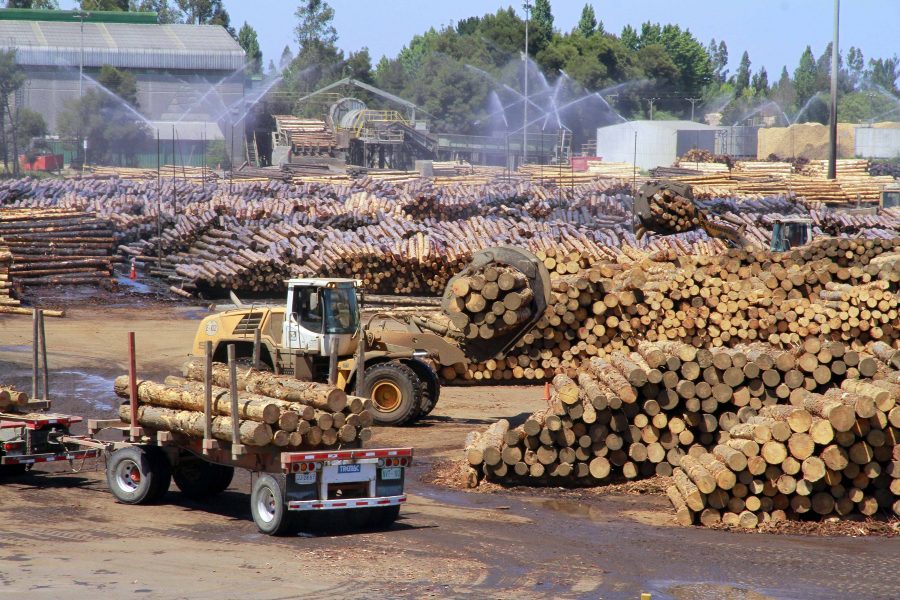
Multiple layoffs in the forestry industry have raised alarms in the Biobío Region. Following the nearly 100 dismissals recently reported by the company Arauco, an additional 600 to 700 workers from contractor firms providing services to CMPC were subsequently laid off, creating a scenario that concerns both the productive sector and the political world.
In response, various actors in the sector agree that these layoffs are part of a broader scenario affecting the industry.
While the Association of Forestry Contractors has warned that the greatest impacts are concentrated in the harvesting and silviculture areas, the College of Forestry Engineers points to lower international demand, falling pulp and timber prices, rising costs, wildfires, reduced afforestation over the past decade, and loss of competitiveness.
In this context, consulted by Diario Concepción, the Chilean Wood Corporation (Corma) argues that the focus should not be limited solely to the layoffs already recorded, but also to the conditions that companies currently face to maintain activity and employment.
“For Corma, every job lost in the forestry sector is a warning sign. Today, concrete and urgent measures are needed to sustain activity and protect small and medium-sized enterprises. We need a more decisive policy to boost wood construction, capable of generating more activity and helping to curb job losses,” stated its president, Rodrigo O’Ryan.
O’Ryan added that one of the most urgent challenges is to provide better conditions for the development of the activity. “It is essential to strengthen security. Today, many SMEs and contractor firms are making great efforts to stay in the market and continue providing jobs,” he said.
Proposals from Congress
The recent events were noted by lawmakers from the area, who agreed on the need to adopt measures to restore the competitiveness of an industry considered strategic for the regional economy, though with different emphases regarding solutions.
Deputy Patricio Pinilla (DC), representing District 21, attributed the situation to a combination of national and international factors. “The main causes are the rise in fuel and input costs, the comparative advantages that other territories have for pulp production, the drop in the international price of pulp, and the delay in generating permits for new investments. This severely affects our region, which defines itself as forestry, leading to very high unemployment and social costs,” he noted.
Along these lines, he stated that he is currently promoting a proposal aimed at strengthening small-scale activity. “We are promoting a sustainable forestry incentive law focused on small plots. In our view, this could revitalize this sector with tax incentives and faster processes,” he commented.
Likewise, he proposed forming a working group made up of the Ministries of Finance and Economy, the Regional Government, municipalities, companies, and unions to advance measures for labor reinsertion and new initiatives to address the situation.
From the same district, Deputy Lilian Betancourt (PDG) warned that the impact of the layoffs extends beyond the companies involved. “What is happening in the forestry industry is a warning sign for the entire Biobío Region. The layoffs in principal companies and contractors directly affect hundreds of families and a broad chain of suppliers, transportation, commerce, and services that depend on this activity,” she stated.
The parliamentarian added that various actors in the sector have expressed the need to restore the industry’s competitiveness and encourage planting again, especially after the 2023 wildfires. In this regard, she argued that it is urgent to “generate certainty for investment, promote incentives for reforestation and new plantations, simplify project processing, and strengthen sustainable forest management.”
Her party colleague from District 20, Patricio Briones (PDG), emphasized Chile’s competitiveness compared to other producing countries. “There is no doubt that tax policies that increased the taxable rate, as well as those that discouraged hiring labor, made Chile less competitive than Brazil, Colombia, and Paraguay regarding forestry investments, which are moving to those countries,” he stated.
In this context, he indicated that he will request the Executive to push for changes in these matters: “We will coordinate with the caucus a request on this matter as soon as possible.”
A similar stance was expressed by Deputy Marlene Pérez (Ind-UDI), who described the forestry industry as “strategic for Biobío” and stated that its weakening represents “very bad news for thousands of workers and their families.”
In the congresswoman’s view, the sector currently faces a combination of factors including falling international prices, rising energy and logistics costs, and the violence that has affected forestry areas for years.
Therefore, she proposed that the State should advance measures to restore competitiveness, strengthen security, streamline investment processing, and encourage new plantations. Likewise, she argues that the Ministry of Labor should reinforce support, training, and labor reconversion policies for those affected by further job losses.
Her caucus colleague in District 21, Deputy Flor Weisse (UDI), warned that one of the main factors affecting the sector is the lack of security conditions. “Without security, there is no development, no confidence to invest, and ultimately, those who end up paying the consequences are the workers and their families,” she stated. To this, she added growing red tape, increased regulatory demands, and an increasingly competitive international scenario.
Regarding measures, she added that she will continue promoting an agenda aimed at providing greater certainty to the sector. Among her proposals, she mentioned strengthening legal tools to combat timber theft, organized crime, and attacks in rural areas, as well as advancing a new forestry promotion instrument to encourage plantations, especially among small and medium-sized landowners, incorporating sustainability and soil recovery criteria.
Finally, Deputy for District 21, Joanna Pérez (Democrats), stated that the forestry industry is severely affected by rising fuel costs. To this, she added that “the important thing is to address a new reforestation law. This has been requested because today we are harvesting much less,” she stated.
Additionally, she explained that the country must create better conditions to encourage investment. In this regard, she supported measures such as tax invariability to attract new projects, strengthening wood housing construction, and incorporating proposals promoted by the Chilean Chamber of Construction (CChC) and PymeMad, with the aim of boosting activity.
Source:Diario Concepción





Comments (0)
No comments yet. Be the first to comment!
Leave a comment