

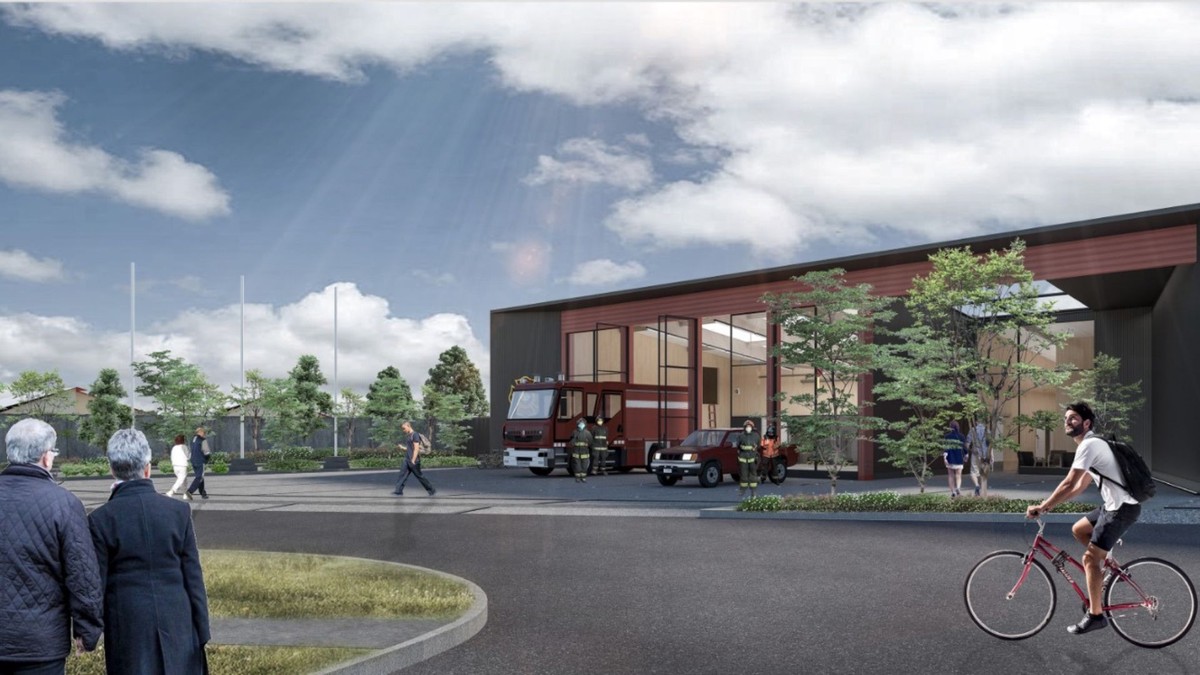
A new standard for public construction in wood is beginning to take shape in the Biobío Region. This is the new Fire Station of San Pedro de la Paz, infrastructure that incorporates around 80% industrialized wood in its construction and exceeds 1,000 m² of surface area.
The project, developed with the participation of CMPC through its specialized line in mass timber, Niuform, seeks to demonstrate the technical, constructive, and architectural possibilities of this material in buildings with high operational demands.
The initiative includes the use of cross-laminated timber (CLT) and glued laminated timber (GLT), with a supply of 224 m³ of CLT panels and 27 m³ of GLT beams. Through a plant prefabrication system, it was possible to optimize material usage, reduce waste generation, and shorten on-site assembly times.
One of the relevant aspects of the project is the behavior of wood in the event of fire. The structural elements consider their resistance through calculations associated with the charring rate of each piece, allowing the structural capacity to be maintained during a fire without necessarily requiring chemical treatments or additional coatings.
Prefabrication and constructive precision
The design was developed through collaborative work between the Municipality of San Pedro de la Paz, Universidad San Sebastián, and CMPC professionals. The company also participated in developing solutions for the connections of structural elements, with the aim of facilitating and speeding up the assembly process.
The use of prefabricated components made it possible to transfer a large part of the construction processes from the site to the plant, favoring more efficient assembly and greater control over finishes.
Additionally, a significant portion of the wood will remain exposed inside the building, becoming a visible element for volunteers and the community and providing an architectural identity associated with the warmth and materiality of wood.
For Camilo Prieto, Mass Timber architect at CMPC, the project brings this construction system closer to the public in a building different from those traditionally associated with wood.
The professional highlighted that a fire station fulfills a function that transcends the protection of vehicles and facilities for volunteers, as it also constitutes a meeting space with the community.
Mass timber for public infrastructure
The construction of the station represents a new application of engineered wood in public infrastructure and expands the field of development of industrialized construction systems in Chile.
From CMPC, the initiative is presented as part of a strategy aimed at promoting construction solutions with lower environmental impact and greater incorporation of industrialization processes.
With its location in the heart of the Biobío Region, the new Fire Station of San Pedro de la Paz thus joins projects seeking to demonstrate that mass timber can meet safety, efficiency, and design requirements in large-scale public buildings.
The work also constitutes a concrete example of how innovation linked to the forestry industry can move from raw material production toward higher value-added solutions for construction and urban development.







Comments (0)
No comments yet. Be the first to comment!
Leave a comment