

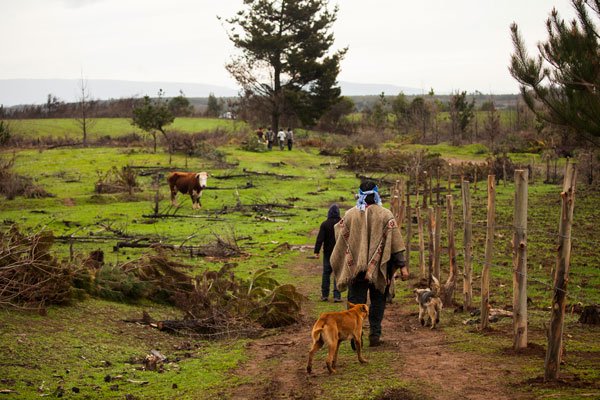
The Association of Forestry Contractors estimates that the modification would allow leasing currently unproductive community lands. Of the nearly 270 thousand hectares delivered by the State over the last three decades, it is calculated that half are in a state of abandonment or without agricultural use.
The proposal to modify the current Indigenous Law, which would allow for more flexible land tenure to facilitate leasing and investment, opens the door to reincorporating between 130,000 and 150,000 hectares into the productive cycle in the Macrozone South, according to the Association of Forestry Contractors of Chile.
It is worth mentioning that since the enactment of the regulation over 30 years ago, the State has transferred between 260,000 and 270,000 hectares to communities, disbursing more than $700 billion.
Delivered lands and abandonment figures
René Muñoz, manager of the Association of Forestry Contractors, detailed in a conversation with Radio Sago the complex situation of these properties, stating that "at least 50% is abandoned. They were handed over, they took what was there, and that was it."
According to Muñoz, in some plots there is only a subsistence economy, while a large proportion simply registers no productive activity.
Limitations of the community model
The status of community property is pointed out by the guild as the main obstacle to individual economic development, since "if a community member wants to invest (...) he alone cannot go to a bank, apply for a loan, or lease that land," explained Muñoz.
This legal limitation prevents owners from accessing new technologies or transferring the use of unproductive land to third parties through lease contracts.
Productive potential and indigenous consultation
The reactivation of these 150 thousand hectares would directly benefit the local economy of the central-southern zone of the country, because the recovered plots could be used to boost the livestock, agricultural, and even forestry industries.
To materialize this reform, announced by President José Antonio Kast in his first State of the Nation Address, the legislative process must comply with current international regulations applicable to indigenous peoples.
This will involve carrying out the corresponding consultations under ILO Convention 169, promoting direct dialogue with the communities.
Source:Radio Sago







Comments (0)
No comments yet. Be the first to comment!
Leave a comment