

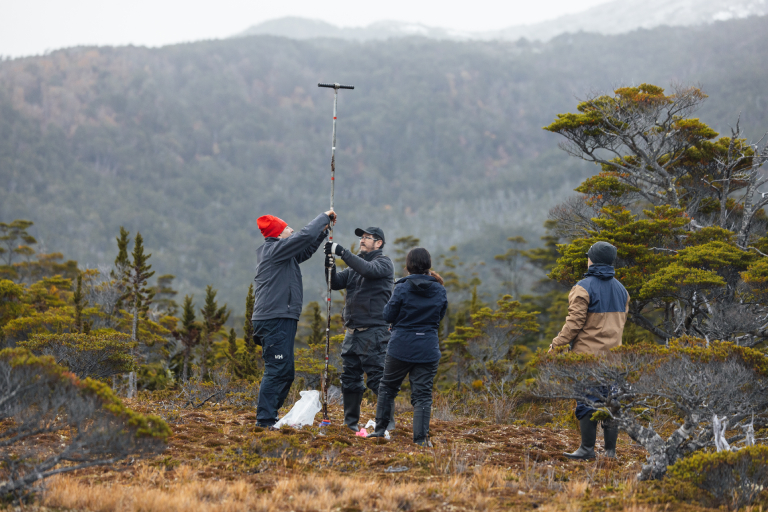
It is known that peatlands—formed by layers upon layers of compressed dead organic matter over centuries under cold, humid, and oxygen-deprived conditions—are major carbon stores, but little is known about what they actually store in the last corner of the American continent: Cabo Froward, on the Brunswick Peninsula, Magallanes region.
Academics and researchers from the Faculty of Forest Sciences and Nature Conservation of the University of Chile (FCFCN) were part of this field research in Cabo Froward National Park in the Magallanes region.
Academics and researchers from the FCFCN were part of this research in Cabo Froward in the Magallanes region.
A pioneering study conducted by the Subantarctic Ecosystem Restoration Program of Rewilding Chile, in collaboration with specialists from the University of Chile, quantified for the first time the carbon storage of the Cabo Froward peatlands. The result exceeded expectations: based on samples collected in the field, laboratory analysis confirmed that they store an average of 1,647 tons per hectare, i.e., three times more than the forests in the same sector, which store an average of 536.2 tons per hectare.
"There is no doubt that peatlands rank first among all carbon reservoirs in the world. What we didn't know is that, within this group, Patagonian peatlands surpass those in temperate climates in the north of the country and even resemble those found in tropical ecosystems, as they store around 1,600 tons of carbon per hectare," explains Jaime Hernández, director of the Laboratory of Geomatics and Landscape Ecology at the Faculty of Forest Sciences and Nature Conservation of the University of Chile.
Hernández had researched carbon reservoirs across the country, except for those in Cabo Froward, which surprised him with their good condition. "They are complete ecosystems, still quite wild. They are protected by water accumulation and the sector's own microtopography, with little human intervention, unlike other areas of the country where commercial exploitation of 'pompón' has been allowed for agriculture," he notes.
In parallel, the research characterized for the first time the morphology of the vegetation cover in the area between San Nicolás and Bahía Cordés, covering the continuous terrestrial patch of the Brunswick Peninsula where Cabo Froward is located. The surface consists of just over 52,000 hectares of forest and about 53,000 hectares of peatlands, with the capacity to accumulate between them approximately 115 million tons of carbon.
"These findings are relevant because they confirm that subantarctic forest ecosystems are efficient natural carbon reservoirs and, therefore, true treasures for counteracting the effects of the climate crisis. Not only that: they harbor biodiversity, contain information about what the environment was like thousands of years ago, and are fundamental for maintaining environmental balance," comments Ingrid Espinoza, Conservation Director of Rewilding Chile.
Regarding the methodology, high-definition cartography was combined with fieldwork, which made it possible to accurately determine how much carbon per unit volume exists at a given point, data that was previously unknown.
The first step was to identify and classify the vegetation covers present in the area through satellite image analysis. After that, two expeditions were carried out to measure in situ the living organic matter above the ground and to collect soil and peat samples at different depths at over 200 defined sites. Once the material was gathered, it was sent to the Ventura Matte Laboratory at the University of Chile to determine the percentage of carbon present. Currently, the research team is finalizing a scientific publication on the results and the methodology used.
To protect these unique territories, Rewilding Chile, together with the Chilean State, is promoting the creation of a national park in Cabo Froward. "While in other regions efforts are made to restore degraded ecosystems, here an intact system is preserved that could play a crucial role in mitigating climate change and therefore urgently needs protection," adds Ingrid Espinoza.
This is not the first time the foundation has studied carbon storage in Patagonia. In 2019, in partnership with the National Geographic Society, the carbon storage of the 17 national parks of the Route of Parks of Patagonia was calculated, determining their relevance as one of the richest carbon sinks in South America.


Comments (0)
No comments yet. Be the first to comment!
Leave a comment