

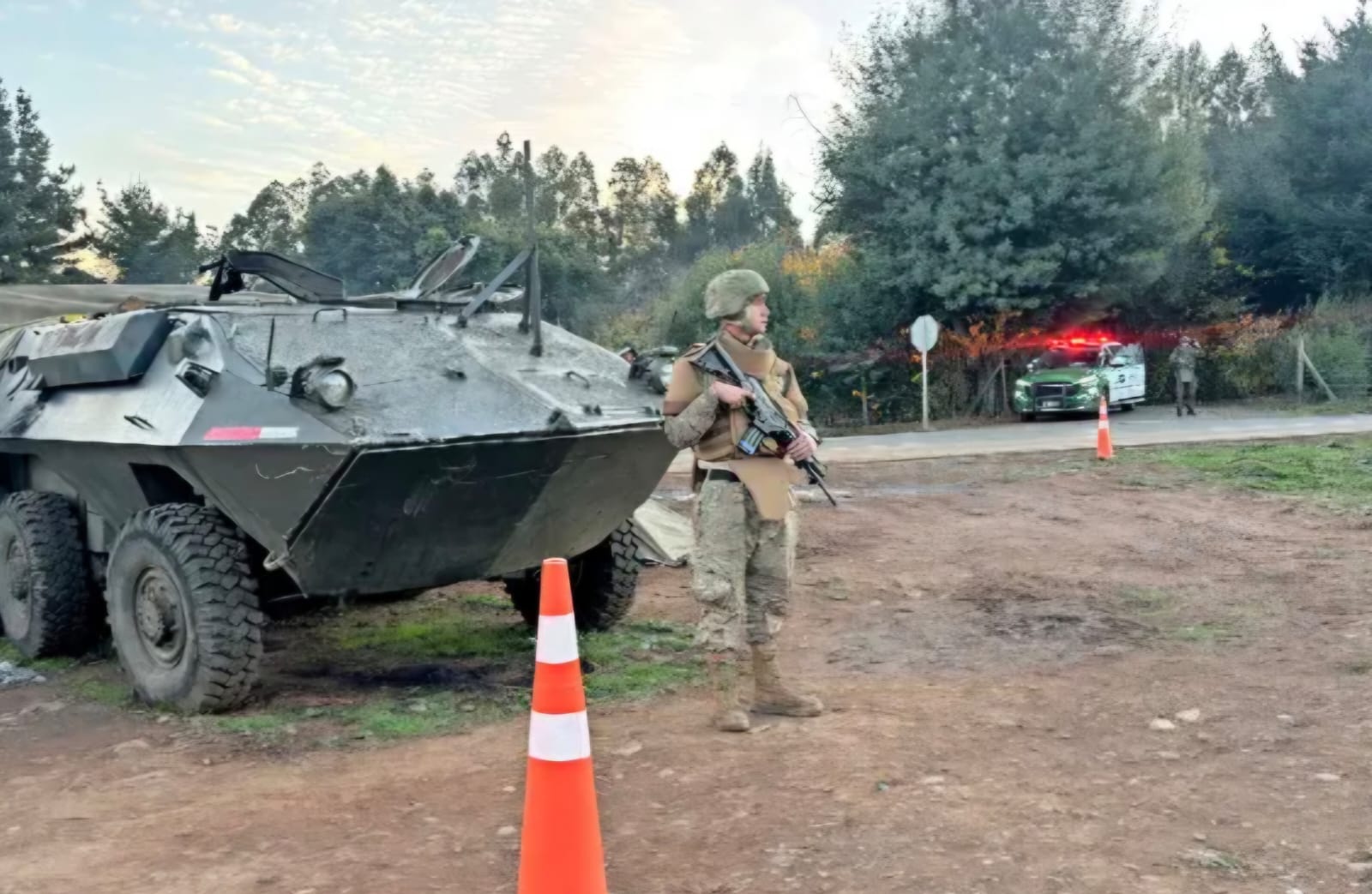
Since the state of exception in the southern macrozone began uninterrupted on May 17, 2022, the presidential decree established two National Defense leaderships for the emergency zones. The Navy was assigned to oversee the two provinces and 21 municipalities of Biobío where the measure is in effect. Meanwhile, in the 32 municipalities of La Araucanía, responsibility fell to the Army.
In its May "Violence Report," the Multigremial of La Araucanía analyzed this issue. Along with highlighting the Government's decision to refine the constitutional mechanism, it expressed concern regarding the establishment of a unified command (which would be under the Army's charge).
"The announced changes to the state of emergency open a new phase that requires careful observation. As of June 20, a structure that operated for four years with two National Defense chiefs—one for La Araucanía and another for Biobío—will be replaced by a concentrated scheme under a unified command. This change occurs in a context where the decree itself acknowledges that security threats persist and where territorial outcomes continue to differ," the document states. The analysis adds that "currently, 77% of violent incidents in the southern macrozone are concentrated in La Araucanía."
Similarly, the report notes that the modification of the leaderships coincides with two judicial milestones: on June 16, the Supreme Court must rule on the appeals filed by the defenses of the four accused in the homicide of three police officers, and on June 23, the trial begins against 21 accused of attacking the Grollmus family.
"We hope there is no detriment"
During the presentation of the study, the president of the Multigremial of La Araucanía, Patricio Santibáñez, addressed the issue of the unified command. "We hope it is done with the utmost care, so that all forces currently operating continue to do so as they have up to now," he stated. He added that "we believe the contingent will not change, because the aim is to optimize and improve coordination, and we hope this does not mean any detriment to current operational capabilities," and called on authorities to "explain how this measure will be implemented."
The executive highlighted the set of actions aimed at refining the exceptional measure. "There are changes to the military's attributions; there is reinforcement of investigative and operational capabilities, and there is the decision to enter roads, with MOP contractors to execute routes that have not been done for a long time," he emphasized.
Former Senator Felipe Harboe, researcher at the Center for Security and Organized Crime Studies at U. San Sebastián, believes that "beyond the number of commands that exist, what matters is that operational capability is reinforced." The former Undersecretary of the Interior also states that "although the presence of the Armed Forces has provided security support, there are still violent incidents that demand a greater presence of police and military personnel."
Source:El Mercurio







Comments (0)
No comments yet. Be the first to comment!
Leave a comment