

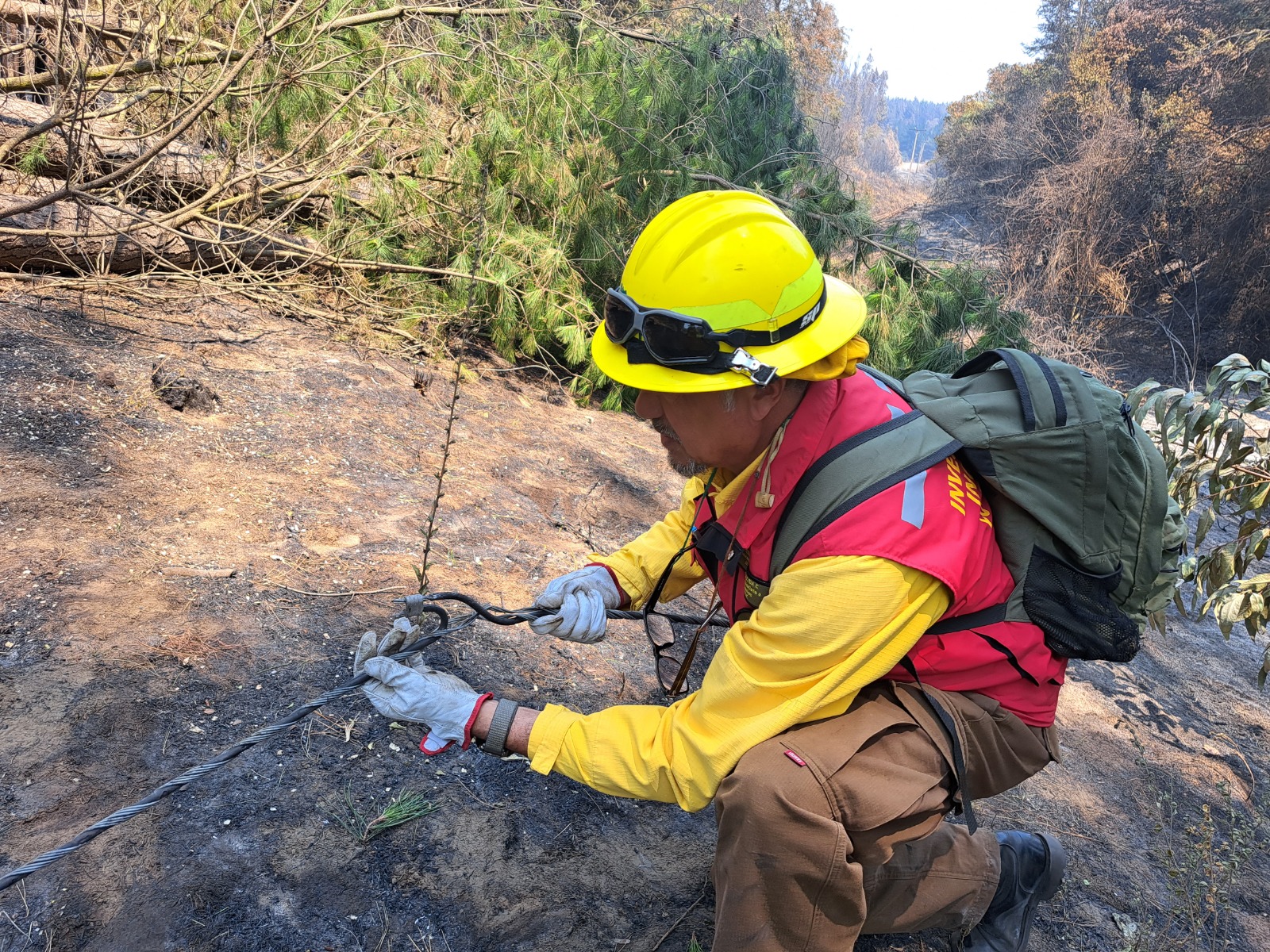
Wildfires in Chile have changed in intensity, behavior, and complexity over recent years. This is stated by Edgardo Fuenzalida, a criminalistics expert and wildfire investigator accredited in all Courts of Appeals of the country, who has over fifteen years of experience and nearly 750 investigations conducted.
From his technical perspective, the year 2017 marked a turning point in how fires develop in the country. During that season, the first "firestorm" was recorded in the central-southern zone, an extreme phenomenon that showed how certain climatic conditions can enhance large-scale fire spread.
"In January 2017, the first firestorm occurred in sectors of Maule and Biobío, affecting large areas of forest and also homes. That event changed the way we understand wildfires in Chile," explains the specialist.
Since then, fire behavior has been increasingly influenced by extreme weather conditions, high temperatures, and variable winds that favor the rapid spread of fires.
Human origin
Despite these changes in fire behavior, Fuenzalida emphasizes that the origin of wildfires in Chile continues to be mostly human. According to various statistics, about 99% of wildfires have an anthropogenic origin. "The origin is the place where the fire starts. Then, through scientific investigation, the cause that generated it is determined," explains the expert.
Among the most common causes are intentional actions, carelessness, or human negligence. For example, burning trash, poorly extinguished campfires, cigarette butts thrown in dry vegetation areas, or the use of power tools that generate sparks during fieldwork.
According to Fuenzalida, the increase in people migrating from cities to rural areas has also influenced these situations. "Many people move to the countryside and carry out construction or work with power tools. In summer, a single spark can be enough to start a fire," he warns.
Electrical factors
The specialist also distinguishes between different types of responsible parties. Not all fires caused by people stem from the same motivation.
"Pyromania is a disease that must be diagnosed by the Legal Medical Service through a psychological evaluation. In contrast, an arsonist is a person who sets fire with a specific motivation, which may be economic, personal, or even criminal," he points out.
However, a significant portion of fires is also related to negligence or infrastructure failures. In his experience, Fuenzalida has investigated over 120 cases linked to fires caused by electrical grids.
"When proper pruning is not carried out near power lines or trees exceed the height of the cables, there is a risk of sparks or contacts that can generate fires," he explains.
These events, though less visible to the public, can become high-impact hotspots when they coincide with adverse weather conditions.
Secondary hotspots
One aspect that often causes confusion during large fires is the presence of multiple hotspots in different areas. According to the expert, this does not always mean that several people are starting fires simultaneously.
"There are often secondary hotspots caused by embers, which are incandescent fragments that detach from the main fire and can travel long distances driven by the wind," he explains.
These embers can travel kilometers through hot air currents generated by the fire itself, falling onto dry vegetation and creating new hotspots.
"It has been determined that they can jump even up to 30 kilometers from the main hotspot. This causes that, while fighting a fire in one area, new hotspots appear further ahead," he adds.
For this reason, analyzing the origin of a fire requires technical and scientific work that allows distinguishing between hotspots generated by human intervention and those derived from the fire's own dynamics.
In recent years, wildfire investigation has also incorporated new technologies that facilitate early detection and analysis of incidents. Monitoring cameras, artificial intelligence, and satellite systems now allow identifying hot spots and reconstructing the start of fires with greater precision.
For Fuenzalida, these tools have strengthened investigative work, although he warns that challenges still exist in coordination between institutions and in access to public information about fires.
At Acoforag, we value the contribution of professionals specialized in wildfire investigation, highlighting that expert work is essential to accurately understand the origin and causes of these events.
The report in theAcoforag Magazine



Comments (0)
No comments yet. Be the first to comment!
Leave a comment