

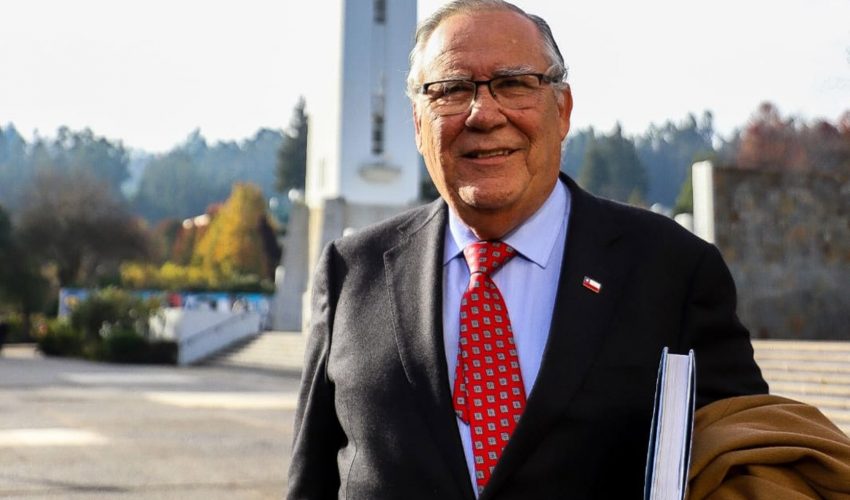
“Historically, Biobío has been Chile’s forest capital,” stated Agriculture Minister Jaime Campos, who, during a visit to the Region, made time in his schedule to delve into the sector’s current issues.
Thus, the head of the Agriculture portfolio affirmed, in an interview with Diario Concepción, that “we aim to create a new forestry instrument that allows us to reach the 1.5 million hectares that have forestry potential and have not yet been planted.”
Additionally, Campos announced that there is a specialized task force that will soon provide updates on the recovery of nearly 400,000 hectares damaged by forest fires, a concern that forestry companies have been requesting for some time.
Furthermore, the minister elaborated on the situation of beet growers, following the cessation of local product supply from Iansa; winegrowers from the Itata Valley - Ñuble Region - while also updating the progress of avian influenza, among other matters.
-What agricultural support can you highlight from the recent Public Account, especially regarding the forestry sector?
-The President (José Antonio Kast) has said something that is very valuable and significant for us and that should mark his administration, namely stating that as a Government we will promote the enactment of new forestry promotion laws in the country.
On this matter, I must add that since the 1930s Chile always had a forestry promotion law; today, in the year 2026, we have no forestry instrument law in Chile.
This has meant that of the 2.4 million hectares of plantations we had, today there are only 1.8 million. Chile’s forest heritage is declining. We are consuming the plantations made by our parents and grandparents. Annually, more is being harvested than planted, and, excuse me, you don’t need to be an economist to see that this path is not leading us in the right direction.
We aim to create a new forestry instrument that allows us to reach the 1.5 million hectares that have forestry potential and have not yet been planted.
Regarding how to address the 300,000 or 400,000 hectares damaged by forest fires, there is a task force I appointed on this matter, and very soon you will hear specific news about this, which is particularly important for the Biobío region and the province of Concepción because historically Biobío has been Chile’s forest capital.
-Will there be a public policy of incentives for beet growers?
-Over a month ago, we were informed that Iansa had decided, for economic and commercial reasons, to stop buying beets starting next season and, consequently, to stop producing sugar from domestic beets. As the Ministry of Agriculture, we are in direct contact with the producers, who number around 240 in Chile. We obviously regret Iansa’s decision, as over 70 years of history are lost, but we cannot interfere in a private sector decision.
All our concern has been focused on how to help beet producers in this complex situation. What we have done is basically the following: Small producers, from the family farming beet sector, who are very few, will continue to be served by Indap as always, through credit assistance, financial support, and technology transfer, among others.
Secondly, we have had a full round of conversations with the rest of the national industry that can acquire or does acquire certain essential products for the development of their activity, which correspond to annual crops like beets.
Thus, we spoke with the millers’ association, with poultry and pig producers, who are large consumers of corn. We met with factories that produce feed for salmon and with manufacturers of inulin from chicory here, in Santa Clara, near Los Ángeles, and we found a very good disposition from them. My impression is that at this point, all current beet producers will have other crop alternatives, but now it is their decision which one to choose.
Finally, and as I announced with Banco Estado a week ago, through the Bank we obtained a special agricultural credit with a preferential interest rate for 18 months, with a Fogape guarantee, so that if any farmer here needs financing through that channel, they will have the possibility to access it.
Consequently, what happened with Iansa is regrettable. I insist. It is not my role to interfere in their commercial decisions, but yes, I regret it, but as the Ministry of Agriculture and as a Government, we have been able to do or have done everything we could without avoiding the issue.
-How can small wine grape producers in the Itata Valley project themselves in a market that pays prices below production costs?
-Last week I participated in the assembly of wine producers in Chile, and there we noted that the Chilean wine sector is going through a complex moment, but it is not only in Chile; worldwide, wine consumption has decreased by 25% globally. In Europe, vineyards are being uprooted in France and Spain. Obviously, this decline in global consumption can affect Chilean producers.
Regarding which national producers are facing this global crisis best, they are those who focus on the quality of their products; premium wine producers are not having major problems today and continue selling their bottles for 50 and 70 dollars.
In the Itata Valley, much of this has already been done, is being done, and will have to continue being done as we aim for quality in such a competitive world as today. The wine sector still has great development possibilities, and I have no doubt that due to agroclimatic reasons, the Itata Valley, like others in the Region, has potential, and we, as the Government and Ministry, will continue to help them with all the instruments at our disposal.
Source:Diario Concepción





Comments (0)
No comments yet. Be the first to comment!
Leave a comment